

Saddled with $300 million in debt, Eurofresh Inc., a hydroponic vegetable grower and major regional employer, filed for Chapter 11 bankruptcy protection Tuesday in Phoenix.
Blaming the filing on its debt burden, labor troubles and crop pest problems, the company said it plans to continue operating after reaching agreement with key creditors to quickly reorganize under bankruptcy protection.
Eurofresh, which grows tomatoes and other vegetables in a 274-acre greenhouse operation near Willcox and a smaller operation in Snowflake, ranked 33rd in the most recent Star 200 survey of Southern Arizona's major employers, listing 1,600 employees at the end of 2008.
In its initial court filings, the privately held corporation said the bankruptcy filing was part of a plan worked out with key creditors to "recapitalize."
The company revealed that it had defaulted on loans totaling about $70 million in late March and missed a payment on $170 million in other debt in January.
People are also reading…
Contributing to the company's financial problems, the firm said, were infestations of plant diseases and whiteflies, resulting in millions of dollars worth of crop losses since 2006.
The company also cited labor problems, including a shortage of workers "due to changes in immigration policy" and an ongoing investigation of its hiring practices by U.S. Immigration and Customs Enforcement.
Eurofresh said it had reached an agreement with a group of investors, including its founder and chairman, Johan van den Berg, to recapitalize the company, which listed total secured and unsecured debts of about $300 million.
Eurofresh Chief Executive Officer Dwight Ferguson said that under the company's reorganization plan, the firm's notes — short-term bonds used to raise $170 million in late 2005 — would be canceled and exchanged for stock.
Ferguson said the company will continue to "operate profitably and effectively, with minimal disruption to our business." He said cash flow continues to be positive and that the company, if it's allowed to follow its reorganization plan, will be able to pay the unsecured debtors — employees, suppliers and other providers of goods and services.
"It is absolutely business as usual," Ferguson said. "The decision to file for Chapter 11 … has absolutely nothing to do with the operations at the company. We're still cash-flow-positive and profitable. We're like companies everywhere that have been burdened by a lot of debt."
Eurofresh attorneys said they expect to submit the company's plan for reorganization in mid-May and complete its financial reorganization in the third quarter of this year. Ferguson downplayed factors other than tightening and expensive credit for the company's financial plight.
"Credit was available and cheap, up until the last couple years," he said. "We leveraged up. This is really being driven by those operations. We felt, at that time, we could service that kind of debt level."
A spokesman for the United Food and Commercial Workers union Local 99 said the company told him of the pending bankruptcy reorganization and assured him that there would be no changes for the local's roughly 500 employees at the Willcox complex or about 100 at the Snowflake operation.
The union crews are working under a three-year contract signed in October, with starting pay around $8 an hour and topping out at about $15 an hour, plus fully paid health benefits, said Paul Rubin, secretary-treasurer of UFCW 99.
The company has expanded rapidly in recent years, despite persistent labor shortages.
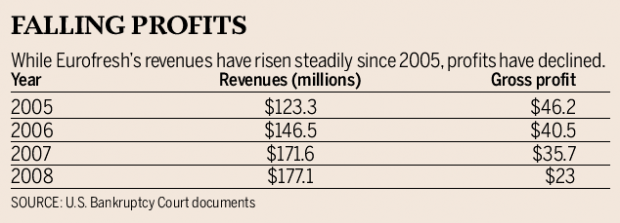
But despite rising revenues, its court filings showed declining profits from 2006 through 2008 amid mounting debt.
In its bankruptcy filing, the company blamed some of its financial problems on plant "diseases and infestations." The report itemized the loss of nearly 8 million pounds of tomatoes valued at just under $8 million, due to plant diseases and whitefly infestations since 2006.
The company emphasized that "the disease and infestation present no risk to humans."
However, the company's sales reportedly were hurt by the 2008 U.S. salmonella bacteria outbreak that was traced to other producers' tomatoes. A company spokesman said Eurofresh's products were grown in sterile conditions, and Eurofresh tomatoes were never connected to the outbreak.
According to Bankruptcy Court documents filed Tuesday, Eurofresh plans to cancel all of its existing stock and the unsecured-debt notes.
In exchange, the company will issue 10 million shares of new common stock and $10 million worth of new preferred stock that will be divvied up among the company's major shareholder and holders of Eurofresh's notes.
Major holders of the unsecured notes include New York investment firm Apollo Investment Management, which holds $76.5 million; Barclays Capital, $47 million; and JP Morgan Asset Management, $35 million.
"It sounds as if they are converting bond debt to equity," said Michael McGrath of Mesch, Clark & Rothschild, a Tucson law firm. "Instead of saying a fixed amount of money is owed to you at a fixed interest rate pursuant to the bond documents, we are writing that off and giving you (that amount) of equity in the company," McGrath said of a common method of handling secured creditors.
And in a Chapter 11 bankruptcy, unsecured "trade" creditors typically will join a group — an unsecured-creditors committee — represented by a single attorney or law firm, McGrath said. He said those companies and individuals, owed money for supplying goods and services needed by the troubled company, are asked to continue doing business and are told: "We'll continue to pay you going forward. We will return to profitability and dedicate a portion or all of it to a pool to pay your bills."
Notable trade creditors include Southwest Gas Corp., which is owed $822,177; Casa Grande-based Fertizona, a major fertilizer, agricultural chemical and seed retailer, $677,570; and Arizona Correctional Industries, a state prison-labor program used by Eurofresh, $653,597.
Eurofresh timeline
1990: Eurofresh Farms is founded in Pennsylvania by Johan van den Berg and Wil van Heyningen, third-generation Dutch greenhouse owners.
1992: Eurofresh chooses Willcox for its greenhouse operation and receives a $400,000 Arizona Department of Commerce loan to build a 10-acre tomato greenhouse north of Willcox.
2000: Following a strike in 1999, workers approved representation by the United Food and Commercial Workers Union, and a three-year contract is ratified in November 2000. The plant also employed prison labor.
2002: The company expands with new facilities in Snowflake, in east-central Arizona, increasing its operations to 318 acres of greenhouses.
2003: Eurofresh announces it will build a new greenhouse and add 65 permanent jobs, in the company's seventh expansion since 1992.
2006: Facing a shortage of workers, the company begins sending tomatoes to Sonora to be packaged and returned to Willcox.
2007: Hiring foreign refugees from becomes part of Eurofresh's staffing plan. The company provide buses to transport the workers from Tucson to Willcox.
Sources: Eurofresh Inc., Star archives