

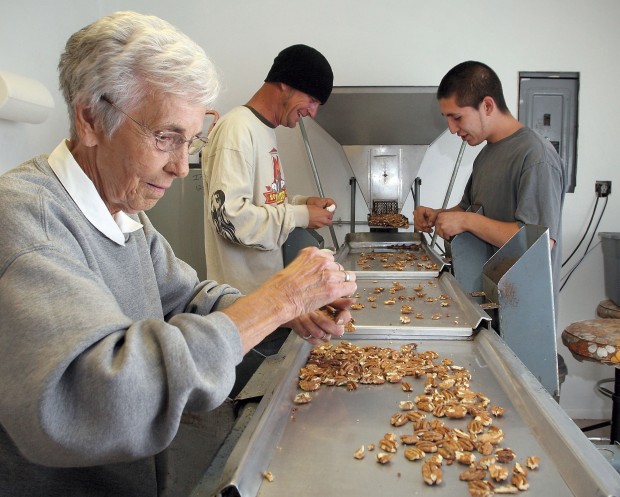
For Penny Bagnall, pecans are a way of life. As operator of Shalako Pecan Farm and daughter of its founder, Bagnall spends her day surrounded by the popular nut.
She oversees the growth, harvesting and processing of her family's crop and also roasts some of the pecans herself in a large copper kettle in her kitchen, then tops them with customer-pleasing flavors like cinnamon, praline and chili.
"I'm a control freak," Bagnall said. "We have complete control over our pecans until they leave the store with the customer."
Shalako Pecan Farm is a 200-tree, eight-acre grove nestled between cotton operations along Arizona 287 east of Casa Grande. It is one of a dwindling number of active pecan operations scattered throughout the area, and although the farm has faced its share of challenges over the years, Bagnall believes Shalako is about to face its toughest year to date.
People are also reading…
With a possibility of no water deliveries from the San Carlos Irrigation and Drainage District combined with a still-sluggish economy and two consecutive low harvest years, Bagnall wonders if the orchard will survive.
"It's a little scary," Bagnall said. "I've got a permanent crop here. If I don't get water and the trees don't survive, it's not like I can replant in a year and be OK."
Shalako Pecan Farm was one of 13 pecan operations in Pinal County a few years ago, according to the 2007 U.S. Agriculture Department's census.
That number is a sharp drop from the 53 active pecan operations recorded in 2002.
"Certainly the building boom made a huge dent in Pinal County pecan farms, most notable of which was the large Smith Farms planting on the east side of Maricopa," said Rick Gibson, University of Arizona Cooperative Extension director for Pinal County. "There were also two up in Queen Creek that are now under houses."
He said he knew of only five orchards that were currently in operation, including Shalako as well as a few in the Picacho area and another south of Maricopa.
Each year, the Shalako pecans are harvested the day after the first heavy frost of the year. In a good year, a typical tree can produce about 300 pounds of pecans, although yields vary with some varieties producing more.
Shalako's 2011 harvest was about half of 2010's yield, but Bagnall said it was a low yield year for all pecan farmers in the state. "We're not sure why. It could be that the wind was blowing the wrong way during pollination," she said.
With a continued drought and uncertainty regarding water deliveries in 2012, she is bracing for another low production year.
DID YOU KNOW?
The farm is named after the Shalako Kachina - or Native American spiritual being - believed to bring rain and blessings to a farm.
THE BIGGEST GROVES
Sahuarita's Farmers Investment Co., which includes the Green Valley Pecan Co. and Santa Cruz Valley Organic Farms, is the largest pecan grower and processor and the largest certified organic grower and processor of pecans in the world. Its groves span 4,500 acres, 1,100 of which are certified organic. In a large crop year, it harvests 11 million to 12 million pounds of pecans.
Source: Star archives