

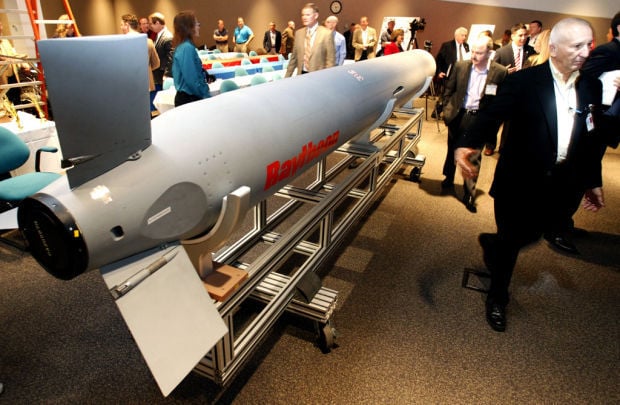
Tucson-based Raytheon Missile Systems is trying to persuade a judge to throw out a lawsuit over a new warhead design for the Tomahawk cruise missile.
Ordnance Technologies North America Inc. sued Raytheon in federal court in May 2012, alleging the missile maker stole trade secrets involving a proposed new, bunker-busting warhead for the Tomahawk.
Ordnance is seeking a court order halting Raytheon’s use of the technology, as well as unspecified damages, saying rights to the technology are worth at least $12 million.
After months of legal filings, part of the case played out in U.S. District Court in Tucson on Monday, when Judge Cindy K. Jorgenson heard arguments on Raytheon’s motion for a partial summary judgment that would throw out most of Ordnance’s case.
Ordnance alleges that Raytheon stole trade secrets for use on a Navy project to develop the new Tomahawk warhead, known as the Joint Multiple Effects Warhead System, or JMEWS.
People are also reading…
Raytheon has denied any wrongdoing, arguing that though the companies’ shared information, no proprietary information from Ordnance has been adapted to the latest version of the Tomahawk, that the disputed design “was independently designed by Raytheon,” and that it essentially purchased the disputed technology under design contracts.
At Monday’s hearing, an attorney representing Raytheon argued that most of Ordnance’s claims would be barred by the statute of limitations that it maintains expired before Ordnance filed its suit.
Raytheon introduced into evidence a letter from Ordnance to Raytheon dated Jan. 19, 2009, saying Ordnance had discovered a potential misappropriation of trade secrets and was considering legal action.
That means the three-year statute of limitations on most of Ordnance’s claims expired in January 2012, Andrew Valentine, a California-based attorney representing Raytheon, told Jorgenson.
Matthew Elstein, an attorney for Ordnance Technologies, tried to introduce evidence showing that officials of both companies corresponded about the dispute by letter in April 2010 and had met face-to-face in Tucson in June 2010 to discuss the matter. Elstein contended that the time clock on any statute of limitations would start after that meeting, meaning Ordnance had filed its lawsuit well within the time limit.
However, Raytheon successfully moved to strike the filings by Ordnance documenting the letters and meeting, because they were filed last Friday, long past the deadline for filings related to Raytheon’s summary-judgment motion.
Elstein blamed himself for the late filings and asked Jorgenson to take “judicial notice” of the existence of the letters and meeting, without admitting them into evidence.
Unmoved, Jorgenson ruled that allowing the late filings would be unfair to Raytheon, striking them from the record.
On the main motion, Elstein argued that Raytheon’s use of the disputed technology continued after April 2009 and was broader than the issues cited in the company’s letter, including proprietary processes as well as design.
“This one letter does not fix forever our ability to bring about claims involving the process,” Elstein told the court.
Elstein accused Raytheon of leading Ordnance along, even as the government prepared to pour money into the JMEWS program. The Navy awarded Raytheon a $12.8 million contract in July 2009 for the development of the JMEWS warhead.
At the end of Monday’s hearing, Jorgenson said she would take Raytheon’s motion for partial summary judgment under advisement. She had not ruled as of late Tuesday.
Meanwhile, the future of the JMEWS program itself remains unclear. The warhead is designed to create an initial blast followed by a follow-on warhead to allow the Tomahawk to punch through thicker concrete and steel structures, according to the Navy and Raytheon.
The Navy completed a technology demonstration project for the JMEWS warhead last year, and budget documents show the Navy planned to start developing project milestones for eventual acquisition in the fiscal year ended Sept. 30.
Neither 2013 budget documents nor the Pentagon’s proposed fiscal 2014 budget includes line items for JMEWS, but Navy documents show JMEWS included in $8.5 million in funding for various Tomahawk upgrades in 2013 and $11.3 million in requested funding for 2014.
A spokeswoman for the Naval Air Systems Command in Patuxent River, Md., could not immediately verify the program’s current status.
Contact Assistant Business Editor David Wichner at dwichner@azstarnet.com or 573-4181.

David Wichner
Reporter