

Sundt Construction Inc.'s new home on Tucson's undulating River Road is notable for the sleek, sustainable design that recently earned it LEED Gold certification from the U.S. Green Building Council. But for employees, one of its most significant features is an inconspicuous office tucked away in the northwest corner of the building.
That space houses a comprehensive medical clinic for Sundt employees and their dependents.
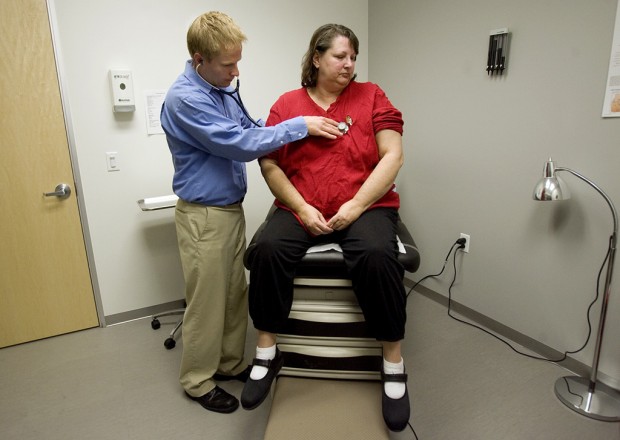
The clinic is staffed with three physicians on rotating schedules who provide the entire spectrum of primary-care services. They conduct yearly physicals and well-women exams, take blood tests, diagnose illnesses, prescribe and dispense medications, and make referrals to specialists.
The company's decision to provide an on-site clinic for its employees reflects a growing trend in America. Employers are turning to workplace health clinics as a way to increase productivity, decrease absenteeism and manage spiraling health-care costs.
People are also reading…
GROWING INTEREST
Companies are increasingly aware that a healthy workforce is a more productive and less expensive workforce - and that the keys to keeping their employees healthy are preventive medicine, wellness initiatives and disease management.
These are the domains of the primary-care clinician, a seemingly endangered species in the U.S. today. With an additional 30 million to 40 million Americans expected to gain access to healthcare if the Patient Protection and Affordable Care Act goes into full effect, the American Academy of Family Physicians predicts a shortage of 40,000 primary-care doctors by the end of this decade.
Not surprisingly, then, employers are looking for ways to ensure that their workforces have access to primary health care. Bringing clinicians to the workplace is one way of doing that.
The National Business Group on Health, a nonprofit membership organization that represents large companies on health-care issues, joined with Towers Watson, a consulting firm, to conduct a health-care survey among their respective members and clients in 2011. They found that 23 percent of the companies surveyed provided workplace health services, and another 12 percent were planning to offer them in the next year.
The trend is also evident in the growth of vendors that operate workplace clinics. Interested employers now have dozens of vendor options to choose from, and many of these companies have grown dramatically in recent years.
For example, CHD Meridian began offering comprehensive workplace health centers in the 1980s but expanded the number of sites it operated by more than 250 percent between 2005 and 2008. That success prompted Walgreens to buy the company and merge CHD Meridian with its main competitor to form the largest provider of workplace health clinics in the country, Take Care Health Employer Solutions.
Doug Adelberg, vice president of the insurance broker Lovitt & Touché, says interest in workplace clinics is on the rise among his clients. "A lot of them are talking about it," he said. "They're asking, 'what can I do to control health-care costs?' And this is one of the options we put in front of them."
Lovitt & Touché has almost 400 clients in Arizona, and the brokers have discussed workplace clinics with more than 50 of them. But only a handful - fewer than 10 - are taking the next steps in determining whether a workplace clinic is right for them.
Creative partnering
Typically, workplace clinics are found at companies that are self-insured and have large numbers of geographically concentrated employees. But increasingly, relatively smaller companies are looking for ways to make the workplace clinic model work.
Although Sundt has about 1,500 employees in total, only about 200 of them are in the Tucson area - not typically enough to sustain an on-site clinic. But the management of this 100 percent employee-owned, 120-year-old construction company loved the idea of a workplace health facility.
So in 2008 it partnered with its considerably larger neighbors, Tucson Electric Power and UNS Gas and Electric -subsidiaries of UniSource Energy - to open a clinic between the two facilities on Irvington Road.
Sundt opened a second clinic when it moved its headquarters across town earlier this year, and now the two sites are available to eligible employees from both companies.
Lovitt & Touché played matchmaker in the partnership between Sundt and Unisource. And the insurance broker has plans to facilitate similar joint ventures in the future. "If we have this employer here, plus this employer here, plus this employer here, they can all link up and then they've got a thousand employees together," said Adelberg. That's enough to operate a full-time clinic.
Such creative arrangements are making workplace clinics feasible for companies that might not otherwise be able to afford them, says Ernie Clevinger, president of CareHere LLC, the company that operates Sundt's and Unisource's shared clinics. He says about one-third of CareHere's clinics are shared in this way.
THE BENEFITS
One reason employers are keen on workplace health facilities is their relative efficiency. When travel time and wait time are factored into the equation, employees often take a half-day off work to see the doctor. But if the doctor works in the same building, patients can continue working right up to the time of their appointments, waltz in without waiting, and return to their responsibilities in under an hour.
The first time Mary Spencer visited the medical clinic in Sundt's office building she popped in for a quick flu shot. "And I thought, 'wow, that was pretty convenient'," Spencer said. "It literally just takes minutes."
Tom Hines, executive director of Santa Catalina Villas, an assisted-care retirement community in Tucson, says absenteeism has been way down since his parent company, Brookdale Senior Living, opened a workplace clinic for its Tucson employees a little more than a year ago. But, he adds, it's hard to know whether that's directly related to the clinic - it could also be that in these tough economic times, people are loathe to miss work.
Hines' observation underscores the complexity of calculating a return on investment for workplace clinics, and experts say their full potential is realized much further down the road.
Many companies are banking on the fact that improved access to primary care will mean fewer emergency-room visits and fewer hospital admissions in the future, says Dr. Ray Fabius, chief medical officer at Thomson Reuters and former president of CHD Meridian. And that could translate into substantial cost savings.
But the economic advantage of workplace clinics largely depends on whether employees actually use them. So, the hallmarks of these facilities are features that tend to make patients really happy: no out-of-pocket costs, prompt appointment scheduling, little to no waiting and lots of face-time with the doctor (many vendors guarantee that clinicians see only two or three patients per hour).
The feedback from Sundt employees is overwhelmingly positive, says Kari Louie, Sundt's corporate director of human resources. According to statistics gathered by CareHere, 97 percent of Sundt employees have used the clinic at least once, and 90 percent of those users would recommend the clinic to a colleague or dependent.
SKEPTICISM OVERCOME
Still, it can take time for employees to fully embrace the workplace clinic. For Sundt employee Spencer, a flu shot was one thing. But before she would rely on Sundt's workplace clinic for her primary medical care, she put it to the test. She had the clinic run blood tests and compared the results with tests done by her usual physician.
"It was like a second opinion for me," Spencer said. "And what the clinic did was pretty right on with their results, so my confidence grew in them and their abilities. So I just continued going to them, and now it's been a couple years."
Dr. David Millward, a physician at Sundt's workplace clinic, says it's not uncommon for patients like Spencer to be cautious in approaching the workplace medical clinic.
That's partly due to the legacy of the "company doctor." Once a staple in heavy industry and manufacturing, company doctors were primarily responsible for treating work-related injuries and determining whether individuals were fit to complete physical tasks. They were accused at times of being more concerned with the company's bottom line than with the well-being of their patients.
In fact, Millward is not employed by Sundt at all. He and all the other clinic staff work for CareHere, a private company that operates more than 100 clinics in 18 states.
That kind of separation can ease concerns over potential conflicts of interest, says Dr. Ken Pelletier, director of the Corporate Health Improvement Program at the University of Arizona College of Medicine. But even more important, he says, concerns over the "company doctor" have been mitigated by strengthened government regulations like the privacy rule in the Health Insurance Portability and Accountability Act (HIPAA) of 1996, which protects patients' medical information.
"I think initially some employees are a little hesitant to come in because they feel like I work for the company they work for," said Dr. Millward. "But after the first visit or two that all goes away."
Anissa Tanweer is a University of Arizona student apprenticing at the Star. Reach her at starapprentice@azstarnet.com or 573-4117.