

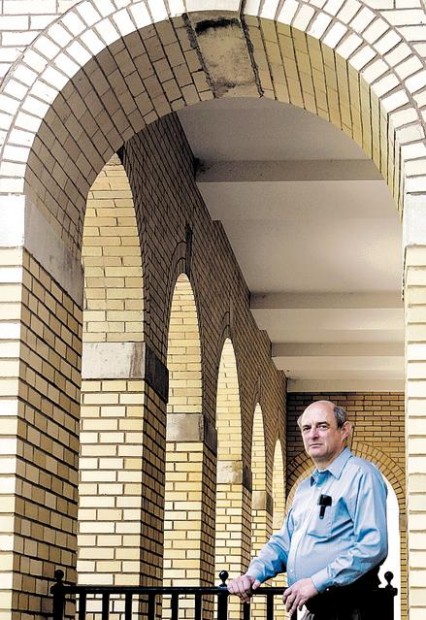
NORTH CANTON, Ohio — From the window in his small union-hall office, Jim Repace can look out at the red brick, four-story Hoover Co. plant and dream about owning the well-known vacuum maker.
Now his task is to inspire hundreds of workers that their best strategy to stop a job drain is a risky one: to buy a struggling company, if they can find some financial help.
They hope to form an employee stock ownership plan now that new owner Whirlpool Corp. is selling the nearly 100-year-old Hoover. The company has employed generations of workers in this northeast Ohio city, and employees now want a say in global decisions, too.
"Times have changed," said Repace, president of the International Brotherhood of Electrical Workers Local 1985. "You can't put a management team in here that doesn't know anything about floor care. This company means a lot to its community."
People are also reading…
The local, backed by the national union, has hired consultants to help find equity investment partners and make a business plan and a bid. The consultants have asked Whirlpool's investment banker, New York-based Lazard Ltd., for specific information about Hoover finances.
But buying a company to save jobs is especially challenging, ESOP experts say. There might not be sufficient profit to help improve a business that may need some capital investment. Most successful ESOPs bought businesses that already were profitable and originate with the company's owners to serve some strategic objective, such as a capital gains tax advantage as part of a succession plan.
Nationally, there are about 11,500 ESOPs with about 10 million participants, said Corey Rosen, executive director of the Oakland, Calif.-based National Center for Employee Ownership.
His organization's research indicates that about 1 percent of ESOPs were formed to save jobs, a move that requires employee concessions or investments.
"Those things are hard to do and risky to do," Rosen said.
Hoover, which also makes other floor-care products, traces its origin to a vacuum cleaner that a janitor, Murray Spangler, designed in 1907. Spangler formed a company with William H. "Boss" Hoover, the husband of a family friend.
The 1,500 hourly jobs of a few years ago at North Canton and two other plants in Stark County have dwindled to about 820 as jobs shifted to lower cost, nonunion Hoover assembly plants in El Paso, Texas, and Juarez, Mexico, which now have about 1,800 workers.
Still, Hoover means a lot to its hometown of about 16,000 people, where streets and schools are named for the company. And the company remains the city's largest private sector employer.
A well-known employee stock ownership plan that grew from a company in distress was Weirton Steel, which was the largest company in America to be owned 100 percent by employees.
Workers paid for a feasibility study and took 32 percent pay cuts to pull the deal off. The company posted profits at first, but eventually Weirton Steel collapsed into bankruptcy under the weight of unrelenting global competition and the nationwide consolidation of the industry. Still, many workers believe the ESOP bought them about 20 years they wouldn't have had otherwise.
John Logue, an ESOP author and researcher, said the plans work best in small, healthy companies.
However, employee ownership has saved some struggling companies, including Springfield ReManufacturing Co., now SRC Holdings Corp., in Springfield, Mo., which formerly was part of International Harvester, said Logue, director of the Ohio Employee Ownership Center, which provides ESOP advice.
Whirlpool, based in Benton Harbor, Mich., acquired Hoover with Newton, Iowa-based Maytag Corp. in March and is selling the Ohio company because it wants to focus on appliances.
Hoover's financial results are not broken out separately in Whirlpool's public filings. When Maytag reported an operating income loss of $24.2 million for 2005 in its home appliances segment, CEO Ralph Hake put some of the blame on Hoover, saying: "We can no longer carry the burden of this underperforming product line."
Analysts say they've been told Hoover is not profitable.
"They haven't spent the time and money to develop new products," said David MacGregor, an analyst for Longbow Research. "The brand is still well regarded and trusted by the consumer, but the product has no allure."
Yet, the company could be a good buy, MacGregor said.
"The business is fixable, whether the new owner is an ESOP or some strategic buyer. The real challenge will be to get retailers excited about the Hoover brand," he said.
l The dream: Since owner Whirlpool Corp. said it's selling Hoover Co., Hoover workers and their union have been trying to figure out how to buy the nearly 100-year-old vacuum cleaner and floor-care business through an employee stock ownership plan, or ESOP.
l The team: International Brotherhood of Electrical Workers Local 1985 represents about 820 Hoover workers in three northeast Ohio plants. Also, 227 workers are laid off and about 30 are on leave.
l The scheme: ESOPs require money, from either a bank or equity investors. So Hoover workers need to find one or more partners. Historically, ESOPs launched with a goal of saving jobs have not worked.