

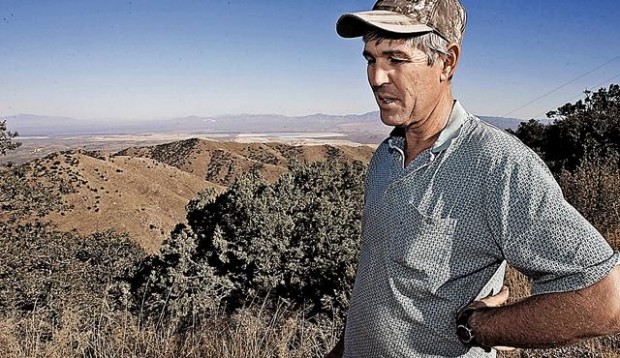
From atop the 6,200-foot Keystone Peak west of Sahuarita, Norman Harris of McGee Ranch has an expansive and impressive view of three valleys — the Santa Cruz, Altar and Sopori.
But when Harris, who was born and still lives at the base of the peak that crowns the Sierra Mountains, trains his eyes on the cactus-covered land near the spread his family homesteaded more than 100 years ago, he envisions thousands of homes and residents, landscaped winding streets, vehicles and public buildings.
It's a change that up until a few years ago seemed unlikely. But the unlikely now seems probable, which stirs Harris' concerns over the future of McGee Ranch and its rural surroundings.
"Our position is selfish," said Harris, 49 and a 1977 Sahuarita High School graduate. "We don't want change."
But the alteration of the land west of Interstate 19 is possibly coming to Harris, his family and neighbors. A Nevada developer, which owns 4,200 acres along South Mission and West Twin Buttes roads, is proposing a 15,000-home master-planned community called Mission Peaks. An adjoining 600-acre parcel of state trust land could be added to the proposed development if the Sahuarita Town Council agrees.
People are also reading…
American Nevada Co. of Henderson, Nev., will ask the Sahuarita Town Council at its 6:30 p.m. Monday meeting for approval of Mission Peak's general plan amendment. If the council says yes, the company will move forward with its plan, which includes annexation by Sahuarita. The developer has also submitted a general plan amendment to the county as a hedge.
The Harris family, which is part of the historic McGee family that settled the land beginning in 1895, sees the proposal as the beginning of the end of its rural lifestyle.
"It will be a complete disaster," said Lynn Harris, Norman's 69-year-old father and family historian.
The Harris family owns the Sierrita Mining and Ranching Co., founded in 1947, a general contractor that builds roads and rents heavy equipment. It also raises beef cattle on 23,000 acres of private and government leased land in the Sierrita Mountains, a range riddled with abandoned mine shafts created by early ore prospectors.
The extended Harris family lives in an enclave of about 150 homes. A smaller cluster of homes, east of McGee Ranch and west of South Mission Road, surrounds the 640-acre Ruby Star Airpark with its 4,300-foot runway. The Quiet Desert Ranches neighborhood, another cluster of homes, is east of the airstrip, and there are homes strung along Wright Brothers Way north of the airstrip.
South of the homes are the mines, their tailings and ponds, and the heavy-equipment proving grounds for Caterpillar Inc.
But the area is primarily devoid of development, which makes it an eventual location for residential development, said Dan Naef, American Nevada senior vice president. Future homes are coming whether the area is part of the town or county, he added.
"We understand this is a change for them they do not want to see," Naef said.
Naef has met with some area residents, including Norman Harris. The residents have expressed concerns about the unalterable impact the homes and their residents will have on the area.
What they foresee: The lonely two-lane winding South Mission Road will become congested and dangerous; the hills will be invaded by people seeking diversion; cattle fence enclosures will be knocked down; the quiet nights will be destroyed by noise and lights.
"It becomes a town, and the town brings on the problems of the city," the elder Harris said.
Naef said the concerns are legitimate and will be addressed as Mission Peaks evolves.
"We obviously need to remain flexible because conditions change," Naef said.
He said the challenges facing Mission Peaks are building roads and schools and providing water. If the general plan amendment is approved, the developer will be required to satisfy questions about the effect the development would have on traffic, infrastructure and water supply.
Naef said Mission Peaks would develop over 20 years, which would give the company and community "lots of time to talk to each other."
But the Harris family is not sure there is much time left.
The family points to Rancho Sahuarita, which transformed the sleepy semi-rural village into a busy bedroom community in less than 10 years.
"We need to be educated about what's going on," said Norman Harris.