

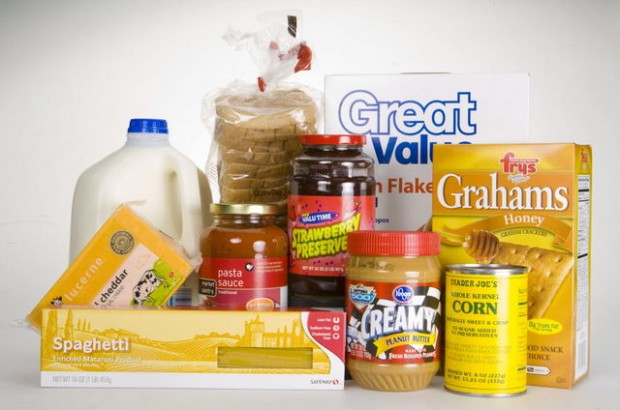
When it comes to shopping store brands, Wal-Mart and its Great Value brand are tough to beat if you want to save money. (Click on lower image at right for a .pdf file of survey results.)
Store brands, increasingly popular with cash-strapped shoppers, are lines of products made by or for a supermarket chain, as opposed to national brands such as Heinz or General Mills.
The Arizona Daily Star surveyed store-brand offerings at major grocery retailers in Tucson last week, and Great Value was the cheapest for the selected items.
When taking loyalty cards into account, Fry's Food Store, which has several tiers of store brands, nudged within 24 cents of the discount retail giant.
With the loyalty cards taken into consideration, Food City, then Bashas', Albertsons and Safeway, followed the two leaders. Even without loyalty cards, Walmart Neighborhood Market had the lowest prices — with Food City coming in second, followed by Albertsons, Fry's, Safeway and Bashas'.
People are also reading…
Interestingly, Bashas' and Food City, which are both owned by Bashas' Inc., had different prices for some products that both had the same brand. Both Food City and Bashas' carry Food Club and Valu Time products. On some products, the price varied, and sometimes it was the same.
The list of groceries didn't represent a complete, healthy diet. The idea was to get a range of less-perishable, widely available staples and provide a snapshot of how the store brands compared with one another for a family looking to save money.
Sales of store-brand items have increased over the past year, and they pose a growing threat to national brands, analysts say.
"This recession has made us all a little more aware of pricing," said JoEllen Lynn, a spokeswoman for Fry's Food Stores in Arizona. Lynn said the stores, owned by Kroger, have seen substantial increases in the sales of Kroger and Fry's store brands.
Signs in supermarkets say the quality of the store-brand products is as good as — or better than — national brands. And a feature in Consumer Reports largely reached the same conclusion.
The magazine's testers tasted a variety of store brands and compared them with national brands for its October issue, reaching the conclusion that store brands are a good way to save money.
THE NATIONAL ANGLE
Industrywide, sales of store-brand grocery items jumped nearly 10 percent last year.
At Kroger (which own's the Fry's supermarkets in the Tucson area), 35 percent of the products sold in its nearly 2,500 stores were house brands, up from 31 percent five years ago.
Kroger makes almost half its roughly 14,400 in-house products, while most grocers contract with other companies to make such items. Kroger — the nation's largest grocery seller aside from Wal-Mart Stores Inc. — has the biggest self-owned manufacturing operation with 40 factories, followed by Safeway Inc., which has 32.
Making store-brand products themselves gives companies better control over costs and production decisions, a key advantage as consumers' recession-driven frugality eats into sales and grocers cut prices.
"Speed to market is a benefit," said Krista Faron, a senior analyst for market research firm Mintel International. "To the extent that you can control your production and manufacturing and getting it on your shelf faster, that helps."
The Associated Press Dean Knuth / Arizona Daily Star
"This recession has made us all a little more aware of pricing."
- JoEllen Lynn, spokeswoman for Fry's Food Stores in Arizona