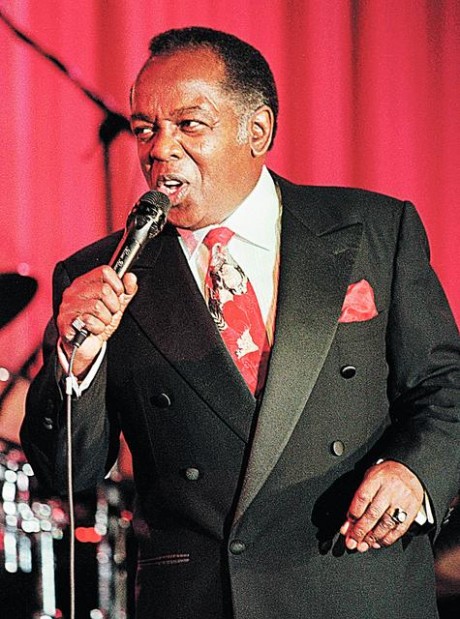
Lou Rawls, the velvet-voiced singer who won three Grammy Awards during a career that spanned more than four decades, died Friday of cancer.
Rawls, who lived in Scottsdale, died at Cedars-Sinai Medical Center in Los Angeles, where he was hospitalized last month for treatment of lung and brain cancer, said his publicist, Paul Shefrin. Rawls' wife, Nina, was at his bedside when he died.
Rawls' family and Shefrin said the singer was 72, although other records indicate he was 70.
A native of Chicago, Rawls started singing in the church choir and went on to record such classics as "You'll Never Find Another Love Like Mine" and "Love Is a Hurtin' Thing."
Frank Sinatra praised Rawls for having "the classiest singing and silkiest chops in the singing game." Rawls' deep, smooth voice was his trademark, and he used it in a variety of genres.
People are also reading…
"I've gone the full spectrum, from gospel to blues to jazz to soul to pop," Rawls once said on his Web site. "And the public has accepted what I've done through it all."
A longtime community activist, Rawls played a major role in United Negro College Fund telethons in the 1980s that raised more than $200 million. In the '60s he often visited schools and community centers.
His introduction to music came in his hometown of Chicago from his grandmother, who shared her love of gospel while raising him. He made trips to the Regal Theatre to see Billy Eckstine, Arthur Prysock and Joe Williams when he was a teenager. "I loved the way they could lift the spirit of the audience," Rawls once said.
Rawls was also influenced by doo-wop and harmonized with his high school classmate Sam Cooke. The two friends joined groups such as the Teenage Kings of Harmony.
When he went to Los Angeles in the 1950s, Rawls was recruited for the Chosen Gospel Singers, then moved on to the Pilgrim Travelers. He enlisted in 1955 as a paratrooper in the Army's 82nd Airborne Division. Sgt. Rawls rejoined the Pilgrim Travelers three years later when he left the Army.
While touring with the group in the South, Rawls and Cooke were in a car crash that nearly ended Rawls' life. A passenger was killed, Cooke was slightly hurt and Rawls was declared dead on the way to the hospital, according to a biography provided by Shefrin.
Rawls was in a coma for 5 1/2 days and suffered memory loss, but he was completely recovered a year later.
"I really got a new life out of that," Rawls said at the time. "I saw a lot of reasons to live. I began to learn acceptance, direction, understanding and perception — all elements that had been sadly lacking in my life."
Rawls performed with Dick Clark at the Hollywood Bowl in 1959. Late that year, Rawls was performing for $10 a night, plus pizza, at Pandora's Box in Los Angeles when he was spotted by Capitol Records producer Nick Venet, who invited him to make an audition tape. He was signed by the label a short time later.
His debut effort, "Stormy Monday," recorded with the Les McCann Trio, was the first of his 52 albums. In 1966, his "Love Is a Hurtin' Thing" topped the charts and earned Rawls his first two Grammy nominations.
During that period, Rawls began what were called hip monologues about life and love on the songs "World of Trouble" and "Tobacco Road," each more than seven minutes long. Some called them "pre-rap."
His "raps" were so popular that 1967's "Dead End Street" won him his first Grammy for best R&B vocal performance.
Later in his career, Rawls opened for the Beatles at Crosley Field in Cincinnati.
Rawls released his most recent album, "Seasons 4 U," in 1998 on his own label, Rawls & Brokaw Records. His many hit songs over the years include "Your Good Thing (Is About to End)," "Natural Man" and "Lady Love." But his trademark will always be "You'll Never Find Another Love Like Mine," released in 1976 and written by Kenny Gamble and Leon Huff, architects of the classic "Philadelphia Sound."
Rawls also appeared in 18 movies, including "Leaving Las Vegas" and "Blues Brothers 2000," and 16 television series, including "Fantasy Island" and "The Fall Guy."
In 1976, Rawls became the corporate spokesman for the Anheuser-Busch Cos. breweries. For millions of TV viewers and radio listeners, Rawls was the familiar voice that said, "When you've said Budweiser, you've said it all."
Rawls was diagnosed with lung cancer in December 2004 and brain cancer in May 2005. Rawls told Shefrin he quit smoking 35 to 40 years ago.
Along with his wife, Rawls is survived by four children.
Funeral arrangements are pending, Shefrin said.