

"My name's John Ford. I make Westerns" is a statement both true — Ford directed more than 60 Westerns in a 50-year Hollywood career — and so self-effacing that it borders on being false.
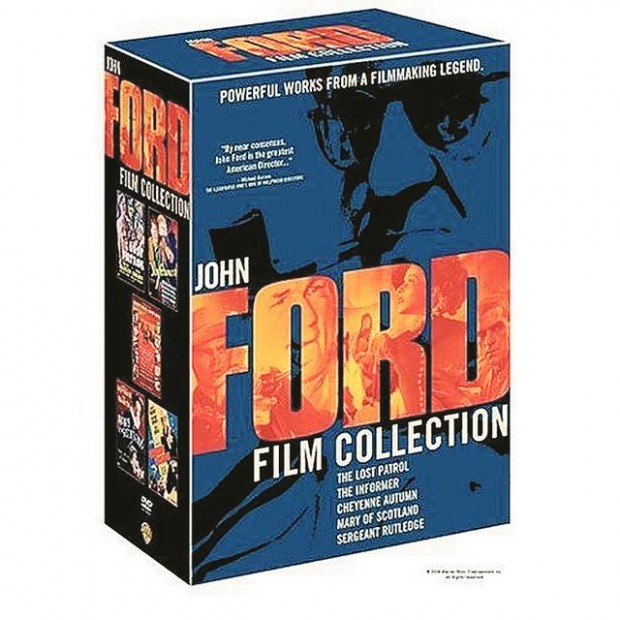
The recent release of two exceptional DVD box sets — "The John Wayne-John Ford Film Collection" (10 discs, Warner Home Video) and "The John Ford Film Collection" (five discs, Warner Home Video) — provides an opportunity to examine the legacy of one of America's greatest film directors. It's a legacy filled with contradictions and ironies.
While Ford has certainly given us some of the most iconic Westerns in movie history — including "The Iron Horse" (1924), "Stagecoach" (1939), "Fort Apache" (1948), "The Searchers" (1956) and "Cheyenne Autumn" in the '60s — the only director to win four Oscars never won one for a Western.
But that's not the only irony about Ford's career. He was famous for his intimidating, badgering style on the movie set, yet his films are often filled with both broad humor and sentimentality bordering on pathos.
People are also reading…
Ford, who died in 1973 at age 79, was long-associated with some of the most outspokenly conservative members of the film community, but Ford was actually a supporter of Franklin D. Roosevelt and the New Deal. His film version of John Steinbeck's "The Grapes of Wrath" was considered downright radical when it was released in 1940, and his "Sergeant Rutledge" in the '60s was one of the first films to explore racism in the post-Civil War era.
Some of Ford's Westerns have helped create the unfortunate image of American Indians as bloodthirsty savages, but other films he directed treated Indians far more sympathetically.
As Ford told Peter Bogdanovich in a 1966 interview that forms the basis for the book "John Ford," referring to his movie "Cheyenne Autumn": "I've killed more Indians than Custer, Beecher and Chivington put together. . . . I wanted to show their point of view for a change. Let's face it, we've treated them very badly — it's a blot on our shield; we've cheated and robbed, killed, murdered, massacred and everything else, but they kill one white man and, God, out come the troops."
With such issues in mind, let's look at the individual movies in the lesser-known collection, "The John Ford Film Collection:"
"The Lost Patrol" (1934): In this movie, set in Mesopotamia during World War I, Victor McLaglen stars as a British army sergeant valiantly trying to lead his squad through the desert while being shot at by Arab snipers.
"The Informer" (1935): Ford won his first best-director Oscar for this drama, set in Dublin in 1922, as Irish rebels struggle to gain their country's independence from Great Britain.
"Mary of Scotland" (1936): Katharine Hepburn stars for Ford in this film version of Maxwell Anderson's play about the Queen of Scots and her relationship with her half-sister, Queen Elizabeth I of England (Florence Eldridge), and her lover, the Earl of Bothwell (Fredric March).
"Sergeant Rutledge (1960): A tribute to the black cavalry men — known as Buffalo Soldiers — in the post-Civil War era, this film stars Woody Strode in the title role as an exemplary soldier who is falsely accused of murder and rape. Jeffrey Hunter co-stars as the young officer who defends Rutledge in court.
"Cheyenne Autumn" (1964): Ford's last Western and his most explicitly sympathetic to Indians, this movie is about the Cheyenne's 1,500-mile march from Oklahoma to their Yellowstone homeland. Its cast includes Richard Widmark and James Stewart.


