

Woodworking was never Kathy Haun’s plan.
Yet, here she is, at the age of 87, still turning out art that’s bigger than she is.
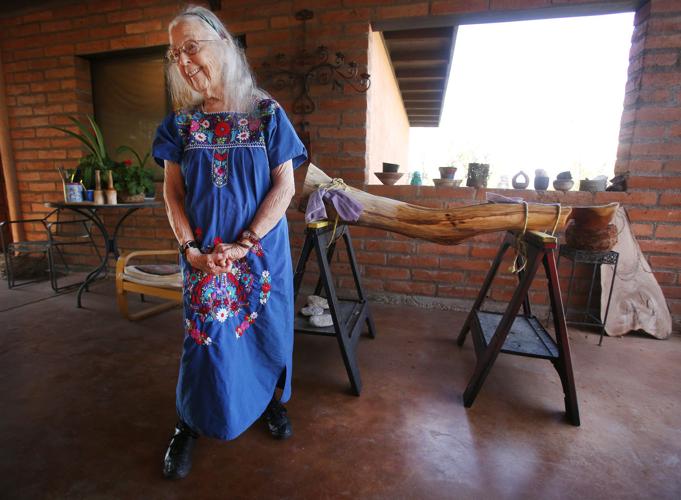
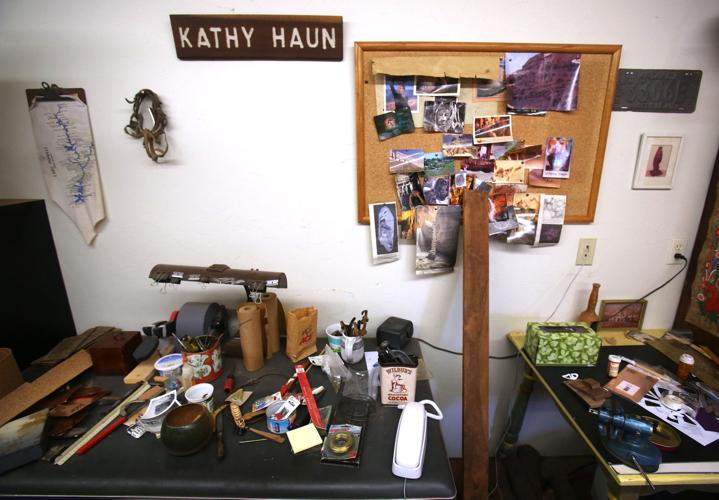
For the past year and a half, she’s painstakingly chipped away at this massive mesquite log with a wooden mallet and straight chisel. It once was a tree that was wreaking havoc with the flagstone at her daughter and son-in-law’s next-door residence. Haun has transformed it into the barest hints of two smooth forms, one stretching to 5 feet tall, the other much smaller.
Mother and child.
“I call it ‘Shadows’ because it’s just a suggestion of figures,” explains Haun, who says the intent is that the finished sculpture would be displayed with a light behind it to throw outlines onto a wall.
Now it’s time to oil the piece.
People are also reading…
She can’t find her large brush in the garage that doubles as her studio. Undeterred, she grabs a small one and sets to work, dabbing boiled linseed oil over the wood, revealing shades ranging from light golden honey — this, Haun explains, is the sapwood or outermost part of the tree — to the deep Grade-B-maple-syrup red of the heartwood buried deep inside.
“I don’t like to stain,” says Haun, a great-grandmother, as she paints on the first of five coats of oil, the sweeping motion sending the copper bracelets she wears to ward off arthritis sliding around her wrists. “The wood itself has so much interest in the grain. I hate to destroy that.”
After 55 years of carving, Haun knows what she likes.
It was an obsession with a Mexican cart spotted at the long-gone Pioneer Hotel’s gift shop that launched Haun’s on-the-side career as an artist in 1960.
“I coveted it,” says Haun, who helped her husband, Jim, with his real-estate and development businesses and managed the Ranch House Lodge, which the two owned for 35 years.
Because she and Jim, who died in 2007, were building a home, she had access to plenty of tools. So she decided to make her own cart.
“That was the first thing I did. I really liked the process,” says Haun, who loves to design and sometimes waits months, sometimes years, to figure out what to do with a hunk of wood.
She enjoys the physicality of carving, using her body as a vice and straining her muscles a few hours a day as she shapes wood into the visions she’s plotted on paper.
“I like to do something I’m totally involved in,” she explains.
The child of missionaries, Haun grew up in China. She studied English and history at Wooster in Ohio, where she met her husband. They came to Tucson so he could better deal with his asthma and transfer to the University of Arizona. Haun’s plan was to write books like Pulitzer Prize-winning author Pearl S. Buck, also the child of missionaries and who spent most of her life in China.
“I found with three kids I couldn’t write,” Haun says.
But, she discovered woodcarving meshed well with the art of mothering. “It was interruptible,” she says. “I could do it with kids.”
She quickly developed enough of a reputation to get asked to carve the doors of a church.
“I’d never carved a door in my life,” Haun recalls of the Congregational Church’s request. “I said, ‘Of course I carve doors.’ ”
She started working with architects around town. “Then I got to the point where I didn’t want them to tell me what to do,” she said with a laugh.
These days Haun sells to repeat customers. But for many years, Haun showed her pieces at art markets and in galleries. She and Jim traveled extensively, too. Easter Island, New Guinea, Egypt, Turkey, Japan and Spain were just the tip of her travels.
“Now I’m perfectly happy to be in my little house with the javelina and quail.”
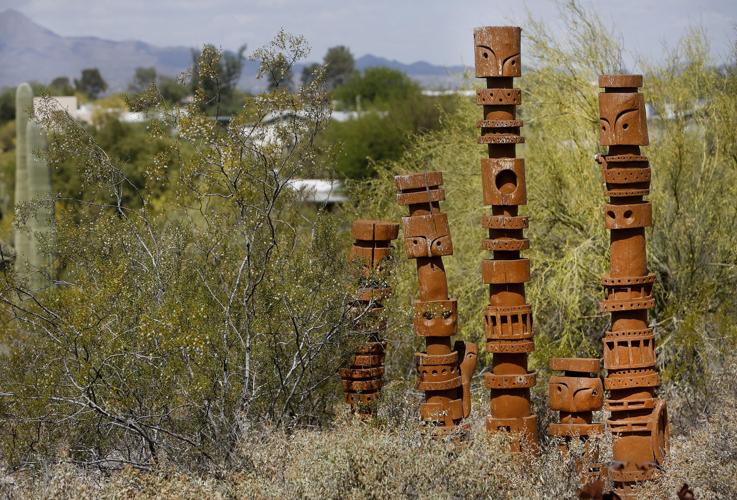
But everywhere Haun went, she picked up inspiration. The five totem poles in the yard of her Foothills home? She got the idea from Aboriginal cemeteries in Australia.
Her home is full of her work — wall hangings; carved toys destined for her great-grandkids; “Catalina’s Dream Machine,” a dark, gnarled piece with a seat cushion that her grandkids would pretend to ride; even a meditation chamber, complete with swiveling bench, made of a series of mesquite planks that swallows the living room.
“I like the idea of having a continuous design you can sit in,” Haun says of the piece dubbed “A Cathedral for One.”
A niece contributed the stained glass that dots the chamber, and her son, Scott, who died of cancer three years ago, crafted the metal door pulls. Haun is looking to donate the piece to a nonprofit. It’s harder to find homes for the larger sculptures, Haun says.
Husband and wife artists Ned and Su Egen — whom met Haun more than 40 years ago when the trio were part of a local artists group — own three of her pieces.
“She’s quiet when you first meet her,” says Su, a tapestry artist. “She’s doing work that doesn’t look quiet.”
Ned, a steel sculptor, calls her art imaginative and powerful.
“When you look at Kathy, you wouldn’t think she could hammer out pieces like that. She gets what she wants out of a piece of wood.”
In addition to her carving, Haun has started dabbling in smaller collages that combine wood with copper, brass and mirrors. It, too, is a lengthy process that keeps her busy.
“I go nuts if I don’t have something to keep mentally active,” says Haun, who still drives and regularly visits the library and movie theater. “I have to think about more than going to the grocery store or what I’m going to cook.”
And she’s finally found the time and peace to write.
Haun self-published the first half of her memoirs three years ago, because she wanted her kids to have the full story about her childhood in China. She figures she’ll have the second half — working title “Etcetera” — finished in the next few years.
Haun smiles. “They’re champing at the bit to get the rest of it.”


