

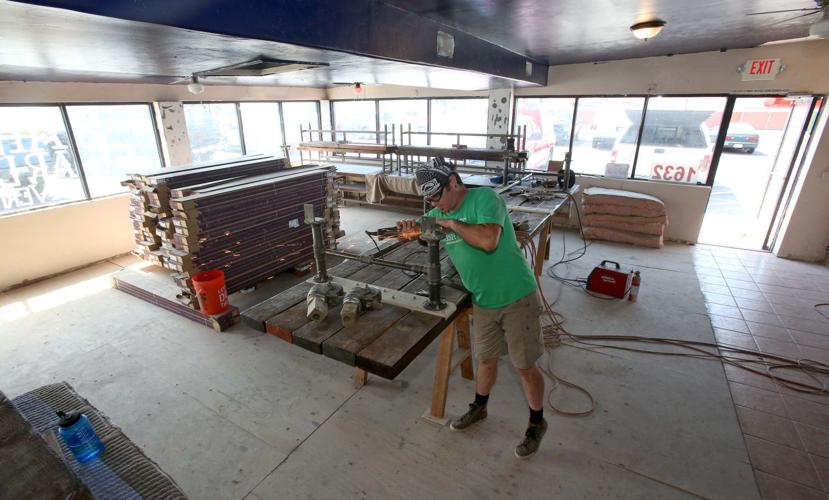
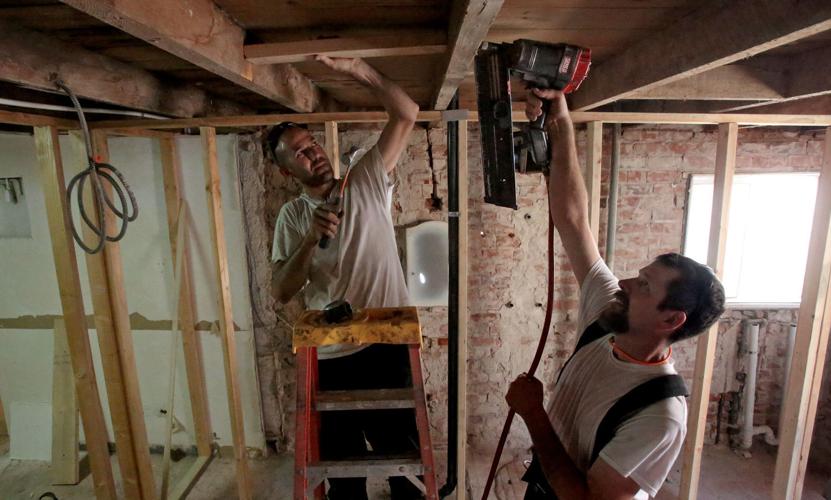
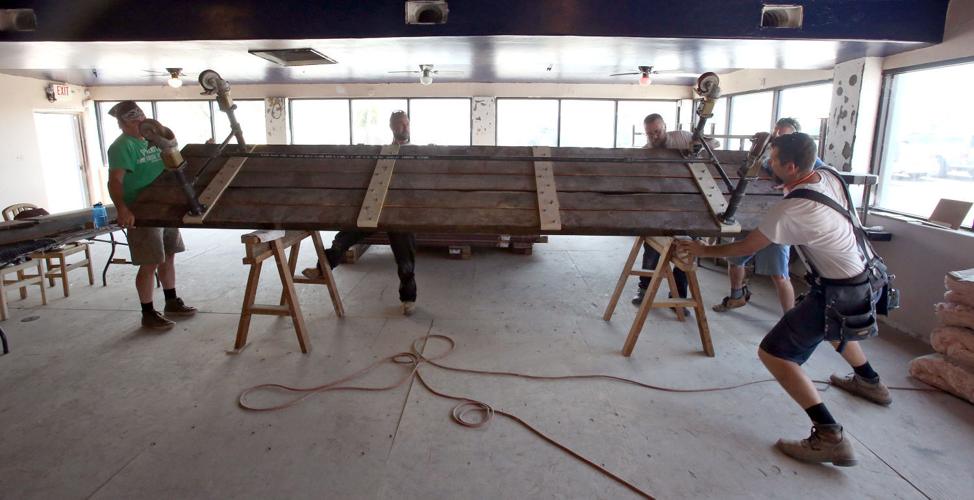
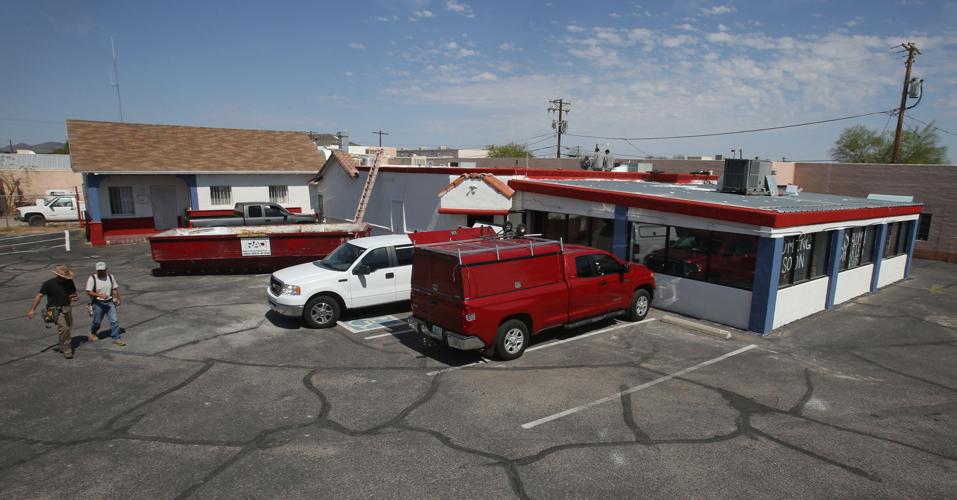
When Saint Charles Tavern pours its first craft beer next month, it will be the only bar in South Tucson and the latest indicator that the 1.2-square-mile city is gaining favor with businesses and residents who would traditionally call downtown home.
“We call it the tip of the spear,” said Elizabeth Menke, who owns the bar with her husband, Churchill Brauninger.
The couple, who have decades of experience in the service industry, played an important part in the development of La Cocina and The Dusty Monk Pub in downtown Tucson.
When it came time to open a place of their own, they said South Tucson offered what they were looking for.
“Places like this don’t exist. They certainly don’t exist for the working-class types,” Menke said. “You can rent something at a strip mall, you can rent a space that you’ll never ever own, but here we have this.”
People are also reading…
At the corner of South Fourth Avenue and 27th Street, Saint Charles Tavern has parking and room for a bar, pool tables, a jukebox, live music, a beer garden and a full kitchen.
There was a time when downtown would have been a natural fit for them, but a lot has changed since 2001, when Menke first brought Brauninger to her native Tucson.
“We kept walking down Congress and it was: boarded up, boarded up, wig shop, boarded up, boarded up, smoke shop. Was there a tornado?” Brauninger joked. “It was full of potential.”
“All those boarded-up buildings are now thriving boutiques and restaurants — great. But it did push out a lot of people. The bohemians, the artists, the musicians, a lot of them have filtered south,” he said.
That displacement is a natural part of development, said Michael Keith, CEO of the Downtown Tucson Partnership, and is really an opportunity for surrounding neighborhoods to grow alongside the city center.
“There are some businesses that will fail with the rent going up,” Keith said. “But if they’re really desirous about staying close to downtown and connected to this younger demographic that’s becoming the signature group here, they will find a spot.”
Nöel Chester owned The District Tavern on East Congress Street for 10 years before she closed it in January because of a rent increase, she said. While she still hasn’t found a place to reopen, South Tucson is her first choice.
“It’s very attractive to go into the city of South Tucson because there’s an interest from the administrators there, there’s real estate that is available and I feel at home,” Chester said.
Her patrons would appreciate the city’s character, she said, and her clientele would become even more diverse if her bar was able to find a place there.
Brauninger joined surrounding merchants, including the city’s renowned Mexican restaurants, in saying they would welcome The District opening in South Tucson.
“We don’t want to be the only destination spot. I want there to be 10 great bars and restaurants down here so you can park your car once and go bar hopping,” he said.
Although Parker Arriaga lives on 23rd Street, two blocks outside South Tucson, he is excited about the changes coming to his neighborhood. Right now he has to go downtown to eat or drink, he said.
“I think (South) Fourth Avenue is going to start picking up, and it’s going to be the next developed district of Tucson,” he said. “It’s going to start bringing in more people to this side of town. It’s going to be good for the South Side.”
Drink to remember
Along with cheaper rents, an active social scene could be a point of attraction for young people, but not everyone is unconditionally happy about the return of bars to the area.
At one point South Tucson had more than 50 liquor licenses in use. For the small city it meant there was a place to drink alcohol on almost every block.
“I remember as a kid people stumbling out of those bars. People my dad’s age who would drink their check,” said Arlene Lopez, a lifelong South Tucson resident.
Residents and city officials spent years trying to push bars out of South Tucson. Antonio’s, on East 33rd Street and South Fourth Avenue, was its last bar, and it closed in 2011.
“There were a lot of famous bars and no doubt it was a good tax base, but the thought was it was not the best for the city of South Tucson, so they drove them out,” said David Carranza, South Tucson economic development specialist.
Things have changed and the city is willing to evaluate bars on a case-by-case basis, he said.
The owners of Saint Charles Tavern say they knew about the city’s history and made sure they weren’t walking into a business they couldn’t run.
“The city manager, the mayor, we talked to all the different people and every single person said, ‘That’s what we were doing, and now we’re not,’” Brauninger said.
“They didn’t come out and say they kind of shot themselves in the foot because they reduced the tax base,” he said, “but restaurants and bars pay a lot of money to city governments.”
South Tucson is financially fragile, officials have said, and 60 percent of sales tax collected in the city comes from restaurants.
The city is trying to attract business through a new economic development plan and an incentive program. Meanwhile the sales tax rate was increased to shore up a budget gap left by the elimination of an illegal secondary property tax.
Neighbors understand the importance of bringing in more revenue and attracting new people to the city. Most said they would withhold judgment.
“I have gone up to the state liquor board and fought bars, but it was over issues that police had to deal with, the paramedics had to deal with, the families had to deal with,” says Lopez, the longtime resident.
“If these places make a go of it, if they bring revenue into South Tucson and are a responsible business, there may not be a problem.”
Both the owners of Saint Charles Tavern and Nöel Chester said they want to be part of the neighborhood, not just exploit it.
“When I think about moving to South Tucson I don’t just think about putting a beer on the bar and collecting money, I think about encouraging a community,” Chester said. “The music, the art, the sense of familia, the heart and the soul that is still South Tucson.”
Keeping it secret
City officials recognize that not only would these new businesses contribute to the tax base, they would also give them credibility with a population they’re hoping to attract.
“We want to have more arts and culture down here,” Carranza said. “That’s getting out amongst the artists and small businesses that are being somewhat overlooked within the city.”
Ideally, South Tucson would grow and remind people of a Congress Street of old, full of galleries, small-business merchants and different types of cafes, Chester said.
Jeik Ficker, owner of Tanline Printing and part of a nonprofit art collective, said he moved to South Tucson recently for the community aspect.
“It’s a small town and it has that feel still, but we’re in the heart of Tucson,” he said.
While he hopes more downtown artists move into town, he doesn’t want to change the neighborhood.
“A lot of families have lived here for generations, and when artists move in then other people move in and start gentrifying the area. I don’t want to see people changing it,” he said.
Longtime residents and new arrivals agree that striking a balance between growth and keeping South Tucson’s charm is crucial.
“The nature of humans is finding something that’s secret, something that’s new, something that’s lesser populated. There’s a great appeal in that,” said tavern owner Menke.
Although city officials would rather the timetable be different, Arthur C. Nelson, associate dean for research and discovery in the College of Architecture at the University of Arizona, said South Tucson won’t see any real downtown-related growth until mid-century.
A successful downtown will spin off development in nearby neighborhoods, he said, but at 1.5 miles from the city center, South Tucson is too far away to reap immediate benefits.
“By 2050, if policy makers are able to respond to the growing demand of downtown living, then you’re going to see collateral impact into South Tucson,” Nelson said. “I wouldn’t see anything substantial in the near future.”
Ficker is optimistic that South Tucson and downtown Tucson will feed off each other and offer different things for different people.
“South Tucson is going to develop slowly. It’s going to get people who are in it for making things and making art,” he said. “That’s all right with me.”
Brauninger at Saint Charles Tavern is more bullish in his assessment of downtown growth and the opportunity it brings.
“This is the new normal. This isn’t some weird spike and then everyone’s going to go back out of business. It’s going to stay there. It’s going to continue to grow,” he said. “We just want to be a continued part of that.”


