

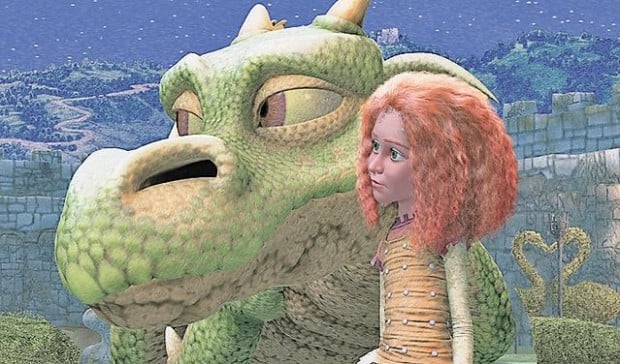
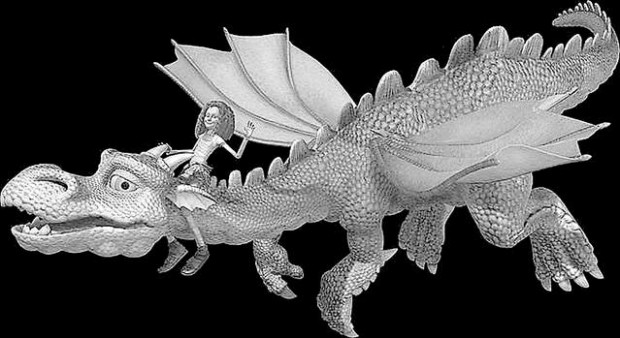
LOS ANGELES — He's the special-effects wizard who seems to visit the Academy Awards every other year to collect an Oscar for a "Lord of the Rings" film. But it's a gentle, animated children's show about a medieval knight and her goofy, fire-breathing dragon that captures most of Richard Taylor's attention these days.
Of course it doesn't hurt that Taylor's own preschool children are among the biggest fans of "Jane and the Dragon," the cornerstone show of the Qubo Channel, NBC's Saturday morning block of children's programming. In Tucson the show airs Saturdays at 10:30 a.m. on KVOA Channel 4 and at other days and times on Qubo's own cable channel and in Spanish on Telemundo.
"I've got a little toddler at the moment, and the show we're working on is aimed at her age group. And that seems quite fortuitous," says Taylor, speaking by phone from his native New Zealand.
People are also reading…
As he speaks, it's early Sunday morning in the land Down Under, and already the sounds of Taylor's daughter and young son are prominent in the background.
They are, he says, among the most exacting critics of the show his production company, Weta Workshop, has created with prominent Australian children's writer Martin Baynton, author of the "Jane and the Dragon" book series.
"People often ask me, 'Why on Earth would we be making a children's TV show after the giddy heights of "Lord of the Rings" and other such movies?' " says Taylor, who has collected four Oscars for "Lord of the Rings" and another for "King Kong."
"They see it as a bit of a comedown," he adds. "But, of course, it's completely opposite in my mind. For one thing, children are a critically discerning audience. There's no gray area at all. They either like it or they don't. Also, there's an incredible need for extreme care to be taken around the moral compass that you build into your show if it's for children."
In his case, Taylor recounts in his laconic New Zealand accent, he had the perfect moral compass in the "Jane and the Dragon" books, a hit with young readers in the Southern Hemisphere since the 1980s but just now being introduced in the United States. The series grew in part out of a conversation Baynton once had with a schoolgirl who told him she hated fairy tales "because all the girls were such wimps."
"They just hung around waiting for the handsome prince to kiss them and save them," the author recalled by phone from his home along Australia's southeast coast.
So enter Jane, a middle-class girl from the Middle Ages who has been chosen to be a lady in waiting but who longs to do a man's job — that of a knight in shining armor. With armor borrowed from the court jester, she goes out to do what all good knights do — slay a dragon.
In this case she finds one who is a bit of a bumbler, not well-suited at all for the terrorizing expected of dragons. And so these two fish out of water become fast friends.
Baynton always hoped to bring his stories to television, he says, adding he tried to structure them like the tales he grew up hearing as a child. But in the modern era of children's television, there seemed to be no opportunity.
"Channels such as Cartoon Network and Nickelodeon, which are the ones so many children watch, they won't run a show like 'Jane' because its pace is too slow for them," he says. "It's too gentle and has too much narrative. They want shows with a joke every few moments."
In "Jane and the Dragon," they get a heroine who won't — make that will not — speak in contractions.
A literary man, Baynton insists that "Jane" remain a literary show.
"One of the things I've seen a lot is the destruction of the written language through texting," he says. "Texting is fine on a cell phone. . . . But those contractions and abbreviations are coming through in the written work in schools now, and it is robbing the language of its subtlety."


