For Tucson artist Alejandra Montaño, painting has always been about more than art — it’s about family, legacy and the lifelong influence of her mother.
Long before Montaño developed her own bold, expressive style, she was a child growing up in a home where art never stopped. Her mother, Guadalupe de la Torre, is an artist and longtime teacher who has spent more than six decades painting, mentoring and creating.

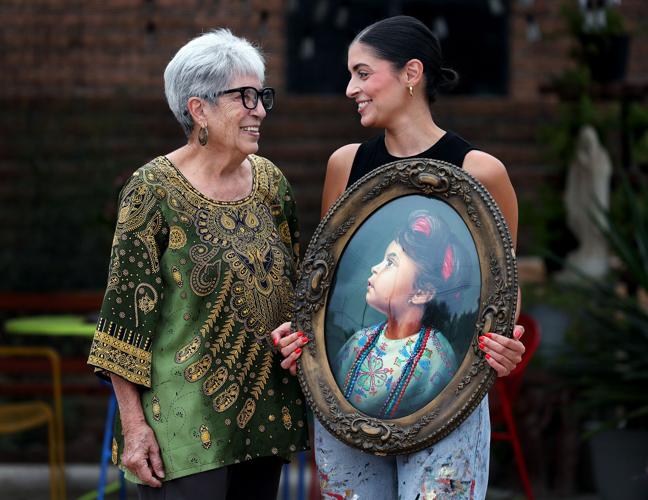
Guadalupe de la Torre, left, poses for a photo with her daughter, Alejandra Montaña, at her home on Tucson's west side. Montaña holds a portrait of herself at 2 years old painted by her mother. The two women are artists and de la Torre teaches art classes.
“Both my parents are artists, but my mom was an art teacher,” Montaño said. “So I grew up around art, with her students, with painting, and people there basically 24 hours a day.”
De la Torre, now 80, started painting when she was 12 years old and began teaching by 15. She later taught at Pima Community College for 20 years, shaping generations of artists — including, in many ways, her own daughter.
People are also reading…
“When you don’t find the words to express something, you use art for that,” de la Torre said.
Montaño is one of four daughters — all artists in their own right — raised in a home where creativity was part of everyday life.
“She grew up in the studio,” de la Torre said. “We had the studio and the house next door, so she was always surrounded by it.”
But following in her mother’s footsteps wasn’t always part of Montaño’s plan.
“I didn’t think I would become an artist,” she said. “I wanted to be in business, do something else.”
It wasn’t until about 10 years ago while living in England that she found her way back to painting. With time on her hands, she began creating again — and quickly realized it was something she couldn’t ignore.
“I would post my paintings, and people started wanting to buy them,” she said. “That’s when it clicked.”
Today, Montaño paints out of her mother’s studio in Tucson’s Menlo Park neighborhood — a different space than the one she grew up in but one that still reflects the same shared creative energy. When de la Torre isn’t teaching, her daughters use the space to work on their own art.
“I respect their technique,” de la Torre said. “If they ask for help, I’m there, but I try not to change who they are as artists.”
That balance — guidance without pressure — has shaped Montaño’s artistic voice. While her mother’s work often focuses on depth and realism, Montaño has carved out her own path with vibrant, abstract pieces inspired by Mexican culture, identity and tradition.
“My thing is culture — music, food, identity,” Montaño said. “I just try to keep it alive.”

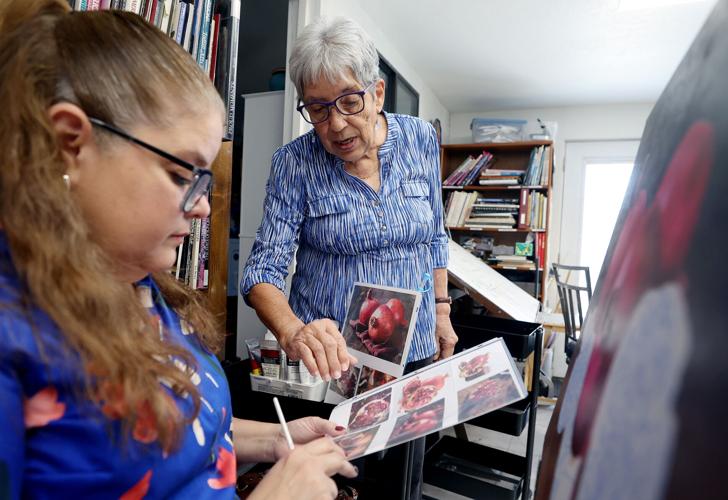
Guadalupe de la Torre, right, talks details with her art student, Myriam De La Torre, during a painting class at her Tucson home.
Her work features everything from saints and cultural symbols to nods to mariachi and Tejano music, all rooted in her heritage. Her latest pieces focus on women — their strength, resilience and role in shaping culture — themes that feel especially fitting given the influence of the women in her own life.
For de la Torre, watching her daughter grow into her own artist has been one of her greatest sources of pride.
“Alejandra is very good,” she said. “She’s going to go far.”

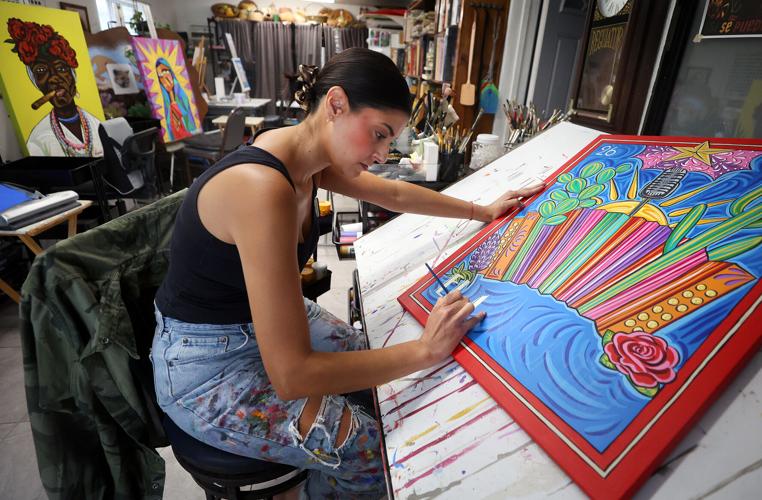
Alejandra Montaño, a local artist, works on a painting titled “El Conjunto,” at her mother’s studio. Montaño says her original paintings are rooted in Mexican culture, folk themes and Southwest desert life.
Though both mother and daughter share a love of art, their styles — and personalities — are different. It’s something de la Torre learned to embrace over time.
“Every person is different,” she said. “You have to treat them that way.”

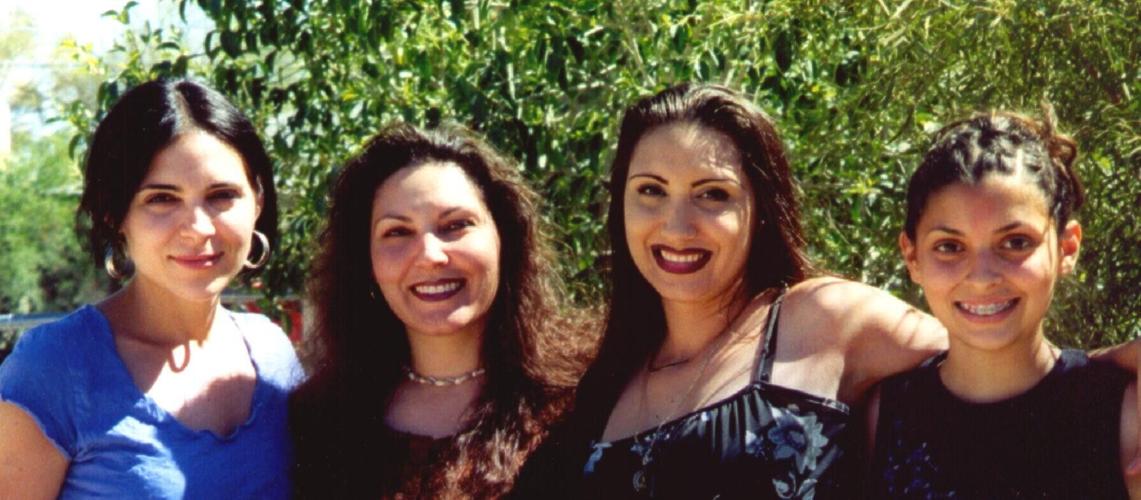
Tucson artist Guadalupe de la Torre's four daughters: Amie Gabriela Tetlowski, Ana Patricia Alcala, Leonora Monica Fimbres and Alejandra Montaño.
That philosophy extends beyond the classroom and into their relationship, where respect for each other’s individuality has allowed both to thrive creatively.
For Montaño, continuing to paint is also about honoring where she came from — and the people who shaped her.
“My dad’s last words were, ‘whatever you do, keep painting,’” she said. “So I have to honor that. It’s their legacy, my mom’s legacy, my grandparents’ legacy.”
And in the shared studio space where generations of creativity continue to unfold, that legacy is still very much alive — passed from mother to daughter, one painting at a time.