

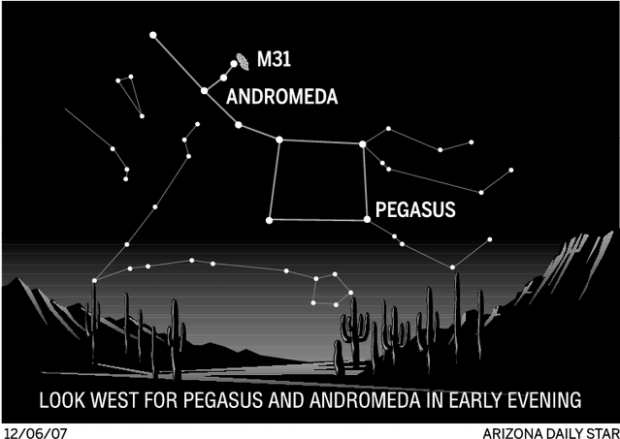
At 8:30 p.m., Pegasus the Winged Horse and Andromeda the Maiden are nearly overhead. These are large, bright constellations, but they in no way resemble their namesakes.
Pegasus is a large “square” of four bright stars. Inside the square are dimmer stars; the number of which you can see on a given night indicates how dark the sky is. Pegasus also consists of two extensions of dimmer stars to the west from the two stars in its western end.
The northeastern star in the “square” of Pegasus is Alpheratz, which technically is in Andromeda, though I like to think of it as completing the square of Pegasus.
Extending from Alpheratz to the northeast are two other bright stars, Mirach and Almach, in that order, making up most of Andromeda.
People are also reading…
Seven degrees north of Mirach is a fuzzy patch which is the Great Andromeda Galaxy, a galaxy 2.5 million light years away and larger than our own Milky Way. On a good night, it is visible to the unaided eye and is a wonderful sight in binoculars or a low-power telescope. It is the most distant object most of us can see without binoculars or a telescope.
On Saturday morning, starting around 5:45, try to see the nearly 28-day-old moon just above the eastern horizon. Only a degree above the moon is ever-brilliant Venus, and close by to the left of Venus is Spica, the brightest star in Virgo the Virgin.


