

If you’ve seen Tucson from 4,500 feet above, you understand the difference between looking at the Grand Canyon from the South Rim, or from the Colorado River as it winds 227 miles through the inner gorge of the canyon.
This is why my daughter Sedona and I are standing with a dozen others at Lees Ferry, meeting the man who will hold our lives in his hands for the next eight days and seven nights: We want to be part of this place, not just gaze down at it.
For me it’s the fourth trip with Arizona Raft Adventures; the others are on their first, which I ruefully reflect maybe makes me the least prepared of all. Because every trip down the river — or arguably, anywhere — won’t be a repeat of an earlier version. I was in my twenties twice, my forties once, and am now back, in my 60s. Sedona’s in her 30s, and like me on my first run, has slept outside perhaps twice. We are all feeling varying degrees of raw recruit status.
People are also reading…

Canyon walls flowed into a boulder-strewn beach at the rockiest campsite of the trip.
Our pilot, Liam O’Neill, sketches in some of what we need to know: The bathroom will be a glorified bucket. The meals will be rhapsodically good. We will be hot, cold, wet, excited, scared by turns. But by God, we will be safe, because we will listen to him; and by extension, his assistant Benjamin and intern Ben, who now become Benjamuffins and Young Ben. We learn that securing a life jacket is Job One every time we step onto the giant silver motorized raft, called the Supai, as a tribute to the Havasupai who have inhabited this canyon for centuries. This will be transportation, magic carpet, headquarters for the next week. We have been prepped, given lists, watched videos, packed our belongings into waterproof bags. We’ve paid a lot of money to be here.
And we are now one step from Parts Unknown.
Because of the web, you can see a lot of what we did: hikes into side canyons, wild runs through major whitewater rapids, vast star-strewn skies, scenery unlike almost anywhere else. But that’s like looking at a photograph of a major piece of art, because the Canyon is a wonder-of-the-world-scale creation.
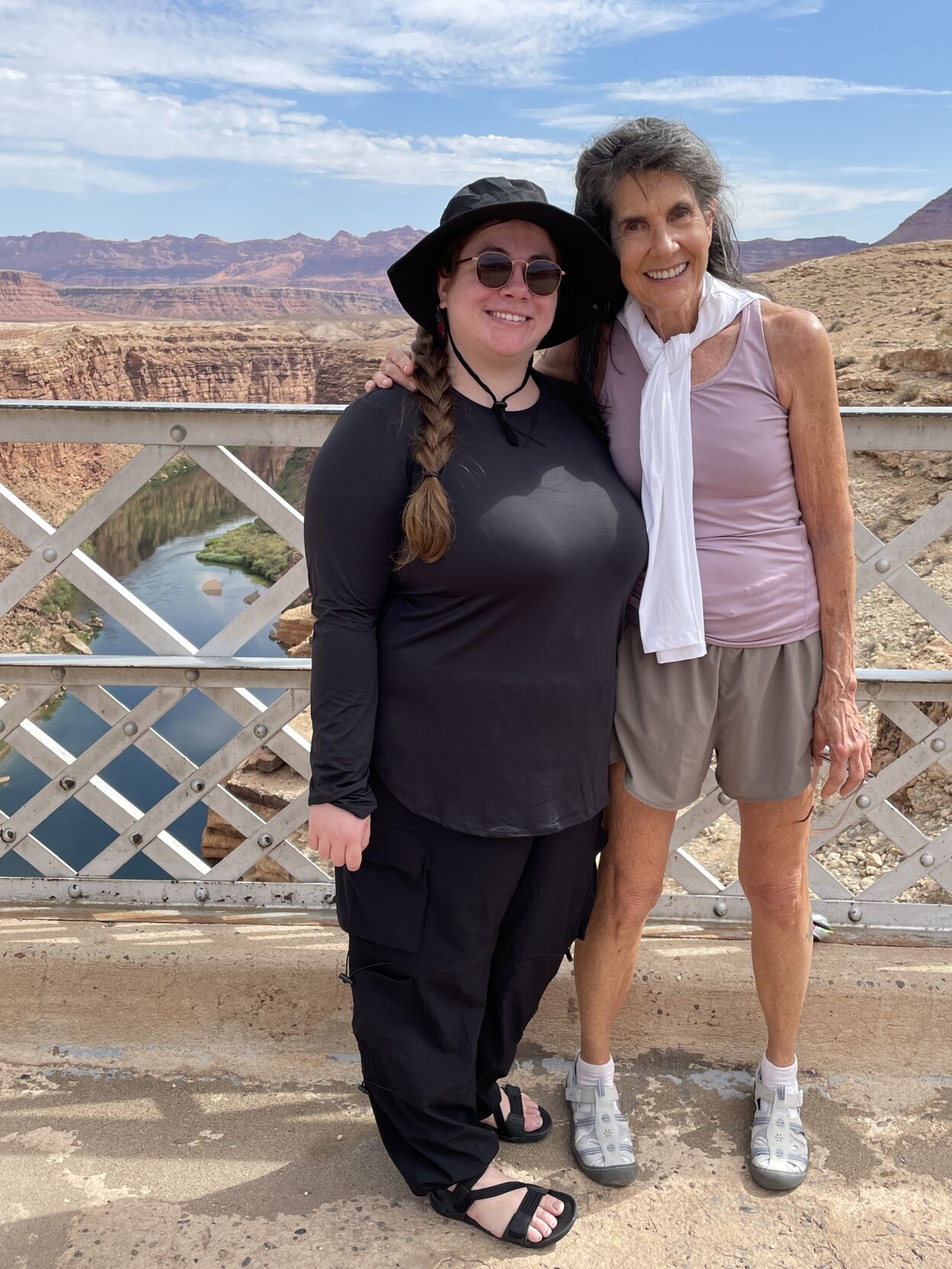
LEFT: Sedona Heidinger with her mother, writer Lisa Schnebly Heidinger, on Navajo Bridge, built the same year Lisa’s father, Larry Schnebly, was born. Larry introduced both Sedona and Lisa to the Grand Canyon.
The genesis for this moment was a conversation in my parents’ living room two years earlier; my dad Larry, brother Linds and I were reminiscing about earlier river trips: Remember when we were battered by hail the last day of our last trip? Remember when other brother Lyle got bitten by a scorpion and our pilot told to me not to let him fall asleep, and come wake him if Lyle’s heart stopped? Remember when our pilot picked up a drowning man and he had to be choppered from our camp? Remember the 40-degree waves washing over us in Lava Falls, the highest, fastest navigable rapid in the Western Hemisphere? While my mother shuddered, Sedona said, “I’d like to do that.”
We all gaped at her. Not because she’s not strong; she climbed the rigging of a tall ship in an Australian harbor. But because she seems more of a city and man-made art appreciator. Further conversation provided the information that neither male member of the Heidinger family had any interest in the experience. So it got bucket-listed.
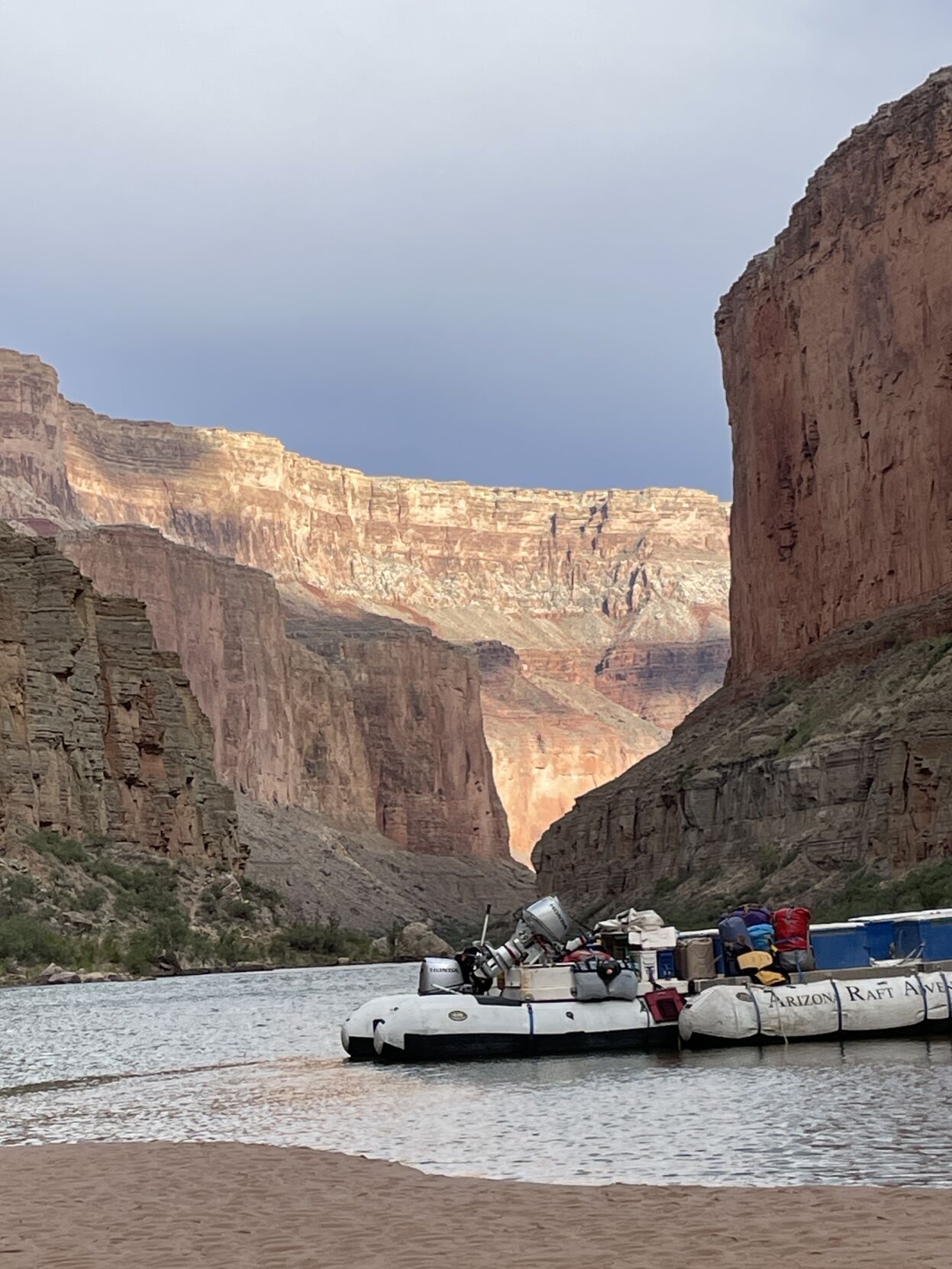
Late-afternoon light bathes the Grand Canyon, the Colorado River and the Supai raft.
But then, in the ensuing 16 months, my brother Lyle, father Larry, mother Lee and finally my son Rye died, Rye ending his life just before his 29th birthday.
So I moved the River Plan to active status.
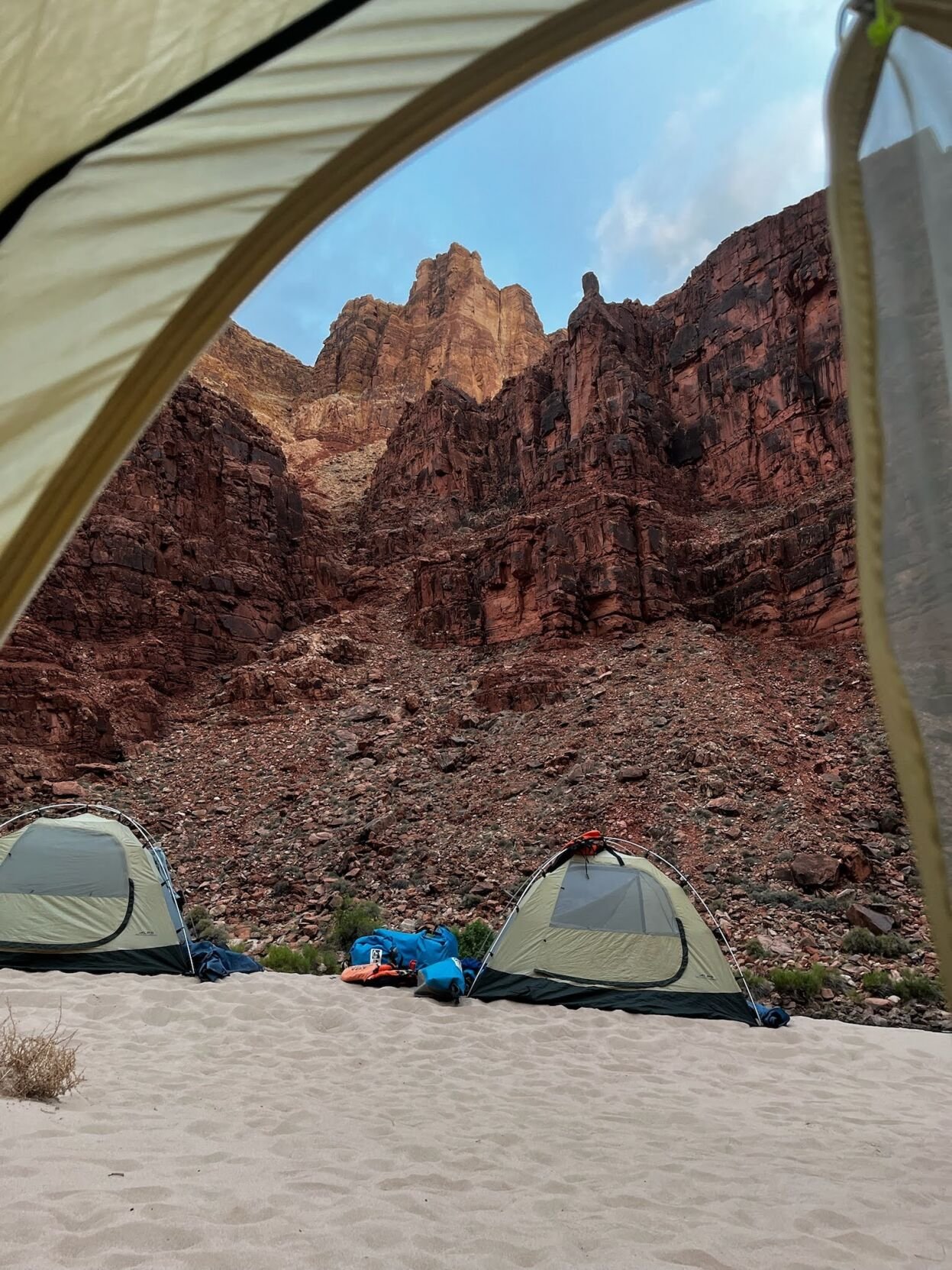
LEFT: Sedona Heidinger with her mother, writer Lisa Schnebly Heidinger, on Navajo Bridge, built the same year Lisa’s father, Larry Schnebly, was born. Larry introduced both Sedona and Lisa to the Grand Canyon. RIGHT: The view of the canyon was often great even from the tent.
I had discovered that life is way less certain than I had wanted to believe. Now, Sedona and I were somehow glad Rye had not planned to come; we won’t miss him on the trip the same way we would have.
Which is not to say we won’t miss him; five other members of our river group also lost him. Each of us knew he had said he would return as a raven and have already seen ravens at some wild places. Dominic, born six weeks after Rye and growing up across the street, sports Rye’s only ink: the title of the poem “Invictus.” Sedona has a raven on her arm. Dominic’s cousin Connor and his sister Devon also grew up with Rye. Now they and Devon’s husband, Andrew, are adding a Major Life Event along with Connor’s and Devon’s parents, Trevor and Jenifer Swanson. I am grateful to my bones that they are all here for this. And the night we get off the river, the young people will make a pilgrimage to a Flagstaff tattoo shop for a line drawing of a raven on four of the five arms. It is, to me, the 21st-century version of Mark Twain’s characters becoming blood brothers.
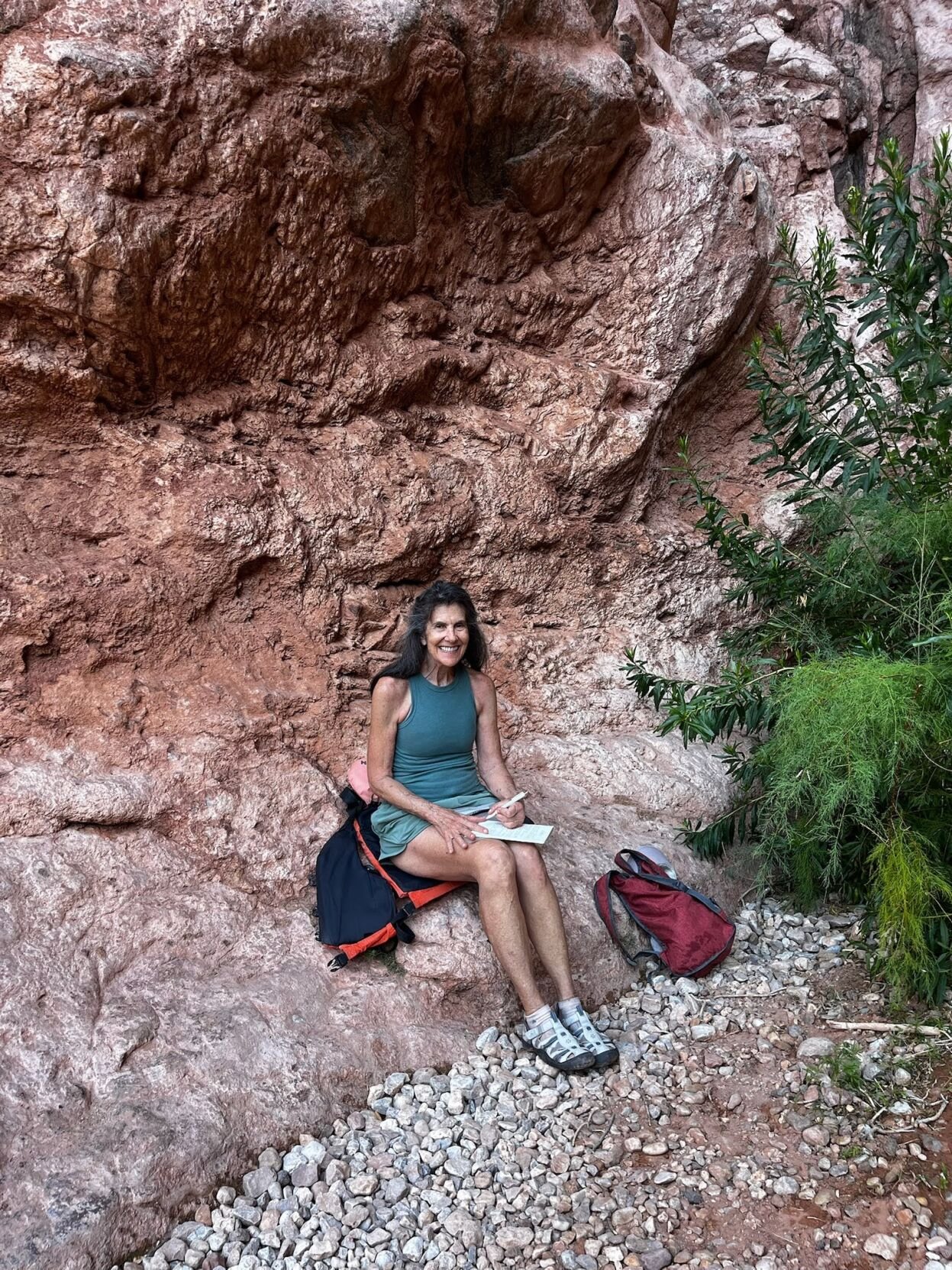
ABOVE: Lisa Schnebly Heidinger finds a moment to write in her journal near Deer Creek Falls. LEFT: Trip mates. Front row, left to right: Thia Sawchuck, Dana Cooper, Lisa Schnebly Heidinger; second row, Jennifer Swanson, Dominic Goshert, Karen Ryman Jones, Harold Brookline, Devon Farley, Andrew Farley; back row, Teresa Welborn, Sedona Heidinger, Michael Jones, Trevor Swanson, Connor Swanson.
But between Lees Ferry and that event are seven nights and eight days of intensity, discovery, and amazement for all of us.
All the best trips are part places and part people. My goal on this one was to be the same person who went to Europe with Sedona eleven years earlier, because that version of me was pretty much zero-percent invested in any experience. I was with my daughter, and everything was once-in-a-lifetime, so who cared what specifics occurred?
For the most part, I succeeded.
What was hardest not to hope for was a hike up Saddle Canyon, which is one of my favorite places on the planet. But it turned out Sedona battles a fear of heights, and after ascending 200 feet of cliff wall, she made the mistake of looking down and decided she would just slow the group if she continued. For a mad moment I thought, “I’ve waited 26 years to see this again!” And then remembered: each trip is its own. This one you’re with your girl. We walked back down together. And it turned out to be the most sacred hour of the trip. Liam told us about a 20-minute walk back upriver to a glen with a shady pool. We went up, and I washed Sedona’s hair for the first time since she was a child. It was truly priceless time. I’m so glad it went exactly the way it did.
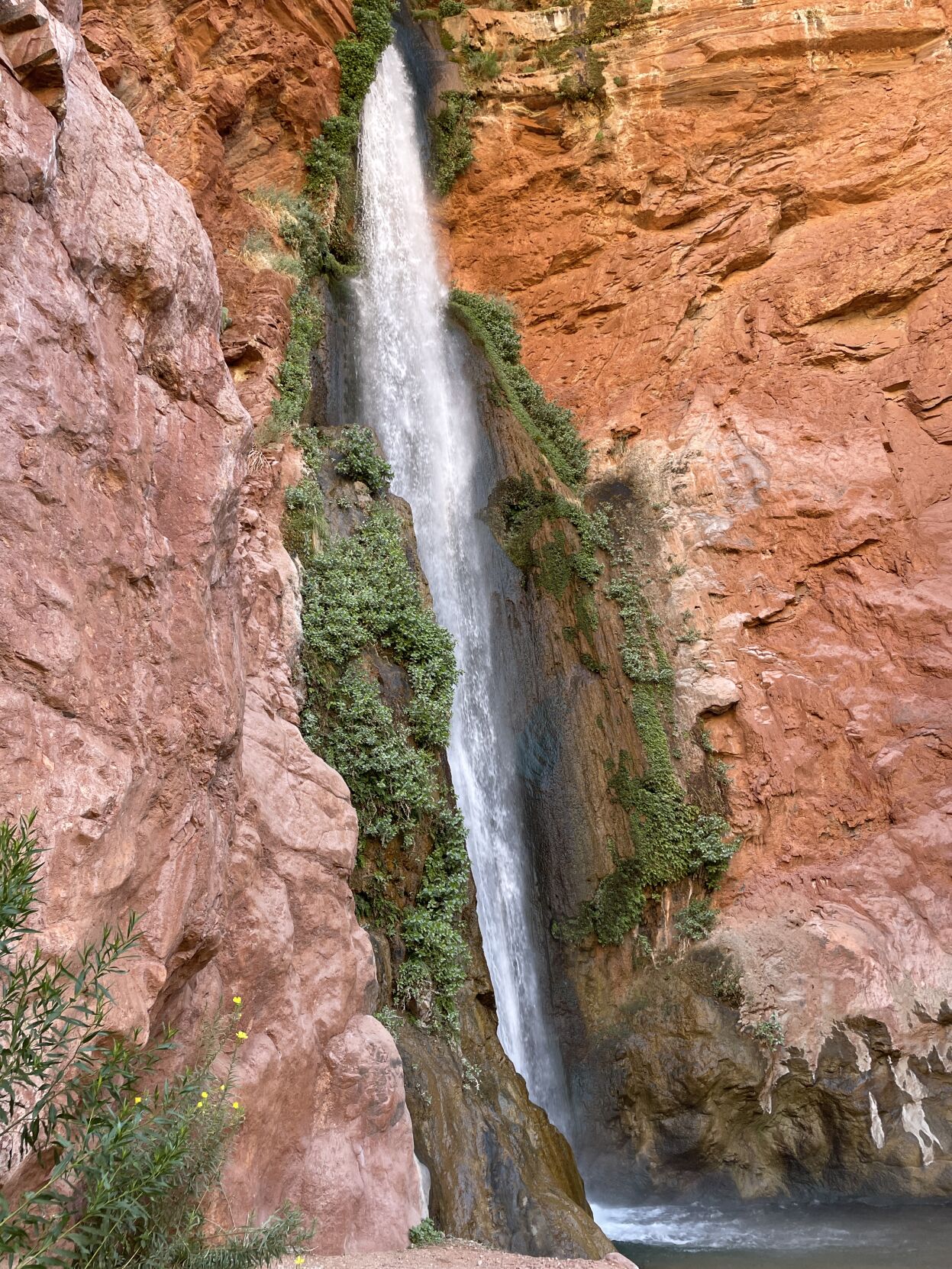
Deer Creek Falls thunders downslope to join the river’s flow.
The Grand Canyon beguiles in a thousand memories, some vast and some minute. The narrowest channel can seem foreboding: bristling black sharp walls formed billions of years ago — pressing close, shot through with veins of palest pink. Other areas look more like the views from the South Rim, wide stretches of green water with walls folding away one behind another, a reminder that the river is only one narrow section of the canyon. But a single ray of light shining on a wildflower provides an exquisite accent note: The very big and very small play their roles in the whole.
Vasey’s Paradise hovers above the waterline, profusions of pale green ferns showing where water seeps through. Another such outcropping of tender growth looks like a holiday tree. They are intimate, especially contrasted with Redwall Cavern, which John Wesley Powell somehow pictured being able to hold a crowd of fifty thousand people. We play frisbee wondering how he came up with that number. We observe that this shape plays out repeatedly in smaller scale throughout the Canyon as erosion carves caves into rock faces.
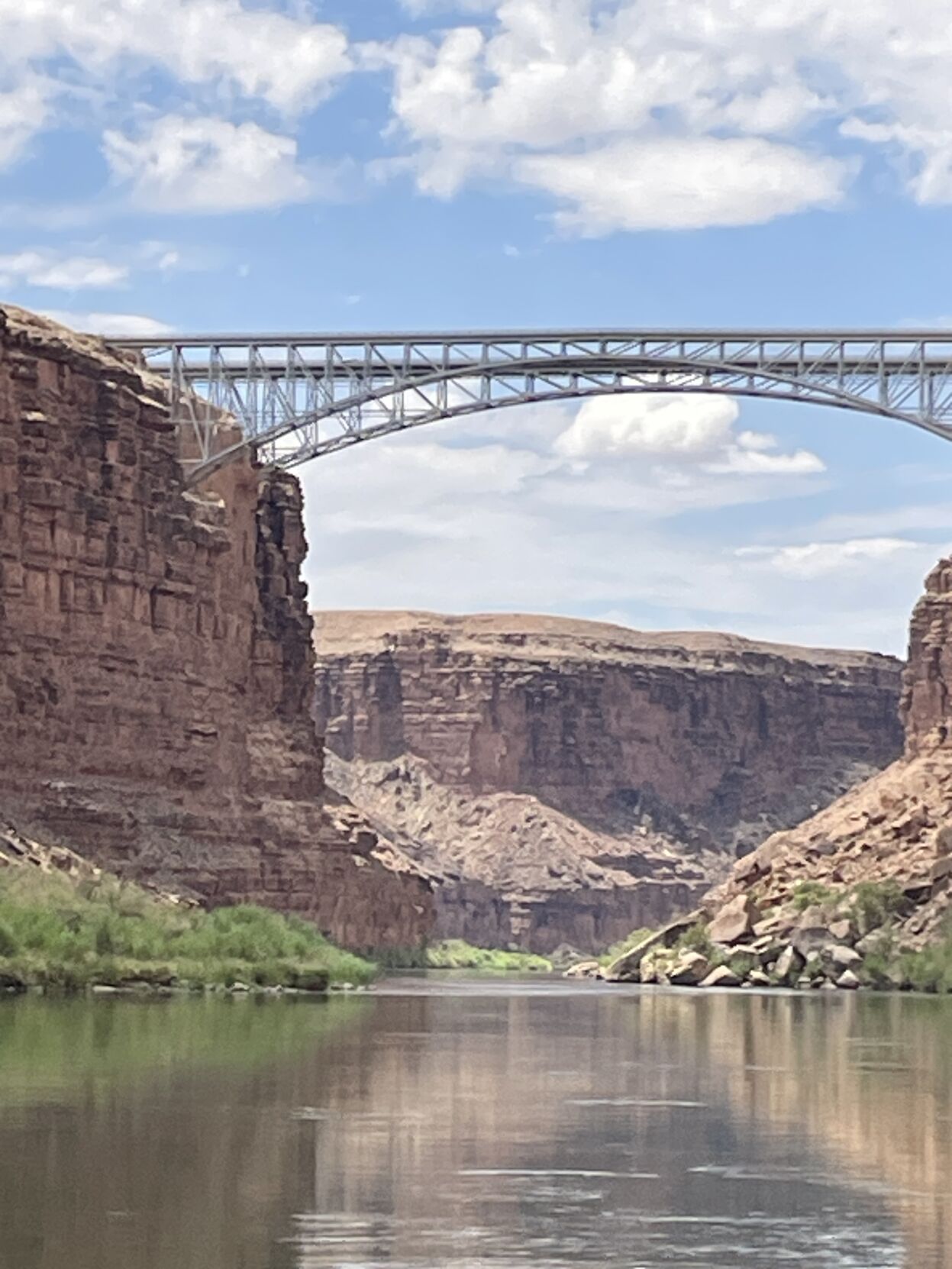
Navajo Bridge, seen from the raft on the Colorado River.
Some places look as though they’d been created for a Star Wars movie: buckled walls scored with designs that seem like enigmatic communications. Others are classic Grand Canyon: cinnamon cliffs with the desert varnish showing where waterfalls appear after rain repeatedly, leaving the dark stains.
Side canyons can range from the Shinumo’s dark gleaming rock with a pure shot of waterfall coming down that lets the intrepid climb into the slick chute and shoot out with the stream, to the almost cavernous Blacktail with intricate layers of fawn, beige, amber rocks that appear fitted together by master masons.
Blacktail had the addition of a concert: Ben had brought his guitar, and probably played for 45 minutes, folk music including “Kelly’s Rag,” which he wrote after his mother died of pancreatic cancer when he was only thirteen. I think each of us wanted to buy him a car or tousle his hair as the last notes of that faded.
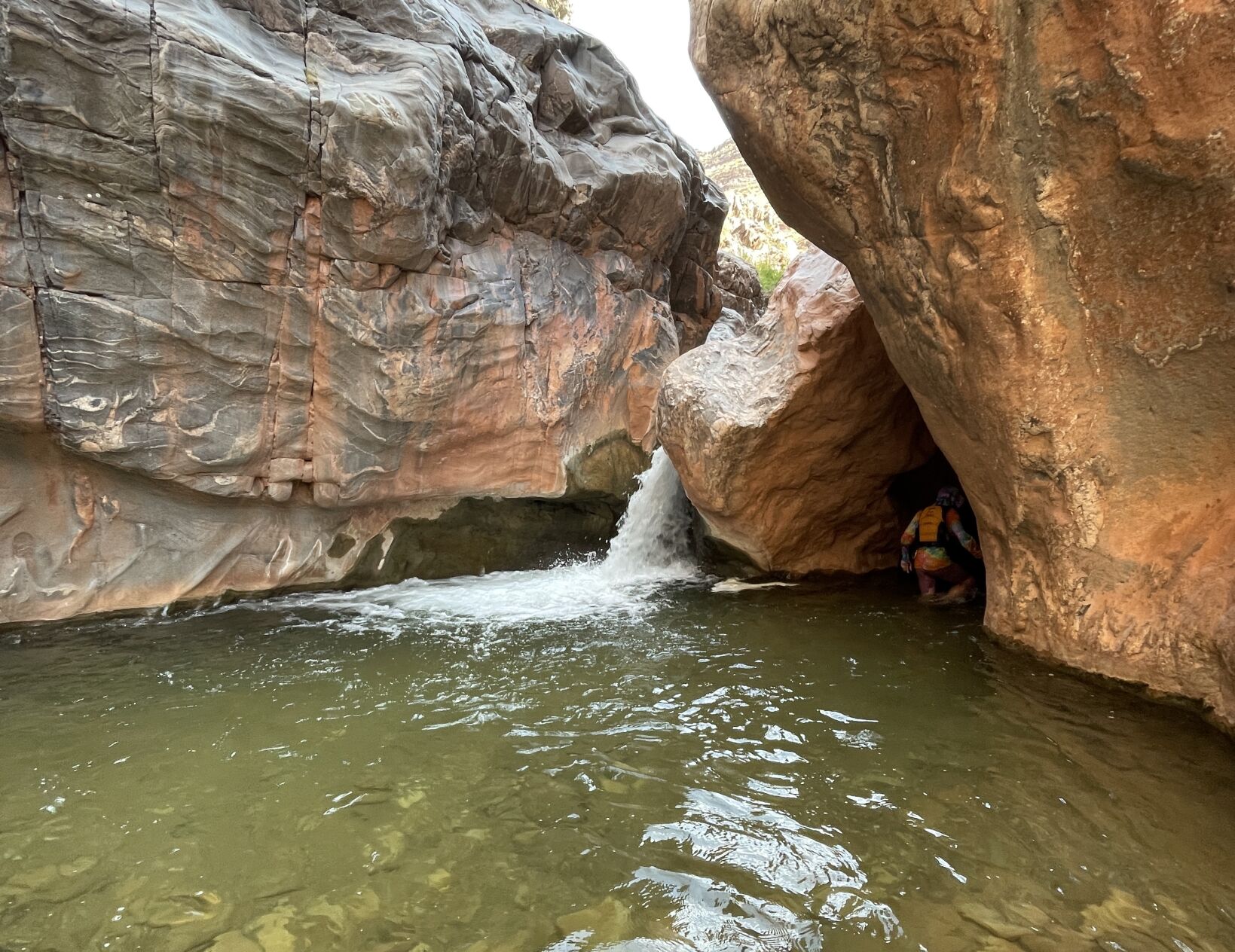
Shinumo Falls on Shinumo Creek, where the boaters got to climb through the hole and shoot down with the water.
Deer Creek Falls comes rocketing down with such force that, standing 30 feet from where the water hits, the rising moisture elevated Sedona’s long hair like a magic trick. You can inch forward across the pool at the base feeling almost amphibian breathing such moisture.
Campsites are as varied. All are comprised of beach sand, but some host riparian groves for setting up neighborhoods of tents for the night, while others offer unimpeded views in all directions. Some have cliffs offering shade, intimations of caves. (Liam provided concierge access to shade during those hot late afternoons.) Because of the extreme heat, we learned to empty buckets of chilly river water on the sand before setting up tents. When we took them down the next morning, the moisture still showed how much cooler sleeping had been.
Rapids each have their own characteristic, while sharing the basic bucking thrusting ride down the slick vee tongue into the maelstroms of standing waves, haystacks, eddies, and rocks visible or not. Hermit had ten standing waves; Bedrock had just one major boulder to avoid, but in some water levels, much easier said than done. It can be trickier than the “famous” rapids, Crystal and Lava.
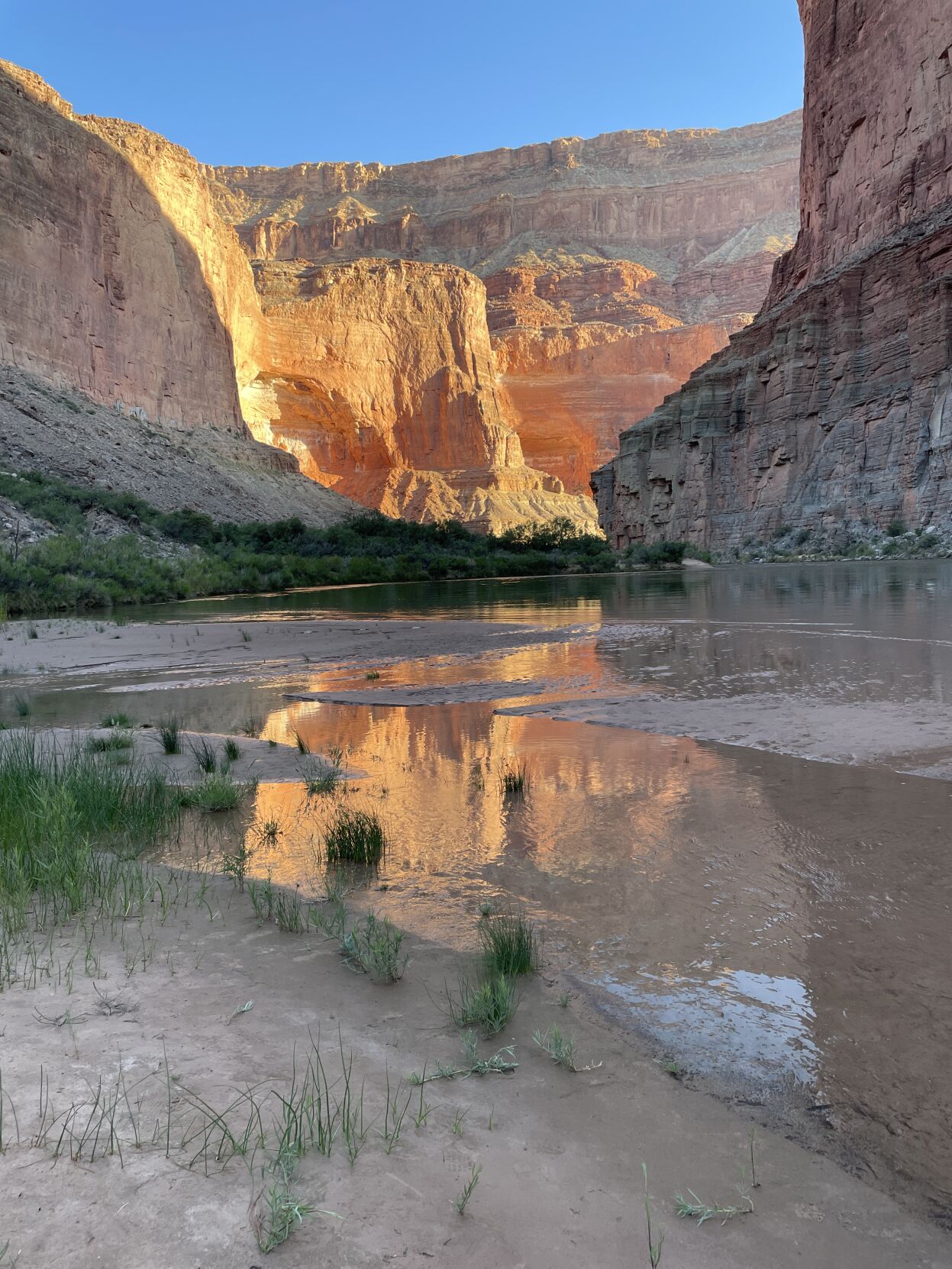
LEFT: Sunlight sets the canyon walls ablaze with color. RIGHT: Sedona’s first visit to Lees Ferry, with grandpa Larry Schnebly, in 1993.
Between all these elements, scenery changes as light travels across the sky. Sun illuminates, then later fades, illustrating what makes golden hour so magical: Colors deepen, burnish, glow as if the rock itself generates light.
Our group set out to set a record for the number of big-horned sheep spotted, succeeding in large part due to wildlife artist Trevor Swanson’s excellent scanning techniques. We could all hear the trilling descending scale of canyon wrens, but I never saw one.
For many of us, obviously, the ravens were the most powerful wildlife. On day three or four, someone heard one of the AZRA crew comment on how many more raven visits there had been than usual. One of our group shared that Rye had said he would return as a raven, and indeed had appeared to preside over every camp and many meal stops. We enjoyed the supervision.
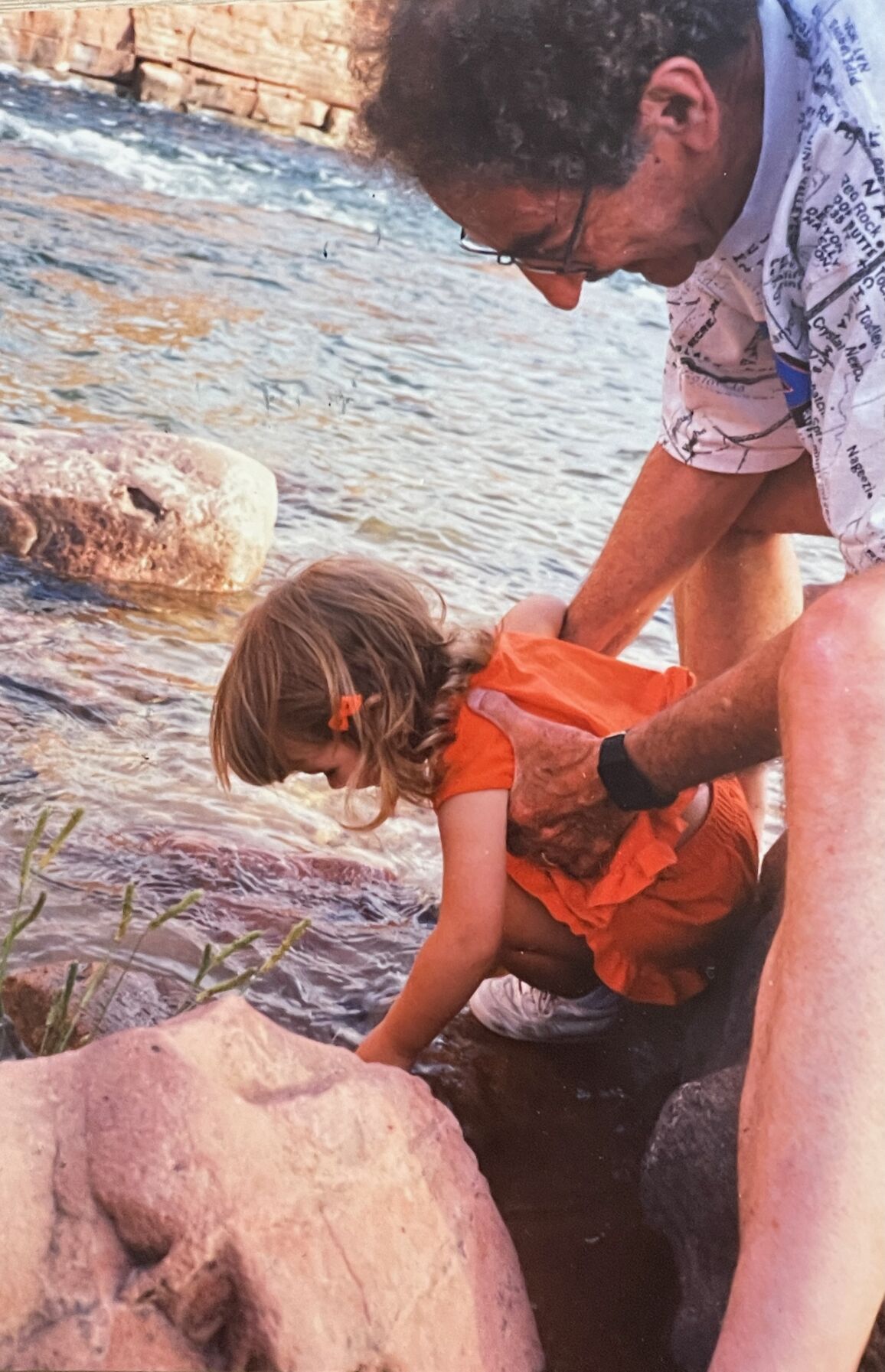
Sedona’s first visit to Lees Ferry, with grandpa Larry Schnebly, in 1993.
Since our introduction to the Grand Canyon came from my dad, both Sedona and I remembered his joy even seeing it from the Rim. After he joyously departed for Heaven at age 94, I’d found the black duffle he had taken on our first trip, when he had bought me the purple one I’ve used each time since. So I had the side seams mended on his to make this trip transporting Sedona’s possessions. I also found a plastic flask he’d used for scotch. I’d attached a note to it after the 1984 trip, telling him he would value it even more because it contained air from our last camp at Pumpkin Creek. But I let that air go to bring elderflower liqueur, a favorite of both Sedona’s and Rye’s. We passed it around the circle before dinner one night, and everyone offered a toast before drinking. It was poetry on the fly, honoring Larry, ravens, the Canyon, memories and new ones being made, individual growth and the tremendous mutual regard we all celebrated.
On the last morning, Liam warned us that leaving would be difficult: no matter how amazing a life awaits you, the temporary construction of this civilization has become life as we know it, and feeling it disappear forever cannot come at no cost.
I thought I would do well, especially considering that the last re-entry meant a return to the routine of young children, and now life is pretty unfettered. We unloaded at Diamond Creek, and I was feeling sanguine, until I saw the big semi rig back down to the water’s edge for Liam to guide the Supai toward it. While I understood having to leave, it seemed impossible for Liam and the boat not to continue their sojourn. I headed toward the back of the area so I wouldn’t break down publicly. When I got there, Sedona’s eyes were huge and sad.
“It reminds me of when they brought Poppa out of the house,” she said. Each generation betters the one before it. Larry introduced us both to the river. She found those words.
But he had also spent decades saying, “The river is still running,” to remind us when we get too wound up by the detritus of life, of those dancing glassy waves. To bring back the clarity, simplicity of living by and on the water, striding in it to wash clothes, cool off. I can still hear her peals of laughter as she took rapids right on the chin. We have a memorial bench for Larry on the Rillito River, just west of Swan, that says, “The River is still running.” It is, and for us, he is.
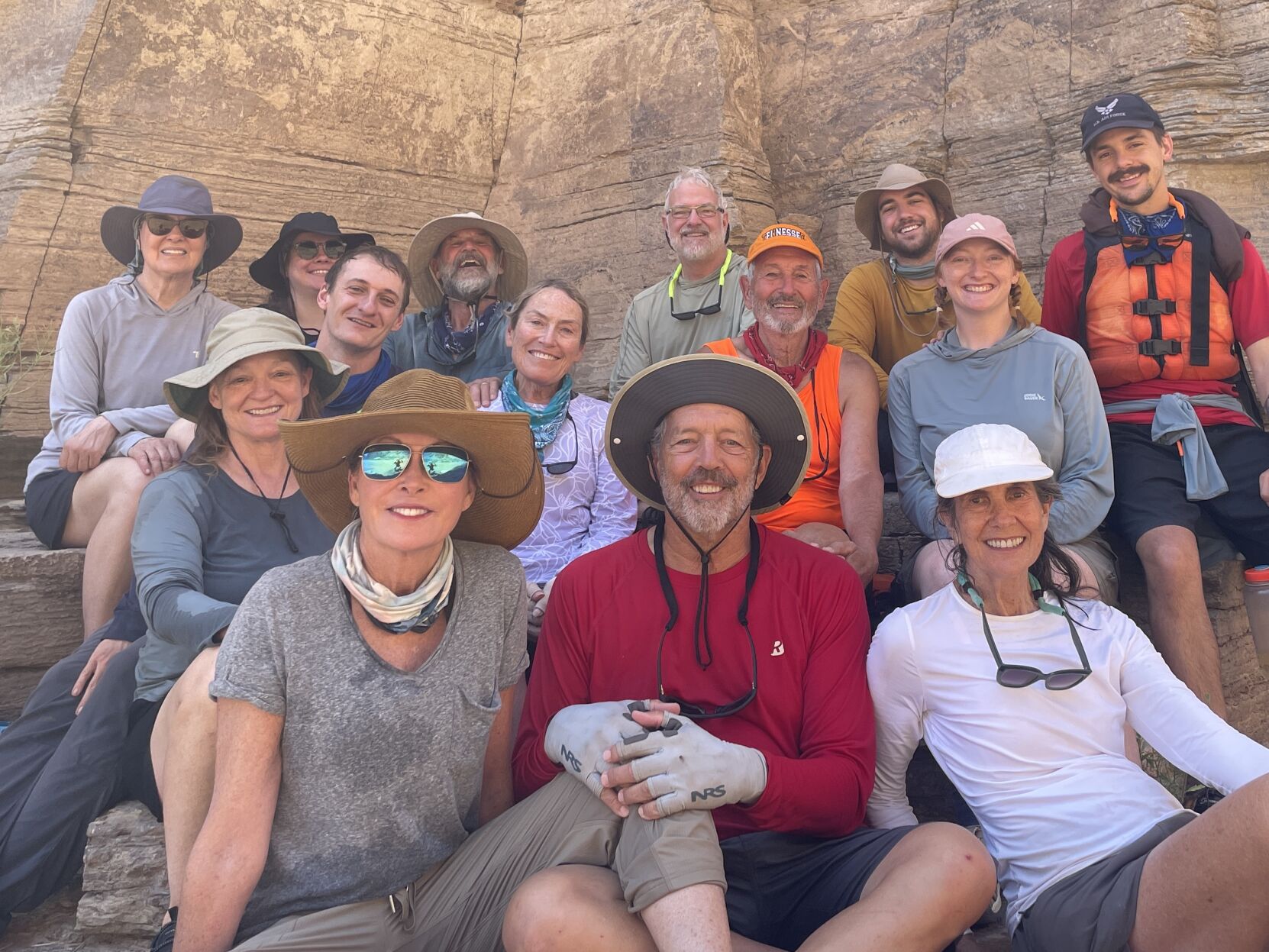
LEFT: Trip mates. Front row, left to right: Thia Sawchuck, Dana Cooper, Lisa Schnebly Heidinger; second row, Jennifer Swanson, Dominic Goshert, Karen Ryman Jones, Harold Brookline, Devon Farley, Andrew Farley; back row, Teresa Welborn, Sedona Heidinger, Michael Jones, Trevor Swanson, Connor Swanson.
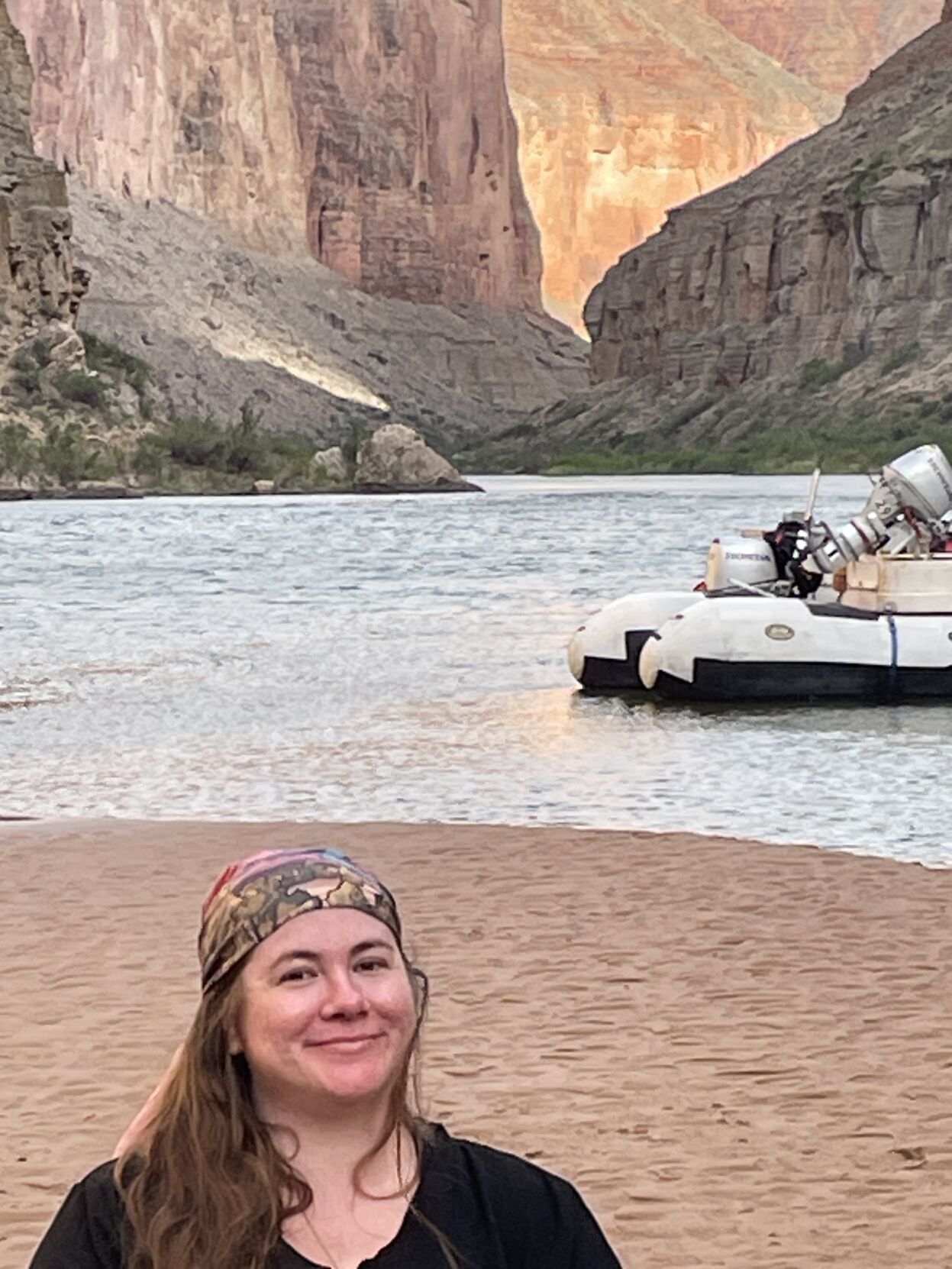
Sedona enjoys a sunset as the party prepares camp for the night.
Lisa Schnebly Heidinger is the author of “Tucson: The Old Pueblo” and 10 other books. The most recent, “Arizona Friend Trips” with Julie Morrison, was chosen as OneBookAZ for the Library of Congress Festival of the Book next weekend in Washington, D.C.


