

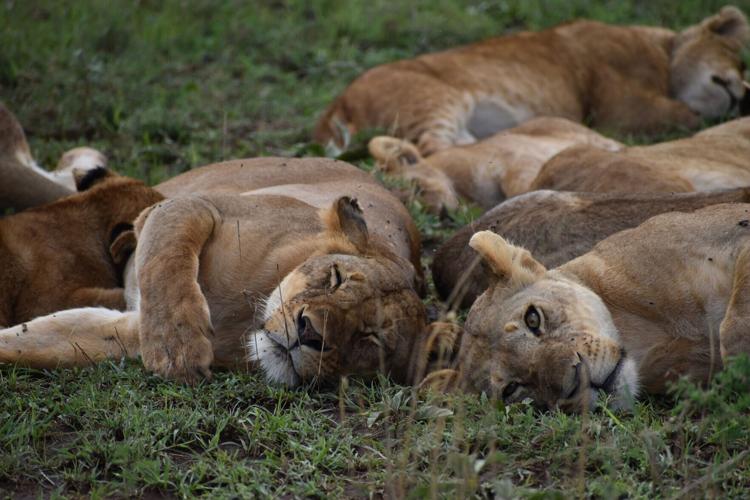
In the crystalline brightness of the afternoon sun, a pride of lionesses and cubs lay sprawled in a luminous tangle of golden fur. Massive paws overlapped, heavy heads rested across one another and long tails flicked lazily against the dust. Their bodies rose and fell in slow, synchronized rhythm, warm breath stirring the dry earth beneath them. From time to time, soft murmurs of contentment slipped from their throats. It was an unforgettable, hypnotic sight, this dozen or so great cats, utterly at ease, gathered into what could only be described as a big cuddle puddle.
The day itself felt suspended in stillness. The air was bone-dry, the aureate light almost honeyed as it cast a soft amber haze over the crater floor. Even the silence carried weight. It was the kind of moment that resists interruption, as though the landscape itself had decided to pause.
This pride rested within the Ngorongoro Crater in northern Tanzania, part of the protected Ngorongoro Conservation Area bordering Serengeti National Park. Formed two to three million years ago when a massive volcano collapsed inward, the caldera spans roughly 12 miles across.
People are also reading…
Within its natural walls lies one of the densest concentrations of wildlife on the African continent. Lions, elephants, black rhinos, zebras, wildebeest and countless other species share its grasslands, forests, swamps and soda lakes. It is not merely a destination but a complete ecosystem, self-contained yet deeply connected to the greater Serengeti.
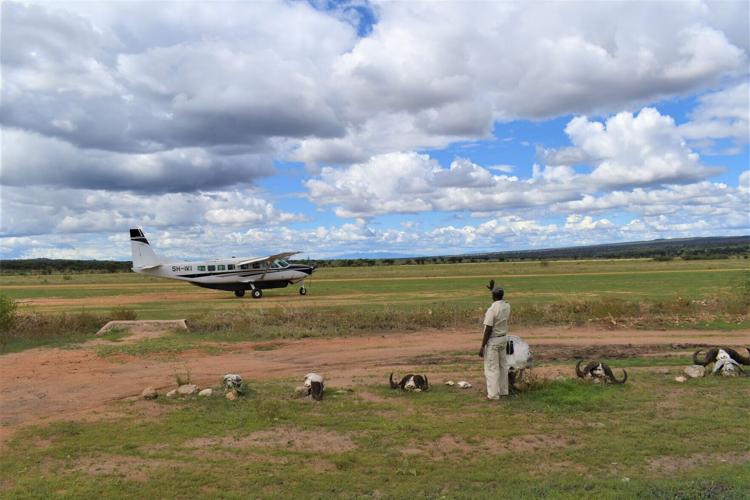
Ngorongoro marked the third stop on my journey with SkySafari by Elewana, an experience that reimagines the traditional safari. Rather than enduring long, jarring drives between parks, we traveled by private aircraft, moving seamlessly from one wilderness to another. SkySafari’s customized Executive Cessna Grand Caravan, with plush leather seating, generous legroom and wide viewing windows, made the journey itself part of the adventure. Time once spent on dusty roads became time spent immersed in Tanzania’s extraordinary landscapes.
Coffee and birdsong
The trip began and ended in Arusha at Elewana Arusha Coffee Lodge. In between were carefully curated stays at Elewana Tarangire Treetops in Tarangire National Park, Elewana The Manor at Ngorongoro and finally Elewana Serengeti Pioneer Camp. Depending on the timing of the great migration, the final stop may instead be the equally remarkable Serengeti Migration Camp, positioned to follow the movement of wildlife across the plains.
Our small group included a Swedish couple, Peder and Catarina Andersen, our shared surname a mere coincidence. We met upon arrival at Kilimanjaro International Airport, where SkySafari representatives welcomed us for the scenic drive to Arusha.
Set within one of Tanzania’s oldest working coffee estates beneath the slopes of Mount Meru, the lodge offered a quiet, restorative beginning. Plantation-style buildings were almost hidden among coffee trees and flowering gardens, creating a sense of calm before the adventure ahead.
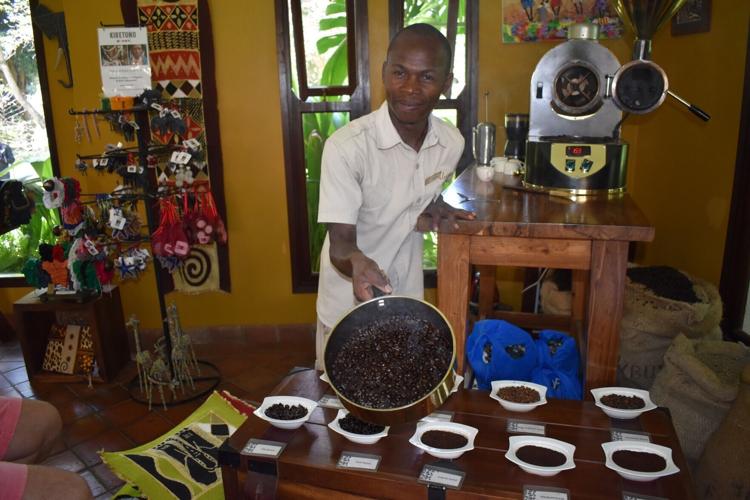
At first light the following morning, Peder, Catarina and I joined our guide, Desmond, for a walk through the plantation. Over the course of an hour, we followed the journey of coffee from blossom to bean to cup, learning how ripe berries — sometimes called cherries — are harvested, dried, roasted and ground.
The air was rich with floral fragrance, and the walk unfolded to a chorus of birdsong. Hornbills called overhead, sunbirds flickered among blossoms and flycatchers darted through the branches. In the undergrowth, pairs of boubous sang their haunting duets, while monkeys skittered playfully through the trees, pausing just long enough to observe us.
The tour ended as all good coffee tours should, and that is with a freshly brewed cup. The beans had been roasted and ground only moments before, and as I took that first sip, the warmth and aroma seemed to perfectly capture the essence of the morning.
Frisky zebras and a million elephants
Soon after breakfast, we made our way to Arusha Airport. From there, the Cessna carried us to Tarangire’s Kuro Airstrip, where several zebra stood watching our arrival as if it were part of their daily routine. The moment we stepped onto the rust-colored earth, the safari truly began.
Waiting beside the airstrip was Hamis, our guide and driver for the week. Soft-spoken and unflappably calm, he bore an uncanny resemblance to Jamie Foxx. Within minutes of leaving the airstrip, we encountered our first wildlife spectacle: a zebra stallion, um, enthusiastically pursuing a mare.
Hamis glanced over and, with perfect composure, said, “Well, that’s one way to make more zebras.”
From that point on, the sightings came so quickly it was almost impossible to absorb them all. Mongooses darted through the brush. Tiny dik-diks vanished almost as soon as they appeared. Impalas bounded gracefully across the savanna, while giraffes moved with slow, deliberate elegance among the acacia trees.
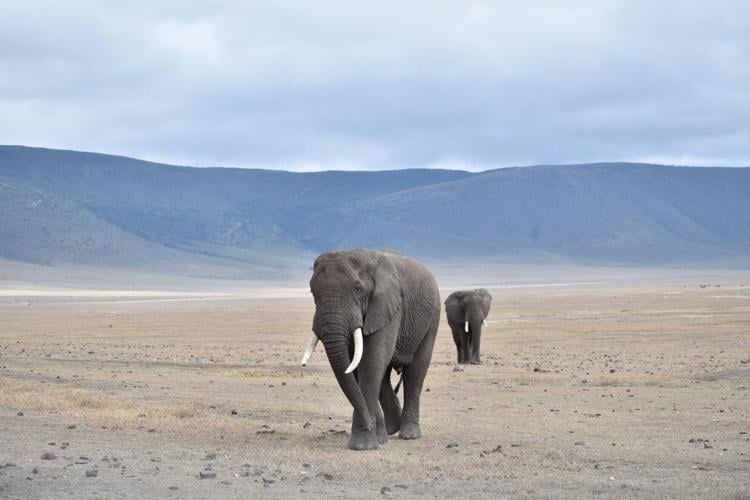
Then came the elephants. Hamis mentioned there were millions of elephants across the region, and judging by that afternoon, I was convinced we’d seen every one of them
Herd after herd emerged from the baobab-dotted landscape. Mothers guided their calves with quiet vigilance, while massive bulls stood beneath ancient trees, feeding in calm solitude. At one point, an adolescent bull charged our Land Rover, not once, but twice.
Hamis remained completely at ease. “He won’t hurt us,” he said with a slight smile. “He’s just showing us who’s boss.”
The birdlife was just as remarkable. Superb starlings shimmered with iridescent blues and greens. Guinea fowl hurried across the road in tight formations, while European rollers flashed brilliant turquoise overhead. Secretary birds strode through the grasslands with deliberate precision, and spurfowl added bursts of color to the ever-changing scene.
Let sleeping buffalo lie
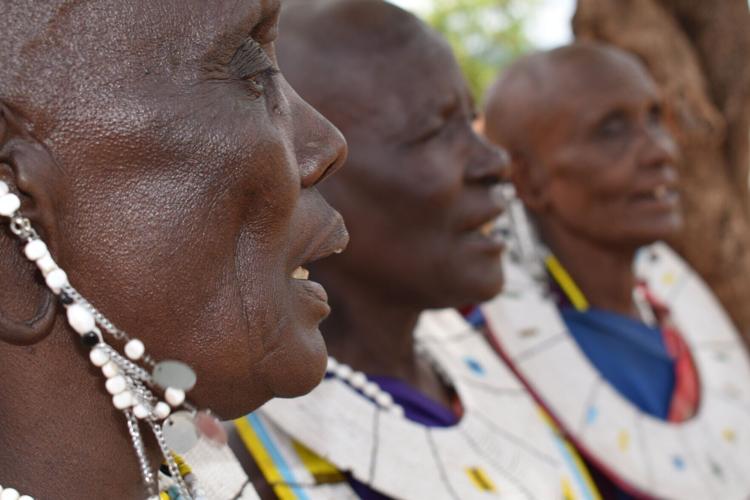
After a visit to a Maasai village, we arrived at Tarangire Treetops as the late afternoon light turned the savanna into a sea of gold. The lodge rose seamlessly into the surrounding forest, with elevated suites nestled among baobab trees and connected by wooden walkways. From my private deck, I could see across the park while listening to distant wildlife and the constant hum of nature.
The next morning began before sunrise. As we set out, Hamis tempered expectations. “Leopards are very secretive,” he said. “Not everyone sees one.”
We had nearly given up hope when he suddenly spoke a single word, “Leopard.”
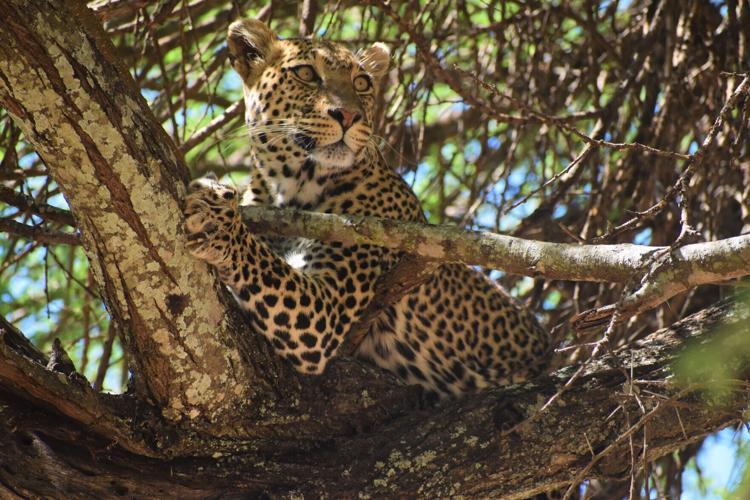
There she was, draped across the branches of an acacia tree, nearly invisible among the thorns. At first she appeared to be sleeping, but the faint click of cameras stirred her. She opened her eyes, stretched luxuriously and yawned with theatrical indifference. Then, with effortless grace, she descended from the tree and vanished into the grass without a backward glance.
That evening, back at camp, I was stopped on my way to my room.
“Miss Mary Ann,” the lodge manager said politely, “there is a herd of buffalo sleeping beneath your stairs. You’ll have to wait.”
So I did. For over an hour, I sat near the watering hole, talking with fellow guests as animals drifted in and out beneath the stars. Eventually, the all-clear was given, and I returned to my treehouse, still replaying the leopard sighting in my mind.
The cuddle puddle
The next day, we flew north to The Manor at Ngorongoro. The change in landscape was immediate. Tarangire’s dry savannas gave way to cool highland air and rolling hills covered in coffee plants. The Manor, set within a 1,500-acre estate, felt like an English country house transplanted into Africa, a place of quiet elegance before the drama of the crater.
The descent into Ngorongoro the following morning was unforgettable. Troops of baboons lined the road like a welcoming committee. As we made our way down into the caldera, our guide Adam pointed out that animals move freely between the crater and the Serengeti.
“This is not a closed system,” he explained. “It’s part of something much larger.”
Mist lingered over the crater floor when we arrived, gradually lifting to reveal a landscape teeming with life and eventually, the slumbering lions that had greeted us at the beginning of this journey.
The Serengeti comes alive
At Pioneer Camp, overlooking vast plains and distant kopjes, the landscape seemed to stretch endlessly. Though the main migration had moved north, remnants remained. On an afternoon game drive, we watched as a few zebras became dozens, then hundreds, flowing through a shallow gully like a living river. Wildebeest joined them, their movement stirring dust and sound into something ancient and unbroken.
We sat in silence, for it was not just the spectacle of the migration. It was continuity, something older than life itself.
That evening’s game drive brought one final surprise. Underneath an umbrella of acacias, a pride of 29 lions scattered across the grass in various states of rest and play. That was more than double what we had seen in Ngorongoro. Cubs tumbled over one another while adults lay snoring.
“I never thought I would be this close to so many lions,” Peder stated.
On my last night, I chose to dine alone under the constellations of the vast African sky. The sounds of the wilderness carried across the darkness, just a chorus of roars, whoops, and distant calls. Then came a sharp, piercing scream. At first, it was dismissed as baboons.
But moments later, a leopard emerged from the shadows, passing just feet away. She moved with absolute confidence, glancing at us only briefly before disappearing into the night.
By morning, our SkySafari adventure came to an end. As the twin-engine plane lifted off the red earth and banked over the endless plains, I looked down at a landscape that seemed unchanged since the dawn of time. Herds of zebra traced faint paths across the grasslands. Elephants moved like gray shadows beneath scattered acacias. Somewhere below, lions slept in the shade, leopards disappeared into the trees and the great migration continued its timeless march.
What stayed with me most was not a single sighting but the realization that for one extraordinary week, I had not simply observed Africa. I had been immersed in it, and that is the untold truth of such a journey. You never leave it entirely behind, and it never quite lets go of you.
If you go ...
SkySafari Tanzania offers packages that combine flights, accommodations, game drives, meals, beverages and many activities. Visit www.skysafari.com or www.elewanacollection.com.
Most international travelers fly into Kilimanjaro International Airport (JRO) near Arusha. From the United States, convenient one-stop connections are available via KLM (through Amsterdam), Qatar Airways (Doha), Turkish Airlines (Istanbul), Ethiopian Airlines (Addis Ababa) and Kenya Airways (Nairobi). SkySafari arranges all scheduled bush flights once guests arrive in Tanzania.
Passport and visa: A passport valid for at least six months beyond your arrival date is required, with at least one blank visa page. U.S. citizens need a tourist visa to enter Tanzania. The current fee is $100 for a multiple-entry visa. Travelers should apply online through Tanzania's e-Visa system, although visas are also available upon arrival at major international airports.
Health: Travelers arriving directly from the United States generally do not need proof of yellow fever vaccination. However, a yellow fever vaccination certificate is required if arriving from or transiting through a country with risk of yellow fever transmission.
Best time to visit: Wildlife viewing is excellent year-round. The dry season (June through October) offers outstanding game viewing, while January through March brings the wildebeest calving season in the southern Serengeti.
______


