
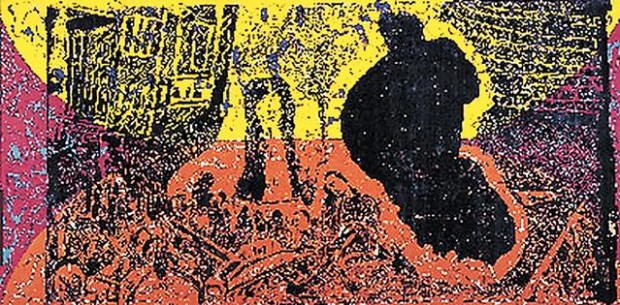
Steven Sles was 6 years old the first time he put charcoal in his mouth and began to draw.
"I had seen a woman painting with her foot," says Sles, 66, who was born with cerebral palsy.
Since then, his medium has varied from oils and casein to aniline dyes, silkscreen inks, and stained glass. His works include landscapes, the human figure and the abstract.
"I like to paint it all," says Sles, who lists Renoir, Monet and Picasso among his favorite painters.
A member of the Association of Mouth and Foot Painting Artists of the World, Sles has his works hanging in museums, galleries and private collections around the world.
But there will be no more. In 1985, he gave up the mouth painting because it was hurting his neck and back.
People are also reading…
"I had painted large works," he says, pointing to a painting at least 8 feet long leaning against a living room wall. "But even with the small works, you have to have greater control."
This is not to say Sles is no longer an artist. Far from it.
Besides his paintings, he has written thousands of poems since the late 1950s, and since the mid-1990s has composed and recorded music with the help of fellow composer Robert Prakash Rai.
"I call them tone poems," says Sles, who operates a synthesizer with his mouth and feet.
Born into a Conservative Jewish family in New Jersey, Sles was exposed at a young age to Manhattan's art galleries and museums.
When he was 6, his family rented a cottage on the beach at Provincetown, Mass. There, art students often sketched the family's picturesque rented cottage.
There is also where Sles first put charcoal to sketch paid. "I recall exactly when I put the charcoal stick in my mouth. Then I went to watercolors."
Painting with the mouth is the same as painting with your hands, he insists somewhat impatiently. "You shouldn't be curious about the mouth. You should be curious about the work itself."
After high school, Sles studied art at several institutions, including Bard College, the University of Madrid and Mexico City College, as well as at Swarthmore College, where he graduated in 1962.
But when you ask him who taught him to paint, he says he was self-taught. With painting, he says, he found "peace and harmony and everything unified. It's rhapsodic."
For the next 39 years, he painted and set up studios, first in Manhattan, then in Martinique, Paris and Cannes.
Then came Valencia, Spain, where he lived for eight years. It was there that he met his wife, Ana, a pre-med student who also studied classical ballet.
While the marriage did not last, it did produce a daughter, now 21.
In 1975, Sles came to Tucson for the warmth. Here, he continued his love for the arts, conceiving and helping to found Arts for All, which offers training in the arts, particularly for children with special needs.
His love of the arts — and life itself — remains constant. "I'm passionate about everything with all my heart and soul. My whole life is a prayer and a meditation."
These days, Sles is writing new poems and completing his memoirs.
He's also working on a new poem. "I had a 400-page poem on the community of life, the oneness, how everything is unified."
But with his new poem, he is hoping to be "less long-winded. I've set myself up a challenge for it to be 20 pages or less."
Asked if he's ever raged against the disease that put him in a wheelchair at age 20, Sles answers, "We're all formed physically as the Creator desires. Those who are aware of that have full lives."
As has he.
more info
For more information on Steven Sles, log onto his Web site at www.stevensles.8m.com/.