

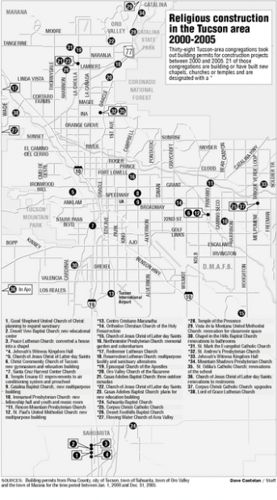
Religious groups in the Tucson area have spent at least $32 million on construction projects during the last six years, with most of the building concentrated among conservative Christian churches in outlying areas.
From 2000 through 2005, as the area population grew by about 115,000 people, local religious groups were issued building permits for 38 projects. Among those were renovations and additions, but also 21 brand-new churches and chapels.
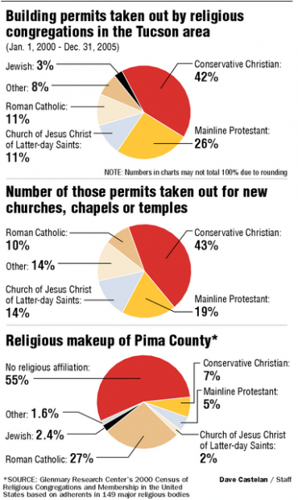
An Arizona Daily Star analysis of building permits shows the greatest number — 42 percent — went to conservative Christian congregations, while 26 percent went to mainline Protestant groups. The congregations that took out permits represent at least 31,000 worshippers.
"The area is growing, that's for certain. But I think a lot of what's happening with Katrina in Louisiana and other disasters around the world as well as things like the bird flu, it's got people interested in what this all means. They want answers," said Erwin Friedenberg, city overseer for the Tucson Jehovah's Witnesses.
People are also reading…
The Jehovah's Witnesses, counted in the conservative Christian category, accounted for two new churches, one in Sahuarita and one on the far East Side. Members say a third recently went up on the Northwest Side.
Jehovah's Witnesses, about 6,000 in the Tucson area, actually worship in what's called a Kingdom Hall. There are 15 Kingdom Halls in Tucson, and two more are planned for the near future — one on the West Side and one on the South Side.
Where information came from
The Star relied on data from building and planning officials at the city of Tucson, Pima County, the town of Sahuarita, the town of Marana and the town of Oro Valley.
The permits were for projects ranging from a renovation to include diaper-changing tables in the men's room at the Chapel in the Hills Baptist Church on the South Side to the construction of a $4 million, 20,000-square-foot church for the 600 worshippers at the fast-growing Oro Valley Church of the Nazarene, a conservative Christian church that began in a school in 1978. Twenty-one of the permits were for churches or chapels.
Eight of the 38 religious congregations did not disclose building costs, among them the Church of Jesus Christ of Latter-day Saints, which built three new chapels in the Tucson area during the last six years.
The greatest religious growth in terms of construction was concentrated in Sahuarita, Oro Valley and the Northwest Side.
Still, it's hard to make firm conclusions on what the construction indicates, said Mark Chaves, a professor of sociology at the University of Arizona who studies religious trends.
Churches follow people, and more new people are moving to outlying areas, Chaves said.
And though the data seem to indicate a rise in conservatives in the suburbs, Chaves said that may not be true. A 2000 national religious census conducted by the Nashville-based Glenmary Research Center said 7 percent of Pima County residents adhere to a conservative Christian faith, but Chaves believes that is an undercount. So the construction may reflect growth of existing population patterns.
The same survey said 5 percent of the local population adheres to mainline Protestantism, while the largest group is affiliated with no religion.
Some of the big projects
Among the largest local religious construction projects:
● A bigger, $5 million church for the 1,400 members of St. Andrew's Presbyterian Church, 7650 N. Paseo del Norte, on the Northwest Side. The new sanctuary opened Feb. 19 and seats 1,000 people, doubling the size of the old one. St. Andrew's is a mainline Protestant church.
● A $4.5 million project to build a new chapel and a two-story meeting space for youths at Casas Adobes Baptist Church, 10801 N. La Cholla Blvd., in Oro Valley. The buildings, to be constructed this year, will add to the vast Casas campus, built in 1999 for an estimated $23 million. About 4,000 people attend the conservative Christian church on a typical Sunday. Church leaders estimate the Casas community includes about 8,000 people.
● A $2.5 million project to build a gym, industrial kitchen and two-story education building for the 3,000 members of Christ Community Church of Tucson, 7801 E. Kenyon Drive, on Tucson's East Side. The non-denominational conservative Christian church is bustling with activities for its two dozen ministries seven days per week.
Diocese likely is held back
Roman Catholic permits accounted for 10 percent of the religious building permits — but the figure likely would be much higher had the local diocese not faced expensive litigation over cases of clergy sexually abusing children that led church leaders to declare federal bankruptcy protection in 2004. The diocese emerged from bankruptcy in 2005 but, as part of a deal with creditors, virtually all the property set aside for future parishes was sold, for $5.28 million.
"We will definitely have more than 74 parishes in the next five to 10 years. We could probably start two or three now if we had the land and the money," Bishop Gerald F. Kicanas said.
Roman Catholicism remains the largest organized religion in the Tucson area, including about 258,000 people, or 27 percent of the population. The Catholic churches issued building permits between 2000 and 2005 — Corpus Christi on the East Side and St. Mark the Evangelist on the Northwest Side — both are growing parishes with about 2,000 members.
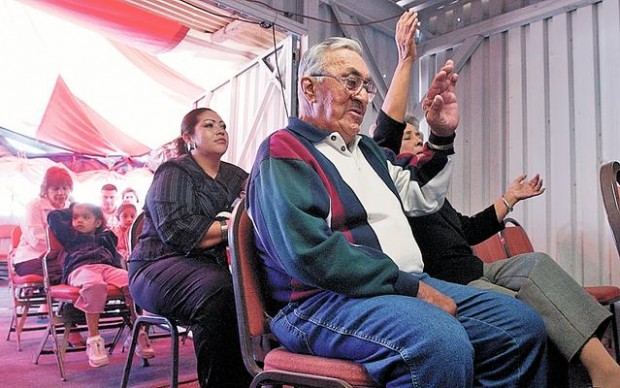
This weekend, St. Mark's began holding five Masses, up from four. Parishioners worship in a makeshift sanctuary fashioned from two mobile office buildings, and leaders say a capital campaign for a new church soon will be needed.
Corpus Christi already is holding a $5 million fund-raising drive to build a church. Its temporary church, built in 2001, will become a multipurpose building.
And St. Rita in the Desert Catholic Church, in Vail, earlier this year began building a $600,000 multipurpose building that will serve as a temporary church until a new one can be constructed. St. Rita's has about 500 families, which works out to more than 1,500 worshippers in a church designed to seat 115.
During weekend services, parishioners often stand outside. Some have stopped coming because of the crowding, pastor Bob Wicht said.
Tucson mainline churches gain
The Glenmary religious census showed socially and theologically conservative Christian churches nationally gained members between 1990 and 2000 while the theologically liberal mainline Protestant churches showed a decline. The Star's analysis indicated mainline Protestantism is faring much better in the Tucson area.
"Many of our new folks are not Lutheran in background. The denomination doesn't make as much difference as it did in the past — that's our experience," said the Rev. James Vadis of Resurrection Lutheran Church in Oro Valley, a mainline Protestant congregation of about 1,300 that in 2003 completed a $1.6 million renovation.
Yet surveys indicate a less rosy picture for organized faith: The number of people in the United States who claim no religious affiliation doubled from 1990 to 2000 and now is estimated at 30 million Americans.
"Overall, nationally, no religion is keeping up with the population growth," said Scott Thumma, a religion sociologist at the Hartford Institute for Religion Research in Connecticut.
"Pretty much every religious organization is experiencing stagnation or some decline," he said.
The Glenmary religious census showed 55 percent of Pima County residents did not belong to any of the 149 major religious denominations that were part of its survey. The religious census provides data on Christian and non-Christian religious groups.
Like much of the western United States, Arizona has a lower number of church-goers than most other states, the study showed.
But several local religious leaders look at non-church- goers as a market to be tapped.
"Some people say they already have a relationship with God and they don't need the church. My response is that you might not need the church, but somebody might need you," said Dale Moe, senior pastor at Lord of Grace Lutheran Church on the Northwest Side, a mainline Protestant church of about 600 members that moved into a new, $900,000 building four years ago to accommodate growth. "We have to help people look outside themselves. That's why we have church."