
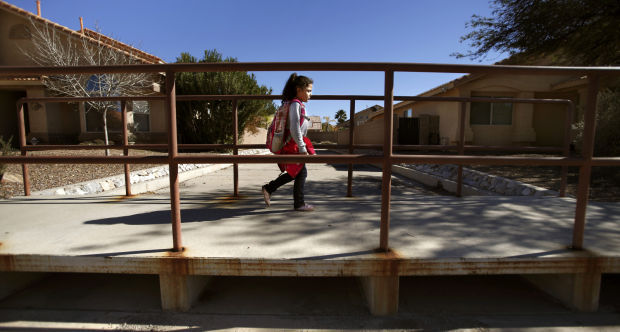
Kids of generations past rode their bikes, played outside with friends and walked to and from school on their own — without adults thinking much about it.
Many stayed out until sunset.
Today is a different story.
A mom in a suburban Maryland town recently made national headlines when a passerby called the police after spotting her two children, ages 10 and 6, walking home without an adult. Authorities escorted the children home and the parents were investigated by child protective services for negligence.
The incident has parents talking about if and when children should be allowed out of their parents’ sight. Some feel the kids need to be supervised at all times while others say independence is good for their confidence and teaches them responsibility.
“We absolutely do not allow our children to walk or play anywhere where a trusted adult cannot see them,” said Renee Duffin, a stay-at-home-mom of three. “I trust my oldest, (age) 8, 100 percent, but I cannot trust that strangers have good intentions 100 percent of the time.”
People are also reading…
The family has gone over stranger danger and emergency procedures, but, even so, there is fear of something going wrong.
“I know that I would never forgive myself if something happened to my children when I wasn’t watching because I didn’t want to drive them or didn’t want to participate at the time,” Duffin said.
Tucson mom Rachael Blackketter says she allows her four kids — ages 10, 8, 8 and 7 — to venture out, as a group, but, with limits.
“They now walk to school and some friends’ houses without me,” Blackketter said. “I still don’t feel comfortable with them playing at the park alone, but they do ride their bikes around the neighborhood in groups without stopping to play at the park.
“I think we have to give them some age appropriate independence, but, it’s so hard to find ways for them to do so and be safe.”
Freedom to go solo depends on the kid, says Peter Staab, father of two.
“Although no one wants to admit it, some kids are more street smart than others,” Staab said. “I’d let my oldest do things I wouldn’t let my youngest do, even though they’re only a year apart.”
As a latch-key kid from second through sixth grade, Karin Christin Harmer remembers riding her bike a mile or so to her friend’s house, as well as playing in the woods alone in northern Virginia when she was a kid. Her parent’s biggest objection? All of the stray dogs she brought home.
Today a mother of a 7-year-old and an 11-month-old, Harmer is a fan of the “free-range kids” movement founded by Lenore Skenazy, who was criticized and called the “world’s worst mom” when she allowed her 9-year-old child to ride the subway alone in New York in 2008.
The movement and its supporters encourage parents to let their kids have experiences on their own. The idea is that to become street smart and self-reliant, kids need to spend some time doing things on their own, such as walking home from the park or school without their parents.
The kids in Harmer’s neighborhood ride bikes around the block together, and check in every couple of loops. Her 7 year old walks home alone from school some days.
“Her life is very controlled in many aspects, and we decided to give her this little bit of autonomy,” Harmer said.
Living in a community where the parents communicate helps put her mind at ease. “There are several neighbors on the street that are home working in their garages in the afternoon, that we know and they know our daughter, and I know they look out for her, too, as I often see her say ‘hi’ or pet their dogs. Then over the weekend, they tell me the funny things she says to them,” Harmer said.
The fears parents have tend to trickle down to their kids, and it’s impacts their childhoods, Harmer said.
“I know that the fear adults have has bled into the children as well,” Harmer said. “We are robbing them of their childhoods and I think that all this restriction is going to make children weaker and less self-reliant and confident as they get older.”
The “overprotective or helicopter parenting” trend is a natural progression as parenting trends have shifted from when people had kids out of necessity, rather than for joy and fulfillment, said Jess Herrera, mother of one.
“It’s natural society would take a different stance on how children should be cared for,” Hererra said. “Unfortunately, I think the trend in the last 10 years has taken a turn for the dangerous. Parents are now afraid to give their children any independence for fear of retaliation from others, that CPS will come and take their kids away.”
Hererra also supports free-range parenting, but with limits.
Her daughter is only a year old, but Hererra is already thinking about when she’ll start giving her freedom to do things on her own.
She says she can see her daughter walking home alone from elementary school if it’s within three to five blocks of their home, beginning in first grade.
But, when it comes to playing alone at a park, she doesn’t see that happening until around age 10.
“Ultimately, we want to raise our children to be independent, productive adults, rather than fearful dependents,” Hererra said.
“The only way kids will learn independence is by being given that opportunity to exercise it. The free-range kids movement does just that. And, interestingly, it’s basically what our parents did with us. It just didn’t have a name back then.”