

Classic cake-making calls for eggs, flour, butter and sugar. But some bakers are juicing up the flavor by throwing liquor into the mix.
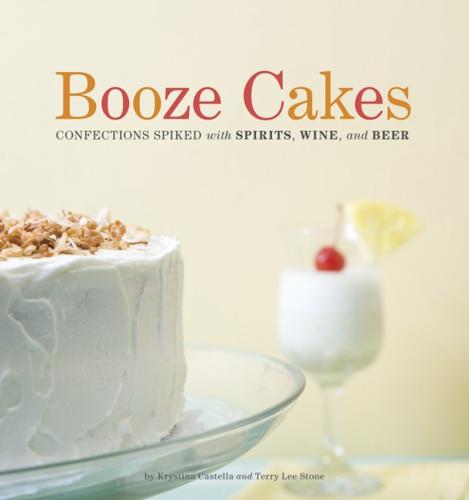
Or, as Terry Lee Stone, co-author of "Booze Cakes" cookbook puts it, "Baking is fun and drinking is fun - let's combine them!"
Stone and Krystina Castella, friends from teaching at a design college, started working on the book after Stone was inspired when making an old cake recipe of her mother's that called for adding alcohol.
"It was really important to us that you tasted the alcohol," Castella says. "When we first developed the idea, there really wasn't much out there. We found people adding different liquors and alcohols to food, but not much in baking."
The recipes they did find generally used liquor as a substitute for vanilla. "So we would find (recipes calling for) one teaspoon of rum. One teaspoon of rum is not going to really give it a rum flavor. You might need 1/4 cup of rum and then soak it in rum and having rum frosting."
People are also reading…
Castella and Stone have invited readers to explore variations on their themes and bloggers have enthusiastically taken to it, posting their results on the "Booze Cakes" Facebook page.
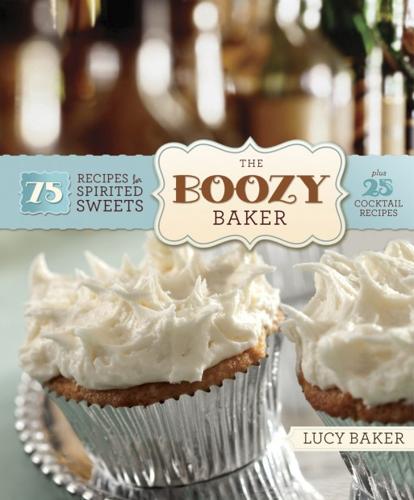
In fact, there seems to be a surge of interest in baking with libations. A second book, "The Boozy Baker," by the aptly named Lucy Baker, also was released late last year.
Baker sees a general trend toward slow-paced activities like baking that she views as a reaction to a high-speed, 24-7 world. "People are looking for ways to relax, to kick back, to reconnect."
Baker was inspired to try adding liquor while looking for something to do with a bottle of ouzo that ended up in her pantry. The anise-flavored drink worked surprisingly well in a cake, and soon she was "pouring in a little bit of this and a little bit of that into all my different recipes and finding that it really worked well."
Her book covers pies, cookies and other desserts as well as cakes, and recipes include a margarita meringue pie and Champagne layer cake. Among her discoveries, ginger liqueur goes great with peach and Port is surprisingly good with fruit.
In their book, Castella and Stone tackle a little chemistry along with confectionery, providing a chart on how much alcohol is likely to remain in cakes depending on how large they are and how long they bake.
Cooking with liquor is something that French pastry chefs have done for years, notes cookbook author Dorie Greenspan, whose latest is "Around My French Table."
Online:
• The Boozy Baker: www.abookintheoven.com
• Dorie Greenspan: doriegreenspan.com
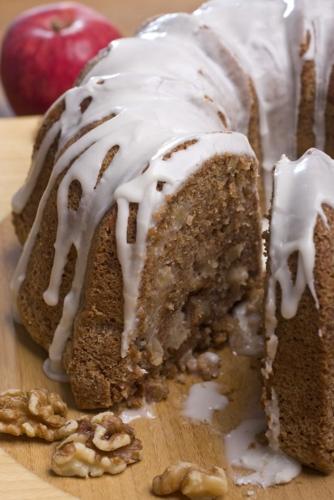
Brandy Apple Chai Cake
Servings: 10
For the cake:
• 1 1/2 cups canola oil
• 2 cups sugar
• 3 eggs
• 2 1/2 cups all-purpose flour
• 1/8 teaspoon ground cloves
• 1 1/4 teaspoons cinnamon
• 1/2 teaspoon nutmeg
• 1 teaspoon baking soda
• 3/4 teaspoon salt
• 1 1/4 cups walnuts, coarsely chopped
• 3 1/4 cups apples, peeled, cored, and chopped
• 1/4 cup brandy
For the chai glaze:
• 2 cups powdered sugar
• 1/4 Voyant Chai cream liqueur OR 2 tablespoons heavy cream mixed with 2 tablespoons chai concentrate
Heat the oven to 325 F. Coat a 10-inch Bundt cake pan with cooking spray and flour (or baking spray).
In a large bowl, use an electric mixer to beat the oil and sugar until thick and smooth. Beat in the eggs one at a time. Mix in the flour, cloves, cinnamon, nutmeg, baking soda and salt. Stir in the walnuts, apples and brandy. Pour into the prepared pan. Bake for 1 hour and 15 minutes, or until a knife inserted at the center comes out clean.
Let the cake cool in the pan for 10 minutes.
Meanwhile, prepare the glaze. In a small bowl, whisk together all ingredients.
Remove the cake from the pan by inverting onto a plate or platter. Pour the glaze over it.
Nutrition information per serving (values are rounded to the nearest whole number): 761 calories; 409 calories from fat (54 percent of total calories); 46 g fat (5 g saturated; 0 g trans fats); 69 mg cholesterol; 85 g carbohydrate; 7 g protein; 3 g fiber; 166 mg sodium.
Recipe adapted from Krystina Castella and Terry Lee Stone's "Booze Cakes," Quirk, 2010
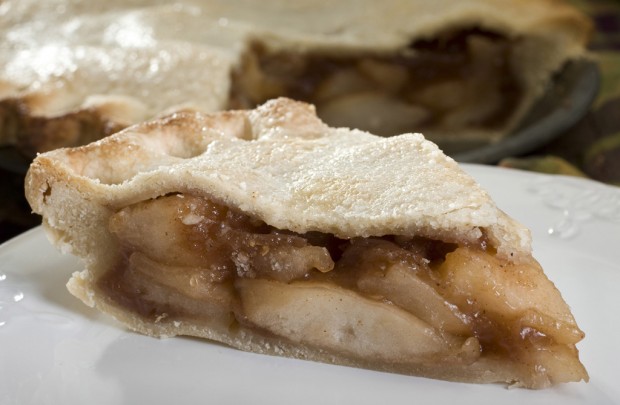
Hard Cider Apple Pie
Servings: 8
For the crust:
• 2 1/2 cups all-purpose flour
• 2 tablespoon granulated sugar
• 1/2 teaspoon salt
• 3/4 cup (1 1/2 sticks) unsalted butter, well chilled and cut into 1/2-inch cubes
• 1 tablespoon vodka
• 6 to 8 tablespoons ice water
• 2 tablespoons heavy cream
• 1 tablespoon raw sugar (optional)
For the filling:
• 2 1/2 pounds (about 5 medium) Granny Smith apples, peeled, cored and cut into 3/4-inch slices
• 2/3 cup plus 2 tablespoons hard cider, divided
• 1/3 cup packed dark brown sugar
• 1/3 cup granulated sugar
• 3/4 teaspoon cinnamon
• 1/4 teaspoon nutmeg
• 1/4 teaspoon salt
• 3 tablespoons cornstarch
• Zest of 1 lemon
To make the crust, in a food processor combine the flour, sugar and salt. Give it a few good pulses to combine. Add the cubes of butter, a few at a time, and pulse until the mixture looks like wet sand. Add the vodka and then the ice water, a tablespoon at a time, and pulse until the dough comes together in large clumps. Gather the dough into a ball and divide in half. Flatten each half into a disk, wrap tightly in plastic wrap, and chill for 30 to 60 minutes.
To make the filling, in a large saucepan over high heat, combine the apple slices, 2/3 cup hard cider, the brown sugar, granulated sugar, cinnamon, nutmeg and salt. Bring to a boil and cook, stirring often, until the sugar has dissolved and the apples are thickly coated, about 5 minutes.
Meanwhile, in a small bowl whisk together the remaining 2 tablespoons of hard cider with the cornstarch. Add the cornstarch mixture to the apples and boil for 1 to 2 minutes, or until the liquid is thick and clear. Remove from the heat, stir in the lemon zest, and allow the mixture to cool for 30 minutes.
Remove both halves of the pie dough from the refrigerator. On a clean, well-floured work surface, roll one disk of the dough into a 12-inch circle. Transfer it to a 9-inch pie plate. Pour the apple mixture into the crust.
Roll the second half of the dough into a 12-inch circle and transfer it to the top of the pie. Pinch the edges of the top and bottom crusts together. Trim any excess dough, leaving 1/2-inch overhang. Crimp the edges decoratively with a fork and cut three 2-inch vents in the center of the top crust. Transfer the pie to the freezer and chill for 1 hour, or until it is very cold and the crust is firm to the touch.
Heat the oven to 425 and arrange a rack in the lower third.
Brush the top of the pie with the heavy cream and sprinkle with the raw sugar, if using. Bake the pie for 20 minutes, then reduce the oven temperature to 375 and bake for another 40 minutes, or until the crust is golden and the filling is bubbling. If the edges of the pie brown too quickly, cover them with foil.
Cool the pie on a wire rack before serving.
Nutrition information per serving (values are rounded to the nearest whole number): 443 calories; 170 calories from fat (38 percent of total calories); 19 g fat (12 g saturated; 1 g trans fats); 51 mg cholesterol; 63 g carbohydrate; 5 g protein; 4 g fiber; 189 mg sodium.
Recipe from Lucy Baker's "The Boozy Baker," Running Press, 2010
