


OK, here's your trivia question of the day - what's the fourth most populous country in the world? Let's see, there's China, India, the United States, and … and … most people don't know, but if you answered Indonesia, with 240 million people, you're right.
I lived in Asia for a few years and we traveled a lot - even now we often go back. Every time the topic of where we're going comes up I always vote for Indonesia. Even at my young age I loved the diversity. One might be in a tropical paradise setting in Bali, or on the world's most heavily trafficked streets in Jakarta - it is all interesting. But, always the real draw for me when I'm going anywhere is the food - if it's really great - like it is in Indonesia - I eventually find a way to go.
One of the best eating experiences is authentic Indonesian food at a local restaurant with Indonesian friends. Before starting everyone first washes their hands in nearby sinks. The group then gathers around a large table where dish after dish appears - there may be 20 different dishes on the table - it is communal style eating where everyone shares everything - and everyone eats with their right hand. It's easy and fun and it is kind of a bonding experience - and best of all the food is absolutely out-of-this-world - Sate, Gado-Gado, coconut rice and on and on. There you are - food all over your hands - enjoying a wonderful festive camaraderie with friends - and eating some of the best food in the world. That's close to heaven.
People are also reading…
Indonesian Cuisine
Indonesian cuisine reflects the complexity and diversity of its past. In fact, there is not a single Indonesian cuisine, but instead, an array of regional cuisines formed by local Indonesian cultures and foreign influences. For example, Sumatran cuisine often shows Indian and Middle Eastern influences featuring vegetables and curried meats. Eastern Indonesian food more closely resembles Polynesian cuisine. Dishes such as bakmi (noodles), bakso (meat balls), and lumpia, originally from China, have been completely assimilated into Indonesian cuisine. Javanese food, on the other hand, is rather more indigenous.
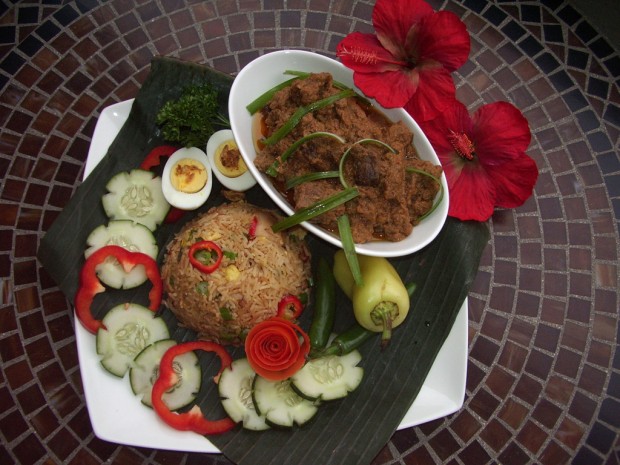
Rice is a staple throughout Indonesia and eaten as both a savory and sweet food. It is most often served as plain rice with a few meat, fish or vegetable side dishes. However, it is also cooked with coconut milk, steamed in banana leaves - or made into intip (rice crackers), desserts, vermicelli, noodles, arak beras (rice wine), and Nasi Goreng (fried rice). Nasi Goreng is omnipresent in Indonesia and considered a national dish.
Beef Rendang
Serves: 4-5
• 1 large onion. I use a combination of half a red onion and half a sweet onion, but whatever you have should be fine.
• 2 or 3 fresh Anaheim peppers. The traditional Indonesian Sambal chilies are hard to find, so I substituted some Anaheim's.
• Ginger root, 1-inch cut
• 4 cloves of garlic
•1 teaspoon turmeric
• 1 tablespoon hot paprika.
• 1/4 cup water
• 1 to 1 1/4 pound beef. A chuck or rump roast will do.
• Two 400 ml cans of coconut milk.
• 1 stalk of lemongrass, chopped finely
Chop the onion into wedges and seed the peppers. Place both into a food processor along with the ginger, garlic, turmeric, paprika and water. Blend until a nice paste is made.
Cut the beef into 1 inch cubes. Take half of the blended paste and combine with the beef in a bowl. Let marinate together for about 30 minutes.
Start the sauce while the meat marinates. Place the other half of the onion mixture into a large pan. Pour in the coconut milk and add the lemongrass, stir together and let simmer for about 30 minutes. After 30 minutes has elapsed, take the beef and marinade and combine into the coconut milk mixture in the pan. Combine well, stir occasionally and let cook for about an hour to and hour and a half, on low heat or until beef has become tender.
The dish should be nut brown in color when fully cooked and reduced.
Shrimp and Chicken Nasi Goreng
Serves: 4-5
• 2 cups cooked, cold basmati rice. I boil 3 cups of chicken stock and 1 cup of water, with 2 cups of basmati rice for about 20 minutes.
• 3 eggs, beaten
• 2 tablespoons butter.
• 1/2 large onion or 1 medium onion, diced
• 2 green sambal chilies. These are almost impossible to find in Tucson, so I just substituted 2 Serrano peppers. Seed and chop finely.
• 1 leek, chopped finely
• 1 teaspoon trasi, a dried shrimp paste used in Indonesian cooking, this can also be found at Lee Lee Oriental Market.
•2 cloves of garlic, minced
• 1 tablespoon vegetable oil
• 1/2 pound of 1 inch chicken cubes
• 1/2 pound shrimp. Any style shrimp will do.
•1 1/2 teaspoon ground cumin
•1 1/2 teaspoon ground coriander
• 1 tablespoon of Kecap Manis. This is a sweet Indonesian style soy sauce and can be found at Lee Lee Oriental Market
Cook the rice. Place cooked rice into the refrigerator until it is cold.
Using just a little bit of butter, grease a pan and cook the eggs, scrambled or into an omelet. Cut into pieces and set aside.
Place the 2 tablespoons of butter into a large pan or wok over medium heat. Fry the onions, chilies, leek, trasi and garlic together, until the onion begins to brown - about 8 minutes.
In a separate pan, heat the oil over medium to high heat, and brown the chicken. Cook for just 3 or 4 minutes; be careful not to burn the chicken.
While the onion mixture and chicken are cooking, take the rice out of the fridge and break apart with your fingers. Then add the rice, shrimp, cumin, coriander, Kecap Manis, and the chicken (with the contents of the pan) into the onion and leek mixture.
Mix well and fry until shrimp and chicken are fully cooked. Serve with the Beef Rendang and enjoy!
Michael Izzard is a 17-year-old junior at Ironwood Ridge High School. This will be his last column for the Star - you can catch him Sundays cooking at his family's restaurant, Izzi's Café, 12985 N. Oracle Road, Suite 165, in Oro Valley.
