

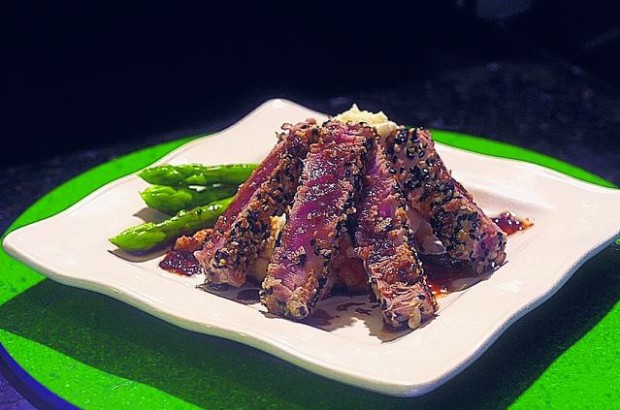
It wasn't so very long ago that most Americans thought tuna came only from a can, and that if they encountered rare tuna in a restaurant they'd send it back to be cooked some more. What a difference a decade or so makes.
Fresh tuna is now found on nearly every menu, grilled, pan-fried, poached, chopped into burgers or tartare — even transformed into upscale versions of good old tuna salad. This rich, beefy fish is popular even with diners who say they don't like fish.
For home cooks, though, fresh tuna can be a bit intimidating. It's pretty pricey, and without careful monitoring it can pass quickly from just right to overcooked.
But the price doesn't seem so bad when you consider there's no waste, no skin or bones, and that by paying attention, you can avoid overcooking.
It's best to remove the fish from the heat just before it reaches the desired doneness. It will cook a bit more in the retained heat, and undercooking is easy to correct. Cooked properly, the fish should have a deeply seared crust with a tender, moist, plum-red interior.
People are also reading…
Here are shopping and cooking tips:
• Like any fish, tuna should smell fresh, look translucent and be moist without being slimy, wet or sticky. Look for tuna steaks with a deep, beefy, red color. Any brown color indicates the fish is past its prime.
• If you like your fish medium or well-done, choose a thinner cut; for rare, pick a thicker cut.
• The best, and typically most expensive, tuna is center cut. Frozen tuna steaks are widely available and acceptable.
• You will probably find yellowfin or ahi tuna, big-eye or albacore. I prefer yellowfin for its sweet flavor and firm yet tender texture.
• If possible, cook the fish the day you purchase it. If you can't, fill a colander with ice cubes, set it in a bowl, cover with a piece of plastic wrap and lay the tuna on top. Cover with another piece of plastic and place in the coldest part of your refrigerator. Replenish the ice as needed and use within a day.
• Because tuna is not fatty, keeping its center medium-rare is important or the end result is an extremely dry piece of fish.
• An easy and delicious way to prepare tuna is to simply sear both sides. Tuna is also ideal for grilling — about 2 minutes on each side for a charred exterior and rare center.
• Asian flavors such as ginger are especially complementary to tuna in marinades and sauces.
Seared Sesame Tuna with Ginger and Garlic
Makes: 4 servings
• 1/4 cup black sesame seeds
• 1/2 cup white sesame seeds
• 4 (6-ounce) ahi tuna steaks, 1 inch thick
• 4 tablespoons canola oil (divided)
• Salt and freshly ground white pepper
In a shallow dish, combine the two types of sesame seeds and stir to mix.
Brush tuna with 2 tablespoons of the oil and season with salt and pepper. Firmly press tuna into the sesame seeds, coating evenly on all sides.
In a nonstick pan, warm the remaining 2 tablespoons oil over medium-high heat until very hot. Arrange the tuna in the pan, making sure not to crowd, and cook until the white sesame seeds start to turn golden, 1 to 2 minutes.
Carefully turn the tuna and cook for another 1 to 2 minutes. (The tuna will be rare. If you like it further cooked, place it in a preheated 350-degree oven for a few minutes.)
Transfer the tuna to a cutting board and cut into 1/4-inch thick slices.
Per serving: 508 calories (57 percent from fat), 32.5 g fat (3.5 g saturated, 15.6 g monounsaturated), 75.6 mg cholesterol, 46 g protein, 9.3 g carbohydrates, 3.4 g fiber, 1,022 mg sodium.
Jason McClain, chef-owner of 8 1/2 Restaurant in Miami Beach
Ginger Soy Dressing
• 1/3 cup soy sauce
• 1/2 teaspoon grated fresh ginger
• 1 teaspoon minced garlic
• 1/3 cup fresh lime juice
• 1 tablespoon canola oil
• 1 tablespoon chopped fresh cilantro
• Salt and freshly ground white pepper to taste
In a small bowl, stir together all the dressing ingredients. Serve immediately alongside tuna.