

Each January, Americans collectively atone for yet another celebratory season of indulgence. Some proclaim sobriety for “Dry January.” Others use the dawn of a new year to focus on other forms of self-improvement, like taking up meditation or a new skin care routine. But adopting a new fitness plan is the most popular vow.
Fitness experts insist that the best kind of exercise is the one you will do regularly – the one you can view as a joy, not a chore. And as more and more bespoke boutique fitness programs pop up, some devotees seem to take this advice even further. The notion that fitness is a religion – a place where people find community, ritual and ecstatic experience – has become a common refrain.
People are also reading…
Can fitness really be a religion? Given the difficulty of defining religion, it’s an almost impossible question to answer. Is religion about belonging? Transcendence? Feeling the divine? Is it scripture, traditions or creeds? Religions can have all of these traits, or none of them.
Perhaps the better questions to ask are why fitness and religion make such a potent combination, or why people see fitness as religious – ideas I explore in my research on CrossFit and SoulCycle.
 A studio set up for a SoulCycle event in New York City. Sean Zanni/Patrick McMullan via Getty Images
Working out with God
There is ample evidence of fitness trainers, influencers and companies unabashedly incorporating religious language, sentiments and practices into their exercise routines.
Take Peloton’s superstar cycling instructor Ally Love. A former theology student, Love offered sermonlike messages on topics such as accountability and selflessness, and occasionally played music from Christian artists during her weekly “Sundays with Love” rides, prompting some riders to argue that Peloton should label her content as Christian.
Then there are explicitly faith-based programs using fitness to enhance religious practice. The Catholic workout SoulCore integrates prayers of the rosary with core exercises, stretches and functional fitness movements to “draw others closer to Christ.” A “Neshama Body & Soul” class offered by a Conservative Jewish synagogue in Saratoga, California, meanwhile, combines prayers with jumping jacks, planks and lunges.
Religion, remixed
More common than traditionally religious fitness programs, though, are ones that borrow the trappings of religion and more subtly tap into spiritual experience.
SoulCycle, another iconic indoor cycling program, makes regular use of religious aesthetics, ritual and language in its classes. Instructors may talk about the cosmic energy radiating from the class or guide riders through opening their spiritual centers, or chakras. In candlelit rooms, instructors praise strong efforts by presenting selected riders a candle to blow out during the “soulful moment” of class. This soulful moment comes at the end of the 45-minute class arc, designed to deliver a breakthrough moment of spiritual or personal revelation and catharsis by combining the natural high of physical intensity with spiritualized self-help messaging.
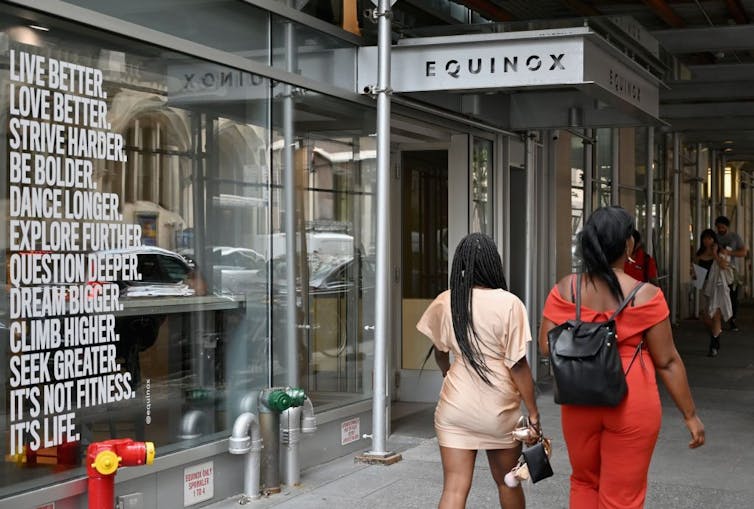 An Equinox fitness center in Brooklyn, New York. Angela Weiss /AFP via Getty Images
Other fitness trends, like CrossFit and the meetup group November Project, are less intentional about incorporating religious messaging. However, they’ve garnered reputations for being religious or cultish because of how intensely they foster community. Special jargon – like “WOD,” which stands for workout of the day – as well as annual activities and special commemorations like “hero workouts,” which honor people killed in the line of duty, solidify the religious comparisons.
CrossFit, in particular, has also attracted overtly Christian exercisers, with some of its most famous athletes publicly professing their faith.
Centuries of connection
To understand the relationship between fitness and religion, it helps to look at their history.
First, fitness itself is a relatively new concept. While there are certainly ancient accounts of sport and military training, the idea that one ought to exercise for health, enjoyment and community is a modern invention, a response to increasingly sedentary jobs and cultures.
But while voluntary exercise is new, intense physical regimens to connect with the divine are not. People have long experimented with ways to generate a sense of transcendence, to stir emotions, or to spur self-reflection through bodily discipline. The Siddhas, mystics in ancient India, developed unique physical practices in an attempt to achieve enlightenment, render the body divine and, ultimately, become immortal beings. Or consider 12th century Taoist ascetics who thought sleep deprivation could bring them closer to the truth. Catholic saints practiced self-mortification, such as wearing itchy sackcloth, to encourage humility and to create greater compassion for the suffering of others.
Religious fixations with the body highlight an abiding paradox: Many faiths view the body as a temple, but also a hazard to the soul. They teach that the body must be disciplined and tamed, yet honored as a conduit to the divine.
Training the body to move the soul along a path toward salvation did not disappear with modernization. Rather, movements like “muscular Christianity” arose at the turn of the 20th century, blending fitness and bodybuilding techniques with Christian piety. The YMCA, for example, opened gyms to train physical and moral strength in young Christian men. As religion scholar Marie Griffith writes, such movements reinforced a message that “fit bodies ostensibly signify fitter souls.”
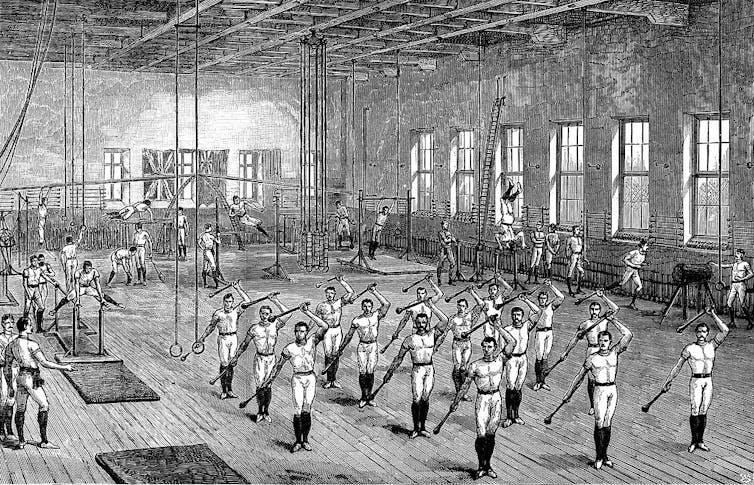 Wooden engraving of a Young Men’s Christian Association (YMCA) gymnasium opened in London in 1888. Universal History Archive/Universal Images Group via Getty Images
Evangelical sports ministries took off later in the 1950s, followed by the U.S. yoga boom in the late 20th century. Together, these developments underscored the enduring connection between flesh and spirit, and primed 21st century exercisers to readily accept spirituality as part and parcel of their fitness routines.
Shopping for fulfillment
This history is important, yet it is incomplete. Most journalists and cultural analysts who write about fitness as religion also cite the decline of traditional religious belonging as the reason people are finding spiritual fulfillment in other settings. People’s religious needs have not disappeared, they argue, rather they appear remixed and re-bundled for the modern secular consumer.
Fitness entrepreneurs use this explanation, as well.
“That stuff that happened on Sunday morning at church or in your synagogue is still important to human beings,” John Foley, founder and CEO of Peloton, stated in a 2017 talk. People want “candles on the altar and somebody talking to you from a pulpit for 45 minutes – the parallels are uncanny. In the ’70s or ’80s, you’d have a cross or Star of David around your neck. Now you have a SoulCycle tank top. That’s your identity, that’s your community, that’s your religion.”
As Foley’s quote highlights, the market is not only responding to people’s desire for ritual, guidance, spirituality, reflection – and even a sense of salvation. Rather, companies are also feeding into those desires, and helping to generate them.
Religious objects and experiences have long been available for purchase, but boutique fitness trends show today’s market logic at work: the idea that if you have a personal, spiritual need, there must be a product out there for it. Various seemingly secular companies have attempted to sell spiritual fulfillment, but few have been as successful as for-profit fitness companies that can capitalize on the long history of pairing the status of the body with the status of the soul.
The next time you hear a friend assert that fitness is their new religion, know that it might not be just hyperbole. Rather, it reflects how religious meanings attached to the body have endured, transformed – and are now available for purchase at the nearest fitness studio.
___
Cody Musselman does not work for, consult, own shares in or receive funding from any company or organization that would benefit from this article, and has disclosed no relevant affiliations beyond their academic appointment.
___
How to plan a year of wild human experiences, from Rio's Carnival to Nevada's Burning Man
Timkat Festival, Ethiopia

When: Jan. 18-19
What it is: For what feels like a step back in time, it's worth planning a trip to this centuries-old religious festival in Ethiopia at the start of the year. Celebrated countrywide by Ethiopian Orthodox Christians, Timkat commemorates the baptism of Jesus Christ in the River Jordan by John the Baptist through reenactment. The festivities begin with parades as Orthodox priests in colorful garments, complete with umbrellas and replicas of the Ark of the Covenant in hand, walk the streets as they chant and pray to the sound of traditional drums. The celebrations always take place near a main body of water — from a river to a pool — that is blessed before believers step into it as symbolic renewal of their baptism vows. The most popular cities for witnessing Timket are Addis Ababa, Gondar and Lalibela.
How far ahead you need to plan: Airfare and hotels book up quickly; Ethiopians expatriates tend to return for the yearend holidays and stay on for this vibrant festivity. Book your airfare and rooms at least six months in advance, or a package tour, to get the best rates.
How you get there: Fly into Addis Ababa Bole International Airport, which is well connected globally via Ethiopian Airlines and major carriers. Catch an internal Ethiopian Airlines flight to Gondar or Lalibela if you’re attending the festival in one of these smaller historic cities. A packaged tour is highly recommended so the logistics of the event will be worked out in advance, including airport pickup.
Where you should stay: In Addis Ababa, the Sheraton Addis Luxury Collection is a favorite. In Gondar, the hilltop Goha Hotel offers splendid views over the city, as does the Maribela Hotel in Lalibela.
Travel agencies that can help: Ethiopian Holidays by Ethiopian Airlines offers packages, or book through Absolute Ethiopia Tours.
La Tomatina, near Valencia, Spain

When: Aug. 30
What it is: This massive tomato fight is celebrated every last Wednesday of August in the small town of Buñol, approximately 25 miles west of Valencia, and dates back to 1945 even if its origin is unclear. By around 9 a.m., head to Buñol’s main square, where people begin to gather for a game of climbing a pole to grab the ham on top. If someone reaches it, the tomato fight begins; if no one does before 11 a.m., a cannon will fire and a truck packed with near-rotten tomatoes will dump them into the streets. People will jump into the trucks or stand around them, grabbing and hurling tomatoes at anyone they spot. Expect several hours of fruit flying about, as well as water hoses spraying the crowd. A final shot sounds to indicate the official end of La Tomatina.
How far ahead you need to plan: Hotels sell out early for this popular festival, so you’ll want to book rooms in Valencia — close enough for a day trip. The same goes for tickets to enter La Tomatina: Admission is capped at 20,000 participants, so keep an eye on the website and purchase online as soon as they’re released. How you get there: A day trip to Valencia by train or bus can have you back in the afternoon; you can opt for transport to be included in your ticket. For a fuller experience, you could stay in Buñol for a few days to witness the related festivities, including a paella competition — after all, Valencia is the dish’s birthplace—on the eve of La Tomatina. Your children could join a 40-minute kid version of La Tomatina, which takes place a week earlier. An after-party follows La Tomatina, if you’re still looking for one.
Where you should stay: The historic beachfront Hotel Las Arenas Balneario in historic Valencia is a popular pick that would let you indulge at its sprawling spa after the fruit throwing, or take a beach walk or poolside nap. The hotel is a short walk from the city’s central Old Town. Also in Valencia, Palaioi Valler is a former 19th century mansion-turned-glamorous 31-room hotel that’s home to a bar-museum paying homage to the city’s craftsmanship in glass and ceramics and offering a rooftop view of the city.
Travel agencies that can help: Totally Spain.
Día de Los Muertos, Mexico

When: Nov. 1-2
What it is: Mexico’s Day of the Dead celebrations are rooted in Aztec tradition and take place around the country, with Mexico City and Oaxaca topping the list of places to visit. This Unesco-recognized Intangible Cultural Heritage of Humanity is a time when Mexicans gather to celebrate the departed. Nov. 1 is for remembering departed kids, and Nov. 2 for the souls of adults, when families gather at cemeteries with offerings of flowers, music and food to honor loved ones who have passed away. It’s not a time of mourning or fear but focuses on color and joy in the memories that remain. Festivities begin a few days earlier with weekend parades, so come before Nov. 1. Expect to see and partake in the painting with make-up of sugar skulls and faces called La Calavera—an artistic rendering of your face to resemble a skull in celebration of the cycle of life and death—and witness altars decorated with candy skulls, marigold flowers and photos of loved ones and their favorite foods.
How you get there: Fly into Mexico City, or head to Oaxaca.Where you should stay: Stay at the St. Regis Mexico City or Quinta Real Oaxaca in the historic center.
Travel agencies that can help: Numerous tour operators offer group visits. Try Goway Travel for an agency or Travelworld International Group, a Virtuoso agency based in California.
