

Q: My porcelain doll is marked Florence Ceramics. It dates from 1954. I'm wondering if it's a collector's item and if it would sell for much.
A: Actually, the "doll" in your photo is a figurine and, yes, Florence ceramics are collected.
Started in Pasadena, Calif., during World War II, the company specialized in figures, all molded by the owner, Florence Ward. She became part of a lively California pottery industry made up of individual studios.
All Florence fancy ladies, gentlemen and figural groups were cast into molds she created, and then hand-decorated. Many were embellished with handmade ceramic flowers.
"The Florence Collection," identified by a paper tag, included fictional characters, European royalty and subjects from paintings. The company also made busts, vases, smoking sets and a general line of ceramics. Production stopped in the early '60s.
People are also reading…
The reader tells us her figure is "Delia." Names were incised on the bottom. About 8 inches tall, the young woman wears a long Victorian coat and hat, and has her hands are in a fur muff. Colors are gray and pink. As all figures were individually hand-painted, "Delia" colors vary.
Along with all collectibles, the general figurines market has taken a hit. The pay-to-use database www.worthpoint.com shows that the same figure with a burgundy scarf and hat sold on eBay for $20.99 in 2008. In 2009, one brought $25.50. In the same year, two Florence figures, including "Delia," sold for $30. All figures were in perfect condition.
Here's a great example of how collecting works: A more unusual version of "Delia" with one hand outside her fur muff sold for $51. Genre collectors always prize distinctive and less numerous versions. The figure also had a lot of painted gold.
Q: I was told that the parchment in these photos is from a monastic songbook from the Middle Ages. All the writing is in Latin. How can I sell it?
A: The pages are illuminated manuscripts. Most that survive are from the Middle Ages, though the type dates back to ancient Rome. During the Middle Ages, monks produced a variety of illuminations, including songbooks such as the reader's. Of course, quality and content varied.
Illuminated manuscripts combine text and hand-painted decoration, such as fancy initials and/or borders, as well as inset miniatures. The best are beautifully decorated with gold. Finely done pages of significant text are works of art that command serious money.
Smart collectors know that as far back as the Middle Ages, paper as well as parchment or vellum (both a mammal skin) was used for illuminated manuscripts and songbooks. The sheets need to be seen to determine composition.
One would think that anything dating from the Middle Ages would be hugely valuable. But loose pages of standard songbook parchment are not all that rare.
As with any item, value depends on what it is and condition. Looking at the photos, I see considerable damage. And the pages seem to have been glued onto a backing. Both are negatives.
Condition can be trumped if the item is a rare example of its kind. But here, the lone element of illumination is decorative initials.
Evaluation takes an expert. I suggest you start by viewing auction prices realized. Key "illuminated manuscripts" on the free site, www.liveauctioneers.com. We found that pages in top condition sold for $130 to $1,000. Top dollar went to superior examples.
Next, send photos or images to the auction houses that sold the pages shown. They'll tell you if the pages are sellable.
AUCTION ACTION
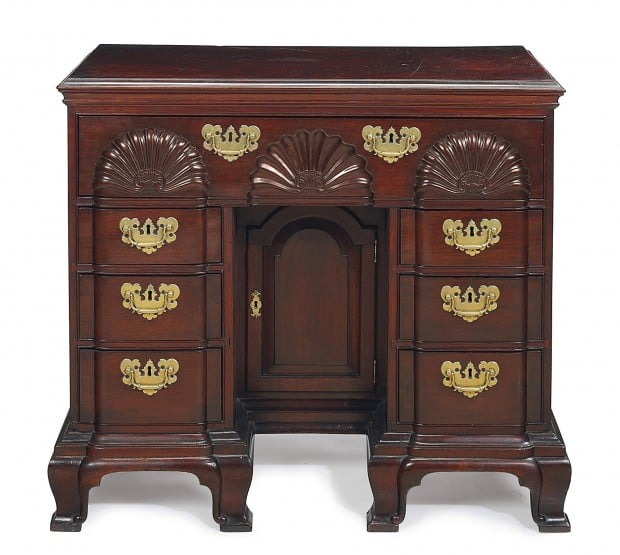
The 18th-century mahogany bureau table sold for $5.7 million at Christie's recently is one of the highest-priced pieces of furniture ever sold at auction.
The gavel actually dropped at $5 million. Add the buyer premium, a set percentage of the selling price, for an additional $682,500.
Known as the Catherine Goddard Chippendale Block-and-Shell Carved and Figured Mahogany Bureau Table, the piece is attributed to Newport, R.I., cabinetmaker John Goddard. A prime example of his work, the bureau is carved in classic Newport block-and-shell style. A handwritten label indicates the carver made the bureau in 1765 as a wedding gift for his daughter. It remained in her family until 1900.
Two top specialists in American furniture drove the price to the final bid. The best of its type, the bureau last sold at auction in 2005 for $940,000.
Collector Quiz
In Plains Indians lore, what do these names signify?
• Bad Leggings
• Tied in a Bundle
• Whistling Water
• Burnt Mouth
• Big Lodges
Source: "Plains Indians: Regalia and Customs," by Bad Hand (Schiffer, $49.99). It's a fascinating, illustrated exploration of societies and customs.
Answer: All are clans of the Crow.
Danielle Arnet welcomes questions from readers. She cannot respond to each one individually, but will answer those of general interest in her column. Send e-mail to smartcollector@comcast.net or write Danielle Arnet, c/o Tribune Media Services, 435 N. Michigan Ave., Suite 1400, Chicago, IL 60611. Please include an address in your query. Photos will not be returned.