

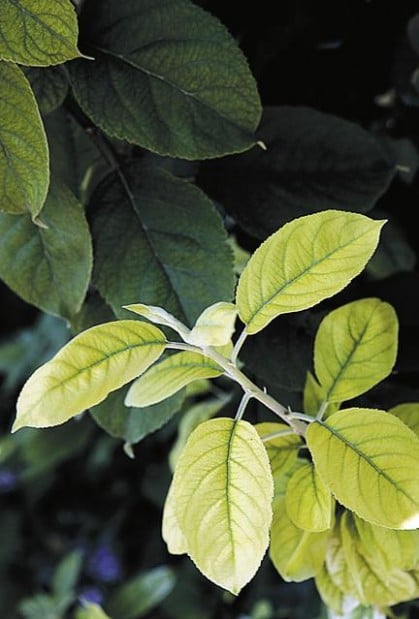
Iron deficiency is very common in our non-native plants here.
Roses, citrus, deciduous fruit trees, hibiscus, pyracantha, bougainvillaea and crape myrtle are just a few of the plants commonly affected by iron deficiency.
It's relatively easy to identify plants suffering from a lack of iron. The youngest leaves will be yellow to nearly buff in color, and in most cases the veins of the leaf will remain green. This pattern of green veins against a yellow background is very distinctive.
As the iron deficiency becomes more severe, the entire leaf may become a bleached-out white. Iron is a major constituent of chlorophyll, the green pigmentation in the leaf. It's chlorophyll that converts energy from sunlight to usable sugars and carbohydrates within the plant to sustain its growth.
It's important to remember that iron deficiency always shows up on the youngest leaves. Manganese deficiency (much less common) can mimic the pattern of green veins on yellow leaves, but with manganese the deficiency appears on the oldest leaves, not the youngest.
People are also reading…
Iron deficiency is most commonly a result of our highly alkaline desert soils and not a true lack of iron in the soil. With the lack of soil acidity, iron present in the soil cannot be dissolved in quantities sufficient for those garden and landscape plants adapted to acidic soils. Our desert plants are quite adept at getting the iron they need under alkaline soil conditions.
It's possible to make slight modifications to the soil to provide some acidity. Soil sulfur may be used to temporarily lower the soil pH (reading of acidity vs. alkalinity), but it must be mixed into the root zone to be of benefit. That's fine when planting new beds of flowers or vegetables, since the sulfur can be thoroughly mixed deep into the soil. That's not possible for established landscape plants.
So what's the solution? Adding chelated iron to the soil.
Chelated iron is a soluble form of iron that plants can absorb through their roots even in alkaline soils. Not all forms of iron sold in local garden centers and nurseries are chelated. Although these other forms, such as iron sulfate, are significantly less expensive, they just don't work in desert soils.
The most commonly sold form of iron chelate is Sequestrene 138. The package or container will advertise in bold print that the product contains chelated iron. Usually the type of iron, Sequestrene 138, will be listed in smaller print.
Iron chelate is mixed with water according to label directions and then poured into the root system of the plant(s) being treated. In most cases, a single application is sufficient to green up an iron deficient plant and keep it green all season long. More than one application can be made on stubborn plants that do not respond to the initial application.
It's rare to induce an iron toxicity from the overuse of chelated iron.
Applications can be made anytime during the warm months from April through September. Iron treatments during the winter months are not effective.
Diluted iron chelate can be sprayed directly onto leaves for a quick-fix but must be followed up with a soil application. To ensure thorough spray coverage on the leaf and prevent green spotting, add a few drops of liquid dish-washing detergent to the spray. This will spread the iron solution evenly out over the leaf and provide uniform greening.
● John P. Begeman is the urban horticulture agent for the University of Arizona-Pima County Cooperative Extension. If you have questions, call 626-5161 to reach a master gardener.
Gardening
Advice by John P. Begeman