

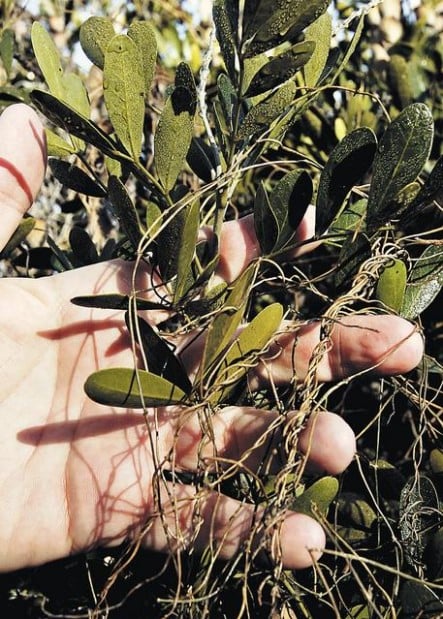
That strange mass of stringy yellow stuff growing across the ground and up onto your trees?
It's not something from a 1950s horror movie, but it is a parasite that can damage your landscaping.
It is dodder — not a common sight, but, like mistletoe, it does pop up from time to time in desert landscapes.
Unlike mistletoe, however, which sprouts from seeds deposited on branches by birds, dodder grows from the ground up — into the host plant.
Dodder is best described as thin yellow or golden yellow threads that grow over the ground and into the canopy of its host plant. Over time, it forms a thick mat of yellow strings twining in and over the leaves, stems and branches of its host plant.
Unfortunately, it's often not until the dodder has become well established that we discover it.
People are also reading…
Dodder is actually an annual plant that sprouts from seed in the ground during our summer monsoon season.
It has only a few days to find a host plant because it has no roots of its own and must live only on the food reserves of the seed.
Unless a host is found quickly, it will die.
If a host is found in time, the dodder grows into it, anchoring itself in place with haustoria — growth pegs that penetrate the stems to draw out water minerals and carbohydrates from the host.
Dodder's connection with the ground then is severed, and it continues growing by means of aerial stems, forming more and more haustoria to draw ever-increasing levels of nutrients from its host.
Dodder doesn't usually kill established trees and shrubs, but it does weaken them and stunt their growth — sometimes severely.
A problem of greater significance is the seed produced by dodder. It is spread by wind and water and establishes itself in surrounding areas of the garden and landscape.
You can't eradicate dodder in a host plant because pulling the threadlike vines out of the plant doesn't get rid of the haustoria embedded in the bark.
Even if all the vines were removed, the dodder would regenerate. But hand-removal of the vines does help to greatly reduce the amount of seed produced, thereby reducing its spread.
The most effective means of control is to remove the infested plants and make sure that newly sprouting dodder seedlings are pulled out before they find another host plant.
If pulling or hoeing dodder seedlings is not practical, spray them with household vinegar.
If dodder becomes persistent, the affected area can be treated with a pre-emergent herbicide containing trifluralin. Read the instructions carefully.
Apply it in late June, just prior to the monsoon, and again in late November, ahead of winter rains.
While we're on the subject of parasitic plants, let's talk about controlling desert mistletoe.
Like dodder, mistletoe cannot be eradicated in infested trees. It can, however, be managed by keeping the vegetative (visible) portion of the mistletoe cut.
That will minimize stress and strain on the host tree.
By cutting out, I mean cutting the mistletoe at its base where it emerges from the branch.
Do not gouge into the branch — it would cause further injury to the tree. And do not remove branches infested with mistletoe. The rooting portion of the parasite grows throughout the tree, so removing an individual branch or limb won't help.
Finally, don't wrap branches with plastic — black or clear — after cutting mistletoe off. Plastic doesn't prevent mistletoe regrowth, but the heat that builds up under the plastic does harm the branch.
A.E. Araiza / Arizona Daily Star
» Demo topic
"Growing Vegetables from Seeds and Transplants" will be the topic of this week's gardening demonstrations. Presentations are slated at 1 p.m. Wednesday at the Wilmot Library, 530 N. Wilmot Road, and at 1 p.m. Friday at Oro Valley Public Library, 1305 W. Naranja Drive.