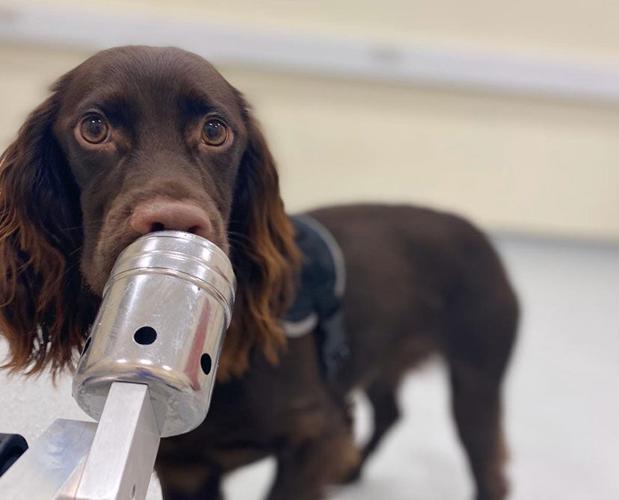
A dog’s nose is 50 times stronger than a human’s nose, which means they can pick up on a lot of things that we can’t.
There's now scientific evidence shedding more light on one of dogs' impressive skills in a long list of endearing traits: the ability to smell when you're stressed.
Dogs can smell the difference between odors from humans when they're stressed and when they're calm, according to a study published Wednesday in the journal PLOS ONE.
Earlier research found that canines may be able to smell when a person is happy or fearful, but this latest study eliminated other competing scents and measured its human participants' stress levels to increase the accuracy of the results.

Researchers first collected breath and sweat samples from study participants to use as a baseline. Afterward, these people performed a mental arithmetic task, counting backward from 9,000 in units of 17 in front of two researchers for three minutes.
People are also reading…
"If the participant gave a correct answer, they were given no feedback and were expected to continue, and if they gave an incorrect answer the researcher would interrupt with 'no' and tell them their last correct answer," said lead study author Clara Wilson, a doctoral candidate at Queen's University Belfast in Northern Ireland.
The study team collected another round of breath and sweat samples after the task was completed.
Additionally, the researchers collected reported stress levels, heart rate and blood pressure before and after the assigned task. Thirty-six participants who reported feeling stressed and had increased heart rate and blood pressure had their samples shown to the dogs.
The researchers presented post-task breath and sweat samples from one person to 20 dogs along with two other blank control samples. The canines needed to select the correct sample at least seven out of 10 times to move onto the next phase.
In the second and final phase, the study team showed the four dogs that passed phase one the same samples they sniffed in phase one along with a sample from the same individual collected before the task and a blank. Presented with these options 20 times, the dogs needed to successfully identify the original post-task "stress" scent at least 80% of the time for the results to be conclusive.
The dogs chose the right sample in 93.8% of the trials, which suggested that the stress odors were quite different from the baseline samples, Wilson said.
"It was fascinating to see how able the dogs were at discriminating between these odors when the only difference was that a psychological stress response had occurred," she said.

Twenty dogs were initially screened to find a stress sample among two blanks before the researchers added in a pre-stress sample.
Dogs have 220 million olfactory receptors compared with humans' 50 million, which makes canines "extremely effective at differentiating and identifying odors," said Dr. Mark Freeman, clinical assistant professor in the department of small animal clinical sciences at Virginia Tech in Blacksburg. He was not involved in the study.
Olfactory receptors are small nerve endings located inside your nostrils that allow you to smell, he said.
"While we can't know with certainty why dogs developed such keen olfactory senses, it is very probably related with the need to identify prey, potential threats, reproductive status, and familial relationships in a pack setting among others," Freeman said.
Twenty pet dogs were recruited from around Belfast, Northern Ireland, and four completed the entire study.
Most of the dogs failed to finish because they either showed signs of anxiety when separated from their owner or were not able to stay focused the entire time.
If the canines in the study were raised from birth with the purpose of sniffing out stress, more dogs would have most likely finished the study, he said.
There was a male cocker spaniel; a female cockapoo; male lurcher type, also known as a crossbred hound; and a female terrier type. Their ages ranged from 11 to 36 months.
All dogs have a strong sense of smell, but spaniels, terriers and lurchers would have likely used their olfactory receptors more regularly as hunting dogs, Freeman said. This could have been a factor in their success in the study, or it might be coincidental because other breeds like retrievers have excellent smelling skills as well.
Real-world implementation
Service dogs who assist people with mental health conditions like anxiety and post-traumatic stress disorder may benefit from these findings, Wilson said.
"Knowing that there is a detectable odor component to stress may raise discussion into the value of scent-based training using samples from individuals in times of stress versus calm," she said.
More experimentation needs to be done outside of a laboratory to see how applicable the results of this study are in the real world, Wilson said.
These findings also open the door to future research to investigate if dogs can discriminate between emotions, plus how long the odors are detectable, she said.
5 common dog myths and the facts behind them
Sniffing out the truth

There are countless myths about our pets — some so old they have become facts in the eyes of many people. While some of these myths are harmless, many are filled with misinformation about a dog’s care, temperament, behavior and intelligence. Pet owners who act on this misinformation may not be meeting the needs of their dog.
To separate fact from fiction, the American Kennel Club clears up some well-known myths about dogs.
Myth No. 1: A wagging tail means a happy dog

The truth: A wagging tail does not always mean the dog is happy. While a natural, midlevel wagging tail does indicate the dog is content, most other wags indicate the opposite.
A high, stiff wagging tail can be a sign of agitation in the dog, suggesting they are ready to protect something, while a low and quick wag may express the dog is scared and submissive.
Myth No. 2: Dogs age seven years for every human year

The truth: This myth has been around for so long most people see it as a fact. Although dogs do age quicker than humans, the 7:1 ratio is not perfectly accurate.
Dogs age faster when they are younger, and then the aging process slows down as they get older.
The size of the dog also plays a role in the aging process — larger dogs age faster than small dogs.
Myth No. 3: A warm nose indicates sickness

The truth: The idea that a dog in good health should have a cold, wet nose is nothing more than another myth. The temperature of a dog’s nose does not represent health or sickness. Using a thermometer is the only way to accurately measure your dog’s temperature.
Myth No. 4: Old dogs can’t learn new tricks
The truth: You can absolutely teach an older dog new tricks, like how to shake hands, speak or roll over. Keeping the training sessions short and fun while using plenty of positive reinforcement like treats and praise can help make the training process easier.
Myth No. 5: Dogs can’t see in color
The truth: At one point in time, it was believed dogs could only see in black, white and shades of gray. This myth is still believed by many people today. Dogs have fewer color-sensitive cones in their eyes than humans do. However, it has been discovered that although it’s not in the same way as humans, dogs can in fact see color. They can see blue, green-ish yellow and yellow along with various shades of gray.