

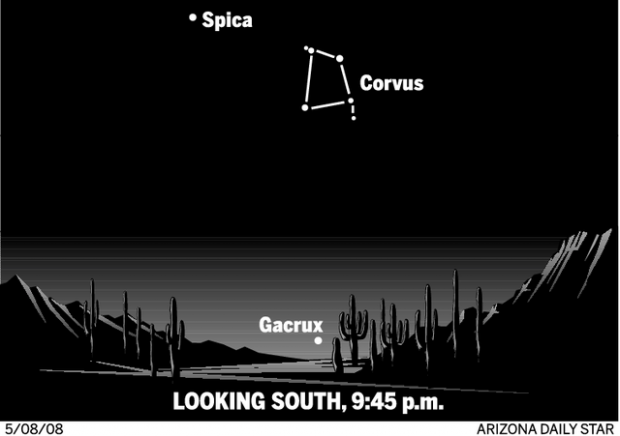
Crux, The Southern Cross, is a beautiful constellation with bright stars. It's so striking that it appears on a number of flags, including those of Australia, New Zealand and Brazil.
Unfortunately, it's too far south to be seen in the continental United States except from the Florida Keys and the southern tip of Texas where it is just visible above the southern horizon.
It is possible, however, to see the topmost star in Crux from Southern Arizona as it skims above the southern horizon.
It's a very bright red star called Gacrux, and I have seen it from Sonoita about a degree above the horizon. I first saw it in binoculars, but it is visible to the unaided eye if you have a very flat horizon free of clouds and haze on a dark night.
If you're up for a real challenge, give Gacrux a try in the next day or so while the moon is not very bright. In theory, Gacrux gets high enough to be seen from Tucson, but the city lights make it difficult to see. I recommend you go south of Tucson as far as possible and find a perfectly flat southern horizon.
People are also reading…
Gacrux is predicted to rise at 8:35 p.m tonight, reach its highest altitude above the horizon at 9:45 p.m. and set at 11:54 p.m.
Tim Hunter is an amateur astronomer. Contact him at skyspy@azstarnet.com.
Star party
Sharing the Sky Foundation Star Party and National Astronomy Day
The Tucson Amateur Astronomy Association, Flandrau Science Center and the local astronomical community will set up about 50 telescopes. You can look at the sun through solar-filtered telescopes during the day and see the moon, planets, galaxies and stars after dark.
There will be a kids corner with a lot of things to do, and you can informally rename a star.
• When: 3:30 to 10 p.m. Saturday.
• Where: University of Arizona mall and Flandrau Science Center, 1601 E. University Blvd.
• Cost: Admission is free, but donations help the Sharing the Sky Foundation's school outreach efforts.
"Every year we're there we have people who have never looked through a telescope before," said David Levy, who hosts the annual Sharing the Sky Foundation fundraiser with his wife, Wendee. First-timers have ranged in age from 3 or 4 up to 90.
The whole idea behind Saturday's event is to get people excited about the idea of looking through a telescope.
"It's a mixture of UA students, because we're at the UA, and families from the city so we get a lot of people," Levy said.
Saturn will be fun to look at on Saturday, he said, and kids will be able to look at the surface of the moon and pretend they are crawling up a mountain or into a crater.
Levy is one of the world's leading comet finders — he's discovered 22, so far. That includes one that will pass close to Earth in 2011, and Shoemaker-Levy 9, which collided with Jupiter in 1994.