

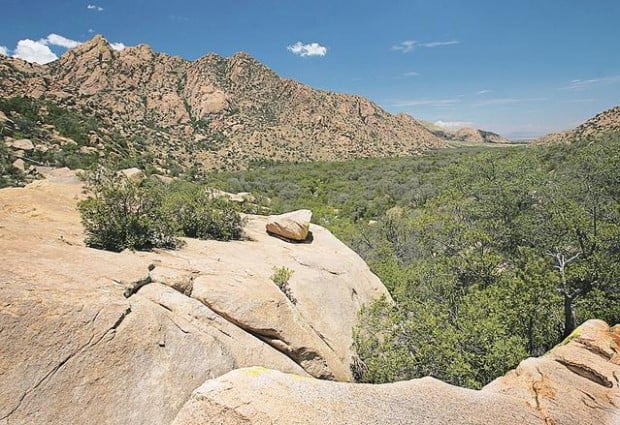
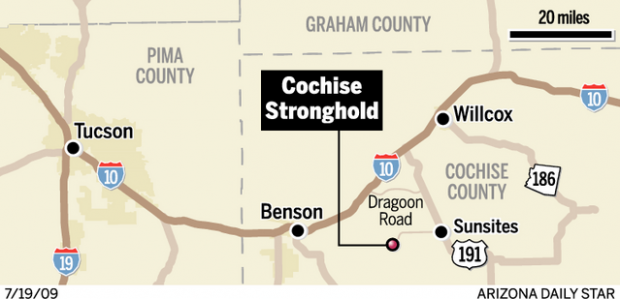
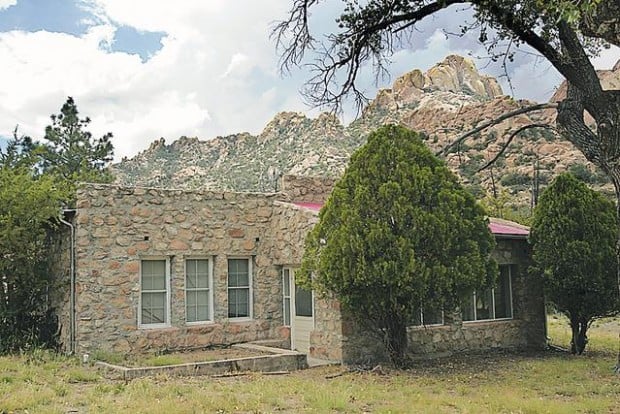
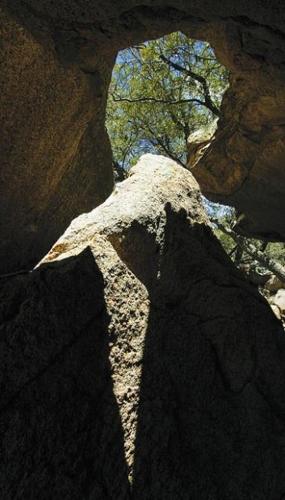
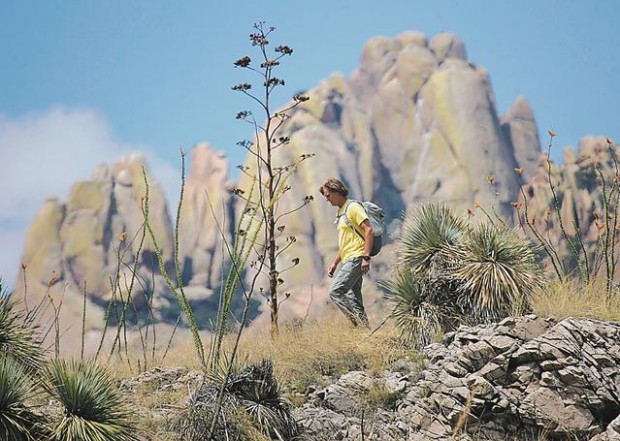
COCHISE STRONGHOLD — Cavalry troops who rode into this place back in the 1860s must have been tortured every hoofbeat of the way by one nagging thought: Ambush. • A wooded canyon hemmed by craggy cliffs, the site was a hideout and natural fortress for Apache leader Cochise and his warriors during a long conflict with U.S. forces. • Today, with the bloody battles long over, the Stronghold east of Benson is a prime destination for outdoor recreation. Hikers, rock climbers, bird-watchers, history buffs and people who just want to bask in a serene setting find a modern-day refuge in the Stronghold. • Other attractions at the site, about 80 miles from Tucson, include a historic, three-bedroom, stone-walled house that the U.S. Forest Service has opened to public rental.
— Doug Kreutz
COCHISE STRONGHOLD — Birdsongs waft down a wooded canyon at the foot of steep cliffs as Sue Senn and her two grandsons set off on a hike into a rich niche of history. • Their trek will take them into terrain used long ago as a sort of natural fortress by Apache leader Cochise and his warriors. The Apaches fought bitter battles with U.S. troops in the 1860s before reaching a peace agreement in 1872. • These days, for Senn and many other visitors, the Stronghold is a place for invigorating outdoor recreation and a self-guided history lesson in a spectacular setting. • Cradled amid the craggy granite domes of the Dragoon Mountains east of Benson, the site attracts hikers, rock climbers, bird-watchers, photographers and folks who like to learn about the past on location rather than merely reading about it.
People are also reading…
The Stronghold, about 80 miles from Tucson, is doable in a day trip. But if you're up for a more leisurely visit, lodging is available in two houses rented by the U.S. Forest Service and a private bed-and-breakfast lodge. See the "Bed down" section on these pages for details.
A Forest Service campground in the heart of the Stronghold is closed through next month. It reopens Sept. 1.
While the closure limits overnight options until September, it also brings the benefit of increased solitude in a normally more busy part of the Stronghold.
Visit the site in the next few weeks and you're likely to see lots of birds and some deer — and perhaps fewer hikers than normal. Be sure to comply with posted instructions for parking when your reach the closed entrance to the campground.
Wait until Sept. 1 or later and you could factor in a camping experience.
Glance around these pages for details on visiting this place of colorful history and natural splendor.
Echoes from the past
History buffs and others seeking a concise introduction to the area might begin a visit with a stroll around a short, self-guided, barrier-free History Trail.
Information panels along the trail offer a wealth of information on everything from prehistoric inhabitants to Cochise.
Some highlights:
• Early inhabitants, known as people of the archaic tradition, lived or passed through the area in the period from 9,000 to 1,300 years ago.
• Ancient Indians, perhaps similar in lifestyle to the Hohokam people who once occupied the Tucson area, lived in the Stronghold region from about A.D. 700 to 1400. Archaeologists believe they planted corn, beans and squash — and also hunted wildlife.
• Sometime after 1500, ancestors of the Chiricahua Apaches moved into the Southwest.
• A group of Spaniards traveled through the area in 1695 and called the Dragoon Mountains "sierra muy peñascosa" — very rugged mountains.
• Cochise was a member of an Apache band known as the Chokonen or "Tall Cliffs People." He organized a group of warriors in 1861 after being falsely accused of a raid. Battles with U.S. troops continued for about a decade. Cochise died in 1874, possibly as a result of stomach cancer.
• A man named John A. Rockfellow homesteaded in 1883 and made his home in the Stronghold for almost 50 years. A prominent rock formation called Rockfellow Dome is named for him.
The information panels also focus on the natural history of the area. A sampling:
• The rugged landscape was formed some 30 million years ago by tilting and uplifting of the Earth's surface.
• Terrain features include rugged cliffs, granite domes and deep canyons with hidden springs and streams.
Trek a trail
Hiking is a good way to get a feel for the Stronghold landscape — with routes ranging from the flat, easy History Trail to the more challenging Cochise Trail.
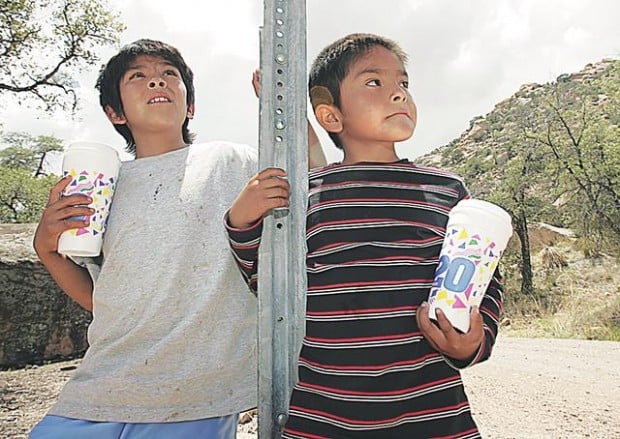
"Today, we're just going to hike along the creek up to where the big boulders are," said Sue Senn, who hiked the area recently with her two Hopi Indian grandsons — Hendrix and Myron Begoshytewa, 9 and 6 years old, respectively.
"We stopped and made offerings because these mountains are sacred," Senn said.
Stronghold trails include:
• The 0.4-mile Nature Trail, an easy route with signs identifying plants native to the area.
• The 4.5-mile Cochise Trail, which begins at an elevation of 4,920 feet. It climbs in its first three miles to a 5,960-foot pass linking the eastern and western flanks of the Dragoons — threading through forests of oak and piñon pine along the way. Some hikers choose to turn around at the pass. Others opt to follow the trail downhill on the other side to its endpoint.
The Nature Trail and the Cochise Trail begin at a shared trailhead at the edge of the Stronghold campground. When the campground is open, you'll pay a $5 parking fee. If you visit before the Sept. 1 reopening of the campground, follow parking instructions at the campground gate.
Climb a rock
The granite domes and steep cliffs of Cochise Stronghold offer beautiful, challenging climbing routes — but this isn't an ideal area for beginners.
Approaches to climbing sites can be difficult and confusing, and many of the routes call for well-honed technical skills. Be sure to make your first climbing visits in the company of experienced companions.
"Climbing in Cochise Stronghold is a truly amazing experience," said Luke Bertlesen, an expert climber who works at the Rocks and Ropes climbing gym in Tucson. "It offers a backcountry feel that is often lacking in some of the other busier areas such as Mount Lemmon. It's rare to see other groups, and this contributes to more of a wilderness feel in the area."
Bertlesen added that "the Dragoon Mountains also have a beauty and historical appeal not found in some of the other mountain ranges of Southern Arizona."
Among his favorite climbing routes in the Stronghold are ones named "What's My Line," "The Wasteland" and "Moby Dick."
An access trail to some climbing sites begins near the entrance to the campground. Even if you're not a climber, a hike of a half-mile or so up the trail will take you into prime Dragoon terrain and provide an overview of the Stronghold area.
Spot birds — or deer
Woodlands and cliffs in Cochise Stronghold provide habitat for a rich variety of bird life.
"It's a great place to go birding," said Matt Brooks, education outreach specialist for the Tucson Audubon Society. "The area has a good variety of birds, including the golden eagle. They probably nest in the cliffs higher up, and you certainly have a chance of seeing them."
Brooks said other birds winging around the Stronghold include acorn woodpeckers, Mexican jays, white-throated swifts and crissal thrashers.
Visitors often see deer along the main road into the Stronghold. It's not uncommon to come upon one or more of them bounding across the road, so drive slowly to prevent a collision.
Bed down
A campground in the heart of the Stronghold remains closed through August. When it reopens Sept. 1, camping fees will be $10 per night.
Lodging options in the area include two historical houses available for public rental from the U.S. Forest Service.
Kathy Makanski, an archaeologist with the Forest Service, says each of the sites — the Shaw House and the Half Moon Ranch — can accommodate up to 10 people. Both sites have corral space for up to six horses.
The rental fee for each house is $150 a night.
Reservations may be made one day to six months in advance online at www.recreation .gov or by calling 1-877-444-6777.
Another lodging possibility is the Cochise Stronghold Bed and Breakfast. For information or reservations, go online to www.cochisestrongholdbb.com or call 1-877-426-4141.
Amerind Museum
Some travelers bound for the Stronghold stop along the way at a museum of American Indian archaeology, art, history and culture operated by The Amerind Foundation.
To get there, follow the directions in the "If you go" section and watch for the museum along the Dragoon Road about a mile east of Interstate 10.
It's open from 10 a.m. to 4 p.m. Tuesdays through Sundays and closed on Mondays and major holidays. Admission is $5 for visitors 19 to 59, $4 for those 60 or older and $3 for youths 12 to 18. Kids 11 or younger get in free.
On StarNet: Check out more photos at azstarnet.com/slideshows
Did you know
An enduring mystery at Cochise Stronghold has to do with the final resting place of Cochise. Some historical accounts say the Apache leader's remains were hidden in a large, deep crevice somewhere in the Stronghold area — along with his horse, dog and rifle. But the accounts are unconfirmed, and there is no record that Cochise's burial site has ever been found.