

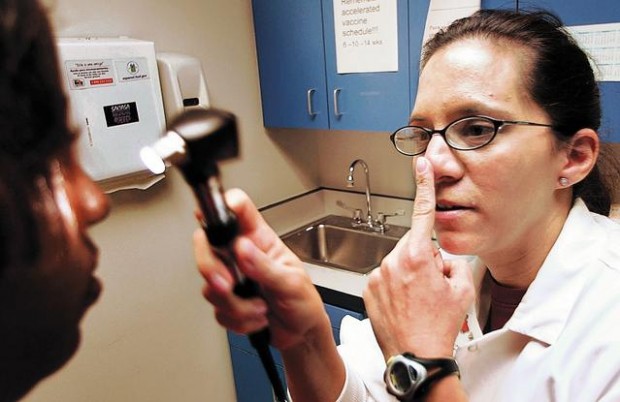
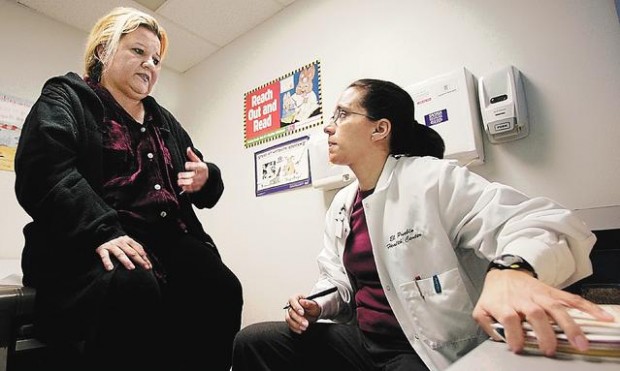
El Pueblo Health Center is trying to raise $1.5 million to help finance construction of a larger, more modern clinic to better serve South Side families.
For more than 30 years El Pueblo has provided free and low-cost health care to one of the poorest — and sickest — parts of the community.
El Pueblo patients live on median household incomes of less than $25,000 a year. And they are two to three times as likely to die from diabetes, heart disease and cancer as other county residents, according to the state health department.
Through most of its 34 years, El Pueblo has struggled to make ends meet. Six years ago, the clinic's financial and administrative problems threatened to close its doors for good.
But that was then.
In March, El Pueblo was designated a "federally qualified" health center — a label that opens the spigot on additional state and federal operating funds that could total close to $1 million a year.
People are also reading…
And with help from Congressman Raúl Grijalva, D-Ariz., who once served as El Pueblo's director, it received a $400,000 federal allocation toward construction of the new health center.
"El Pueblo sits in an area of town that has the neediest population," said Dr. Joy Mockbee, a family-practice doctor who trained at the University of Arizona and Harvard before becoming El Pueblo's medical director. "There's a big demand for our services.
"People come here because they want to do the best for their families. And they're always really appreciative of what we offer."
Dr. Laura Elias de la Torre, also a UA medical-school graduate and a Tucson native who grew up near Downtown, explained why she is drawn to El Pueblo.
"I feel the people on this side of town are valuable people who deserve good care, and I'm happy to provide it to them," she said.
Since 1983, El Pueblo clinic has been part of El Pueblo Neighborhood Center, 101 W. Irvington Road, near Old Nogales Highway. The neighborhood center is next to the Roy Laos Transit Center, making the clinic easy to get to for families who rely on the city's bus system.
A new senior center was dedicated earlier this month. A library, Department of Economic Security office and other services are all part of the neighborhood complex.
Diabetes — an epidemic among Hispanics and Indians of the Southwest — is the most common chronic disease treated at El Pueblo.
The health center also is a federal Superfund site that offers comprehensive physicals to people who lived, worked or studied in the area before 1982, when drinking water was found to be contaminated with TCE, an industrial solvent dumped there until the early 1980s.
One-third of El Pueblo's patients are uninsured, paying nothing or reduced fees, based on their income. Another 30 percent are covered by the Arizona Health Care Cost Containment System, the state health plan for the poor.
El Pueblo's four physicians and a nurse practitioner — two of them native Tucsonans — see about 1,000 patients a month.
The new health center will stand on the southwest corner of Nogales Highway and West Irvington Road and will be about twice the size of the current 5,000-square-foot clinic, which stands near the center of the neighborhood center complex.
El Pueblo needs up to $2.5 million to build the new clinic, but it has close to $1 million on hand. In addition to the $400,000 federal allocation, El Pueblo has $168,000 of its own money — including $42,250 from affiliated Marana Health Center — and $400,000 in loans from the state, the county and the National Council of La Raza.
A bulldozer has started leveling the site. Construction is expected to start next summer, with the new clinic ready to open in the fall of 2007.
Frank Hale, a former Peace Corps volunteer and a retired professor of family medicine at the UA, gave up retirement three years ago to head El Pueblo Health Center and help it get funding for the new clinic.
"It's a challenge to run a primary-care clinic in today's fragmented health-care system," Hale said. "I think it allows me to make a difference in people's lives by supporting these physicians who I think are probably the most caring and committed in the community. It's really a privilege."
El Pueblo's neighborhood compared to Pima County as a whole in percent:
Hispanics 79 32
Less than 9th grade 24 6 education
College degree 8 34
Uninsured 33 20
AHCCCS-enrolled 60 16
Average life 64 73 expectancy
Median household $24,900 $38,386 income
Arizona has designated El Pueblo a "qualifying charity" which means your donation of up to $200 will come back to you as a tax credit in your state tax refund. The tax credit can be in addition to school tax credits. Mail donations to:
El Pueblo Building Fund El Pueblo Health Center 101 W. Irvington Road Tucson, AZ 85714
● You can call El Pueblo at 573-0096 for more information.


