

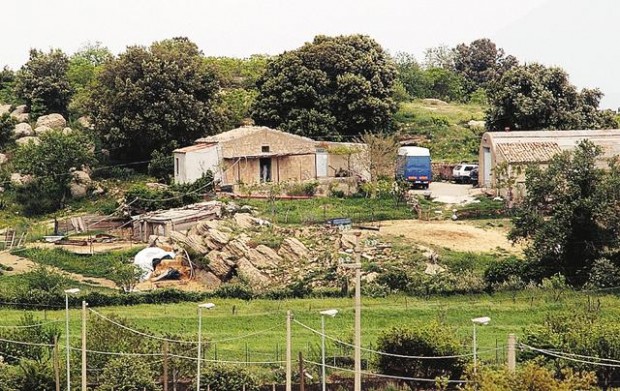
CORLEONE, Sicily — Decades before Mario Puzo borrowed its name for his novel about a ruthless Mafia family and Marlon Brando brought "The Godfather" to life with a throaty voice, Corleone — the town, not the don — had its own bloody story.
For generations, this medieval mountain town overlooking rolling fields where sheep and horses graze has been home to the murderous Corleonesi crime clan.
The capture this month of Bernardo Provenzano, reputed chieftain of the Corleonesi crime family and No. 1 boss of Cosa Nostra across Sicily, ended one shameful chapter in the town's life.
While breathing a sigh of relief over the arrest of "The Phantom of Corleone," many townspeople who share the steep, stony alleys with the wives, sons and daughters of Mafiosi expect another chapter in the town's real-life crime saga will inevitably be written.
People are also reading…
But young people say they have grown up without the everyday terror of slayings in the streets. "In our basic, everyday lives, absolutely nothing changed" with the arrest, said Maria Laura Di Palermo, a 23-year-old Corleone native and university student.
"I grew up with an anti-Mafia culture," she said, referring to a rebellion, mainly by young people, against Cosa Nostra — a movement sparked by the 1992 killings of Sicily's two top investigators of organized crime.
She was 10 in 1993, when Provenzano's predecessor as "boss of bosses," Salvatore "Toto" Riina, another Corleone native, was captured after 23 years as a fugitive. Then, students at Corleone's high school ran into the streets in joy and rallied behind a banner that read, "Finally."
Her mother, Maria Concetta Pinzolo Ventura, runs a bookstore filled with books about Sicilian food and the Mafia, including one volume with a photo of Brando on the cover.
At 53, she is old enough to remember the warnings of parents to come straight home after school or Saturday movie matinees. In the 1950s and '60s, Mafia rivalry in Corleone meant a killing nearly every day.
"You can image how happy we are" about Provenzano's capture after 43 years on the run, Pinzolo Ventura said. "We are very normal people. The name Provenzano only gave an ugly image to our town."
"If you lived here in town, you'd see we are normal people. The Mafia mix among us honest, kind, open people with a heart."
The son of a Corleone couple, Gino Felicetti, who grew up in England and returned some 15 years ago after marrying a woman from Corleone, said residents generally live in peace with the families of Mafia bosses.
"Provenzano's son, Angelo, is a very bright guy, very, very affable," said Felicetti. Both he and his brother, Paolo, who teaches Italian in Germany, are respected in town. Their mother "is very, very discreet, very polite," Felicetti said.
Felicetti works at Corleone's International Center for Anti-Mafia Documentation, which is associated with an anti-Mafia museum that opened in 2000.
Twice a week, the 40-year-old Felicetti takes U.S. tourists to see some of Corleone's 101 churches. In one hall decorated with photos of Mafia slayings, he speaks about Mafia folklore and reality. His most recent tour group wanted to know if Provenzano's capture ended an era of Mafia domination here.
"Absolutely not," he said he told them. "When the pope dies, you can always make another, and that way, the church stays on its feet," said a former Riina bodyguard, Gaspare Mutolo, who turned state's evidence.
Investigators say Cosa Nostra will eventually anoint a new "boss of bosses," and for the first time in more than 30 years, the new don may not be from Corleone. One contender is Matteo Messina Denaro, who comes from western Sicily and is considered the mob's No. 2. The other is Salvatore Lo Piccolo from Palermo, a fugitive who has been convicted of murder.
Felicetti estimated 10 to 15 percent of Corleone's population has Mafia ties. A smaller percentage, mainly Corleone's young people, are active in the anti-Mafia movement.
But "it's not about numbers. It's about power, a power to intimidate that basically forces people into a corner," Felicetti said.
Many townspeople lead lives that would be of little benefit to the mob. "The Mafia can't take advantage of them," and so these Corleonesi largely lead lives that don't overlap with Cosa Nostra, Felicetti said.
According to Italy's top anti-Mafia prosecutor, Piero Grasso, Provenzano was able to stay in his latest countryside hideout, receiving food and clean clothes, because he had connections in town, including relatives, friends and others.
For many older people, the influence of the Mafia runs deep in Corleone, although few are willing to talk freely.
"If the Mafia were simply a criminal organization, it would have been already defeated," said Dino Paternostro, an author and labor organizer. "The Mafia has insinuated itself" into economic and political power, he said, sitting on a shady bench outside town hall.



 Jim Click’s Tucson dealerships sell for $93 million


