
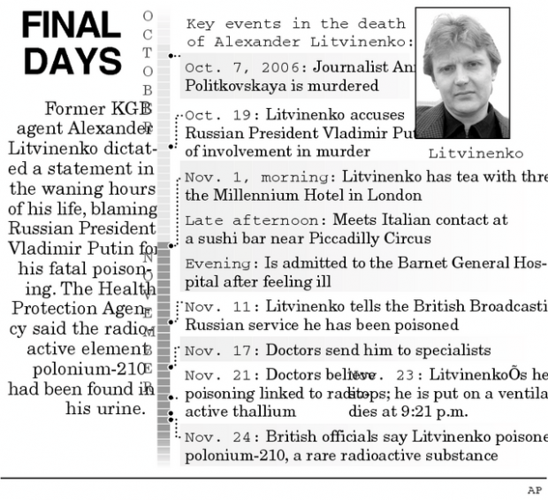
LONDON — He stopped at a bar to meet with a former colleague. Later, he rendezvoused with another contact. Sometime that day a few weeks ago, former KGB spy Alexander Litvinenko may have been poisoned.
Police now are tracing his final steps trying to determine how a rare radioactive substance could have killed the sharp critic of Russian President Vladimir Putin.
Authorities said Friday that radiation traces were found at the Millennium Hotel's Turner Bar near the U.S. Embassy in Grosvenor Square and the Itsu Sushi restaurant near Piccadilly Circus. Litvinenko had meetings in both spots Nov. 1, fell gravely ill and finally died late Thursday.
In a dramatic statement written before his death and released Friday by friends, Litvinenko called Putin "barbaric and ruthless" and blamed him personally for the poisoning.
People are also reading…
The Russian leader, in Finland, offered his condolences and denied any involvement. He called the release of the death-bed statement a "political provocation" by his opponents.
Litvinenko died at a London hospital after spending days in intensive care as doctors puzzled over what was causing his organs to fail and attacking his bone marrow and destroying his immune system.
Britain's Health Protection Agency said Friday the rare radioactive element polonium-210 had been found in his urine.
Police said they were treating the case as an "unexplained death" — but not yet as a murder.
Litvinenko, 43, who fiercely criticized Putin's government from his refuge in London since 2000, told police he believed he was poisoned while investigating the October slaying of Russian journalist Anna Politkov-skaya, another critic of Putin.
Litvinenko's statement, read by his friend Alex Goldfarb to reporters outside the hospital, put the blame for his death squarely on Putin.
He accused Putin of having "no respect for life, liberty or any civilized value."
"You may succeed in silencing me but that silence comes at a price. You have shown yourself to be as barbaric and ruthless as your most hostile critics have claimed," the statement said. "You may succeed in silencing one man but the howl of protest from around the world will reverberate, Mr. Putin, in your ears for the rest of your life."
Goldfarb said Litvinenko dictated the statement before he lost consciousness Tuesday, and signed it in the presence of his wife, Marina.
Putin strongly denied involvement by his government.
"A death of a man is always a tragedy, and I deplore this," the Russian leader said. Putin said the fact that Litvinenko's statement was released only after his death showed it was a provocation. "It's extremely regrettable that such a tragic event as death is being used for political provocation," he said.
At a meeting Friday with Russian Ambassador Yury Fedotov at London's Foreign Office, British diplomats asked Moscow to provide all assistance necessary to a police inquiry into the death, government officials said. Putin pledged to cooperate.
Home Secretary John Reid convened the British government's crisis committee Friday to discuss the death, a Cabinet Office spokeswoman said.
Experts said small amounts of polonium-210 — but not enough to kill someone — are used legitimately in Britain and elsewhere for industrial purposes.
Professor Dudley Goodhead, a radiation expert at the Medical Research Council, said that "to poison someone, much larger amounts are required, and this would have to be manmade, perhaps from a particle accelerator or a nuclear reactor."

 Japanese company invests in mine near Mount Lemmon