

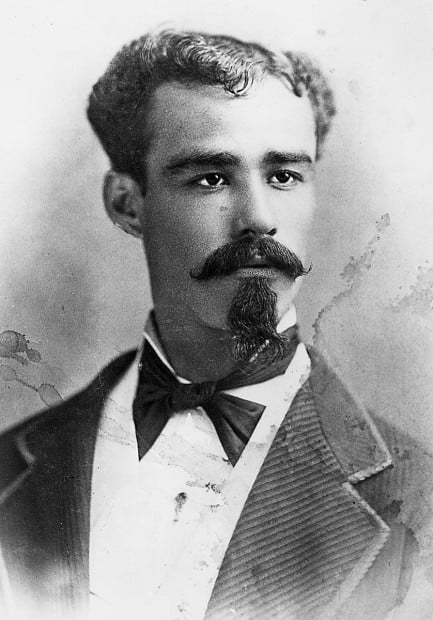
Editor's note: Today, writer and historian Jim Turner begins a monthly column about Tucson's early history with tales of pioneers, Spanish descendientes, unsung heroes, and even a few outlaws and journalists. Turner, who has lived in Tucson since 1951, retired from the Arizona Historical Society in 2009. He is now a freelance writer and lecturer.
If there had been cars back in 1872, Ignacio Bonillas' father's bumper sticker would have read, "My son is on the Honor Roll at Tucson Public School."
Decades later, Bonillas' named landed on the ultimate "honor roll" after he almost became another unfortunate dropout.
Bonillas was born in Mexico in 1858; his family moved to Tucson when he was 12. Neither of his parents knew how to read, but they wanted a good education for their children.
Although Tucson's first public school, run by Augustus Brichta, opened in 1868 and closed a few months later due to lack of funds, their timing couldn't have been better. Gov. A. P. K. (Anson Pacely Killen) Safford championed an education tax, which allowed Swiss immigrant John Spring to open a permanent school (for boys only) in 1872.
People are also reading…
The one-room adobe building on the northwest corner of Meyer and McCormick streets housed 120 rowdy boys of all ages, but the story has it that parents gave the teacher permission to punish their boys if they acted up.
Young Ignacio did well in school. Even though he didn't speak English when he got there, he worked with a private tutor and caught up quickly. So much so that when Gen. O. O. Howard , the officer who officiated the peace treaty with Cochise, offered two prizes for the best students in Tucson, Bonillas won them both.
His success was almost cut short, however, because his family did not have enough money to buy school supplies. But teachers hate to lose star pupils, so John Spring talked with Gov. Safford to see what could be done.
Safford offered to pay for the supplies, but Ignacio's father, Gervasio Bonillas, would not accept the charity. Instead the governor hired young Bonillas to care for his horses and do other chores around his office -something easy to do since the state capital was in Tucson from 1867 to 1877.
They became good friends, and only a few years later Ignacio Bonillas was hired as an assistant teacher at the school for $15 a month - good money back then. Since he was bilingual, he also contracted to translate documents. By the time Bonillas was 17, he was able to buy his own house.
In the meantime, Safford got the young Tucsonan an appointment to West Point. When he followed his father's wishes that he use his education to help the Mexican people, Ignacio then was accepted at the Massachusetts Institute of Technology (MIT) with the help of the governor. Although he did well in mining and geology classes, he had to drop out, once again because of finances.
When he left MIT, Ignacio became an assayer in Tombstone. He visited his old school in Tucson often and met the new schoolteacher, Elizabeth Borton, and her sister Mary. He married Mary Borton in 1885 and raised a family.
Bonillas used his education to become a mining engineer in Mexico, where he won the trust and respect of the Republic's leading businessmen and politicians. He was elected mayor of Nogales, Sonora, and joined Gen. Venustiano Carranza's army when the Mexican Revolution began in 1910 .
When Carranza became president of Mexico in 1917 , he appointed Ignacio Bonillas ambassador to the United States. He was also a major candidate for president of Mexico in 1920, but lost to Álvaro Obregón.
Bonillas loved learning and worked hard to get through school and go on to remarkably successful careers.
He died in 1942 and never knew of his lasting standing on Tucson's "honor roll." In 1953 , what's now called Bonillas Basic Curriculum Magnet School, at East Winsett Street and South Swan Road, was named after him.
The family legacy in the Tucson Unified School District includes Borton Primary Magnet School, named after his sister-in-law Elizabeth; John Spring Middle School (now closed) was named after his first teacher; and Safford Engineering/Technology Magnet Middle School was named for his old friend the governor, who married Bonillas' sister Soledad in 1881.
Contact Jim Turner at www.jimturnerhistorian.org


