

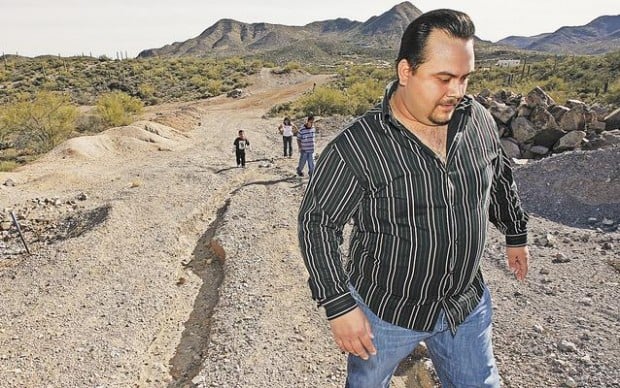
Look left and the saguaro-studded Tucson Mountains rise above you. Look right and Downtown peeks from behind a ridge.
Little wonder, then, that buyers snapped up 18 of the 21 lots at the Enclaves at Gates Pass. They paid around $200,000 each for improved lots, drew up house plans and waited.
Three years later, they're still waiting.
The developer never finished the roads and utilities, costs escalated, the developer declared bankruptcy, and now those property owners want Pima County to make it right.
It was Pima County that allowed lots to be sold without the roads and utilities. Instead, West Speedway Partners put up a $696,813 bond — essentially an insurance policy to cover the cost of the infrastructure. That's legal under county code, though not very common.
Only now, county officials estimate that completing the project could cost as much as $1.2 million. County officials say they are trying to collect from the developer and the engineer who did the original estimate.
People are also reading…
"Our preference is to arrive at a conclusion in which private funds can be found to complete the improvements," said county Development Services Director Carmine DeBonis.
Meanwhile the court-appointed agent in charge of restructuring the company wants the county to allow a second phase of the project, with an additional 19 lots, which could be sold to raise money to complete the first phase.
"Everybody's pointing the finger at everyone else, and nobody is thinking outside the box," said Reuben Grinstein, summing up the frustration felt by many property owners.
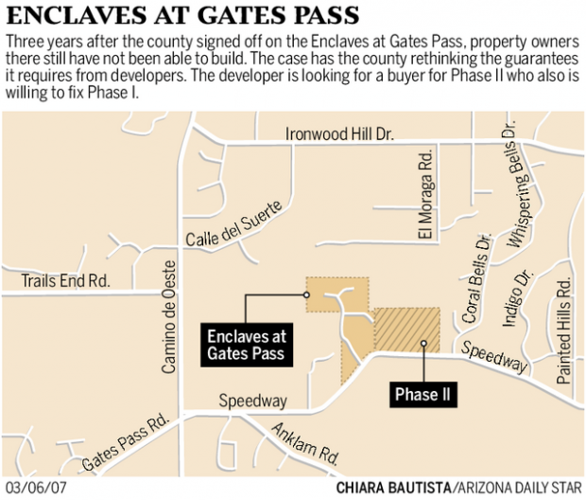
This is not the first time controversy has visited the 37-acre Enclaves, on West Speedway just west of North Painted Hills.
Back in 2001, neighbors opposed to the project said the access road encroached on a protected ridge. The Board of Adjustment agreed and the developer sued the county.
Under a 2002 settlement agreement, the county paid West Speedway Partners $50,000 for delays caused by the road fight, and condemned land on the west side of the property to make room for the road.
Finally, in 2004, the county signed off on the subdivision plan and accepted the bond in lieu of the actual roads and utilities being put in.
When Grinstein, a small-claims-court judge in Tucson, bought his lot in May 2004, he was assured the infrastructure would be done in a few months.
Tucson Water documents show an estimated completion date of September 2004. But work didn't even start until then.
Soon David Mason, the partner overseeing construction, was feuding with the contractor, M.L. Parkhurst Construction.
Mason did not respond to a request for comment made through his attorney. But property owners said Mason blamed the delays on the contractor, while the contractor blamed Mason for ordering the road recut after the utilities had already been installed.
In October 2005, Tucson Water called for the work to be redone after a city inspector found "serious deficiencies."
Lorenzo Hernandez, a construction section manager at Tucson Water, said water lines were too close to the surface, exposed pipe was sun-damaged, some connections weren't done properly, and electric and gas lines were too close to the water lines.
Hernandez also called county subdivision coordinator Deborah Marchbanks and told her not to allow the lots to be sold.
But it was too late. Most of the lots were sold months earlier.
Through it all, Mason reassured property owners.
"All I heard from him was excuses," said Jim Zubick, a small builder who bought two lots at the Enclaves. "All you had to do was go out there and see they weren't doing anything."
Javier Teran, a Tucson mortgage broker, was so certain the project was moving forward that he sold his West Side house and moved his wife and four children in with his parents to save money during construction of his dream home.
His family lived with his parents for almost a year before Teran decided the project was going nowhere. He started looking for another house but had to move out to Avra Valley to find something he could afford while still making the mortgage payments on his Enclaves lot.
Teran estimates he has $60,000 tied up in the lot, between his down payment and money he spent on plans, with nothing to show for it.
"The county needs to make this right," he said recently. "I don't understand why they don't just come in and do the work and then go after the developer."
Deputy County Attorney Lesley Lukash said the county cannot spend public funds to benefit private parties.
"We don't believe the county is obligated to construct the road at its expense," Lukash said. "It's a private road."
In August 2006, almost two years after the work was scheduled to finish, county officials decided to collect on the bond.
Then, in September, Mason accused the majority partners, Martin Collier and Albert Gersten II of California-based GC Enterprises Inc., of diverting $1.6 million from West Speedway Partners.
A Superior Court judge appointed a receiver to manage the company's affairs, but in December, West Speedway Partners — under the direction of Collier, not Mason — declared bankruptcy.
"This is in litigation, and there are a variety of matters in dispute," said Philip Rudd, an attorney for Collier and Gersten. "We don't feel it's appropriate to comment while it's in litigation. We disagree with much of what Mr. Mason says. His allegations are in dispute."
DeBonis said the county had no reason not to accept the bond back in 2004. It's been allowed in the county code since the 1980s, although most developers build their infrastructure before selling lots. The county is now reconsidering the practice.
Inflation accounts for some of the cost increase. So does having to redo previous work.
But DeBonis said the county also is looking beyond that, to the original engineer's estimate, and may pursue a claim against the engineer's insurance for errors and omissions.
The county also plans to file a claim in bankruptcy court for the difference between the bond and the cost of the work.
Keith Bierman of MCA Financial Group, West Speedway's chief restructuring officer, said completing the work at the Enclaves is his first priority.
West Speedway Partners owns another 28.5 acres just to the west of the Enclaves, where it started but never completed the platting process for the other 19 planned homes there.
Bierman said he wants to find a buyer for that land and either use the money from the sale to fix Phase I, or find a buyer willing to fix the first part of the project as part of the deal.
Bierman said he believes a buyer could be interested in taking responsibility for finishing the first phase, with all its problems, in order to maximize the value of the last 19 lots.
He said he hopes to have a plan approved by the bankruptcy court within 60 to 90 days.
Property owners said they have heard similar promises before. They have little choice but to wait and see.
This much they have learned:
"Don't buy the property until everything is completed and you can see it with your own eyes," said property owner John Harris. "That was our mistake. We bought in good faith."
"All I heard from (development partner David Mason) was excuses. All you had to do was go out there and see they weren't doing anything."
Jim Zubick, a small builder who bought two lots at the Enclaves




 Historic bank vault now new Tucson speakeasy

