

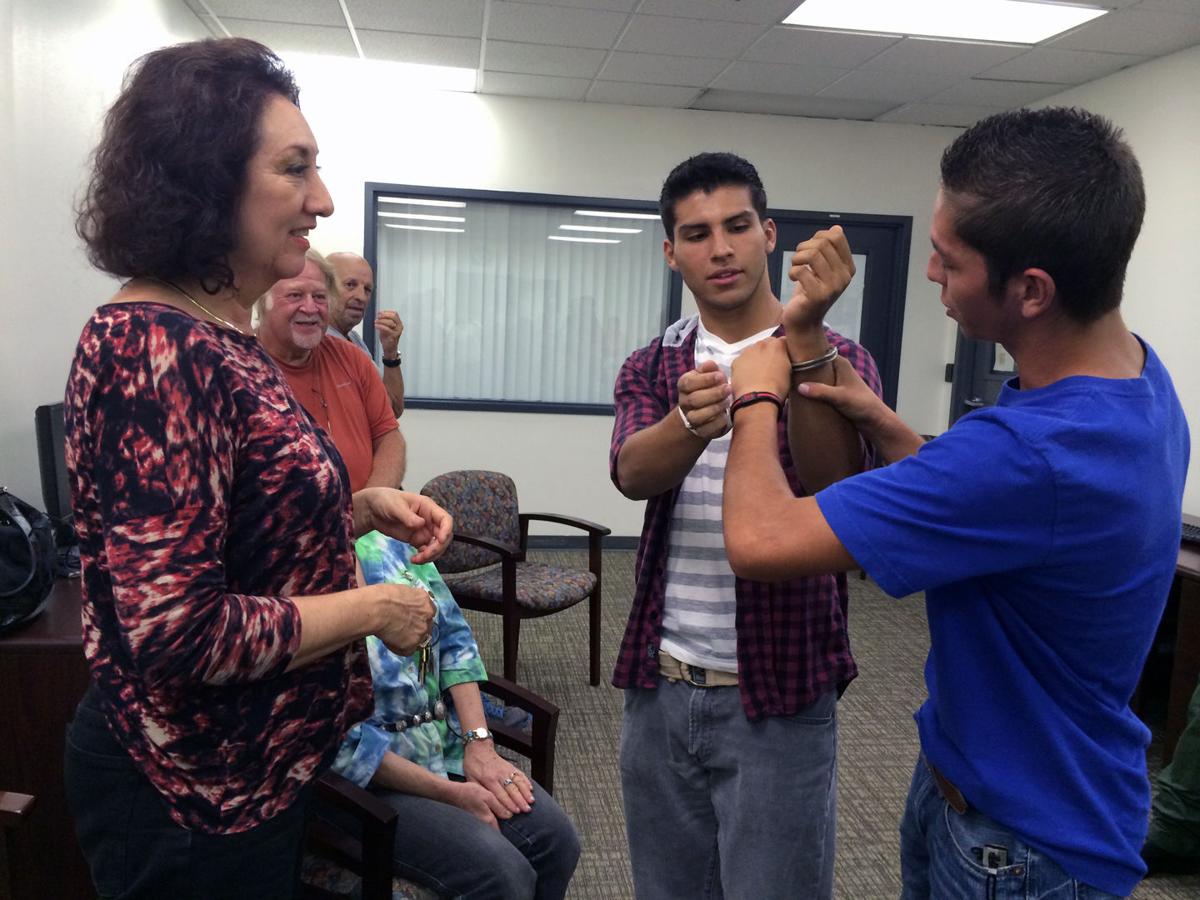
[Border reporter Perla Trevizo is participating in the Nogales Station Border Patrol Ambassador classes. The group meets every Thursday.]
Leslie Lawson, the Nogales Station chief, started Thursday’s Border Patrol Ambassadors class by talking about changes regarding the agency’s use-of-force incidents and transparency.
The agency has come under increasing scrutiny regarding its use of force, how cases are investigated and how much information is given to the public. In response, newly appointed Custom and Border Protection Commissioner R. Gil Kerlikowske, a former Seattle police chief, has pledged greater transparency and accountability.
People are also reading…
One of the most recent examples of what might be coming, Lawson said, was a statement she had in her hand regarding a Border Patrol agent who turned himself in at the Santa Cruz Sheriff’s Office that day. She read the statement, which basically said there was an incident on Jan. 30 against a minor who was in custody at the Nogales Border Patrol station. A supervisor reported it and the office of internal affairs brought their findings to the Santa Cruz County Attorney’s Office who accepted the case for prosecution.
Lawson said that’s the first time she has seen a news release like that, a sign that times are changing for the agency.
When they are criticized for not talking about cases or investigations, she said, “We can only say as much as we are allowed to say.” And when it’s a federal agency investigating a shooting case, such as the FBI, Lawson said, “The response I get, very politely, is go pound sand.”
The name of the agent was also released, which doesn’t happen often either and it's something Lawson still doesn’t think should be made public.
As to why she feel that way, she gave the example of a memo she sent to her staff this summer regarding the unaccompanied minors, which led to personal threats. She changed her routes and her clothes, she said.
The Pima County Sheriff’s Department recently released the name of a Border Patrol agent who shot a man in Green Valley. Lawson said they immediately made a threat assessment on the agent. Although they didn’t find anything, they continue to monitor, she said.
The class covered the agency’s use-of-force policy, which they recently made public and which you can read here. It’s 111 pages long. CBP also released its guidelines, which basically emphasize that agents shouldn’t stand in front of moving vehicles and should avoid "placing themselves in positions where they have no alternative to using deadly force."
A couple of interesting things from Thursday’s class:
• Agents are required to carry at least one less-lethal force option (e.g. collapsible baton, pepper spray, Taser).
• Agent must report within one hour (in person or via radio/telephone) any use-of-force incident and include date, time, location of incident; nature of any injuries/if medical assistance was requested; less-lethal/technique used by agent; name/DOB and location of suspects.
Here are some cases the agency uses to review use-of-force incidents:
Tennessee v. Garner (1985): “Law enforcement officers may use deadly force to prevent the escape of a fleeing subject only if the officer has probable cause to believe the subject poses a significant threat of death or serious physical harm to the officer and/or others.”
What this case gave the agency, Agent Richard Funke said, was that deadly force may not be used solely to prevent the escape of a fleeing suspect.
Then there’s Graham v. Connor (1989): “Created an objectively reasonableness standard that applies to a citizen’s claim that law enforcement officials use excessive force in the course of making an arrest, investigatory stop or other seizure of a person.”
The “Graham factors,” Funke said, include the severity of the crime at issue, whether the suspect poses an immediate threat and whether the suspect is actively resisting or attempting evade arrest by flight.
And the objectively reasonable test incidents must go through is:
1. Must be judged from perspective of a reasonable officer on scene; not 20/20 hindsight.
2. Ask the question based on the totality of the facts and circumstances, would an officer believe the force was reasonable?
Agent Funke wanted to go over this case law and policy before talking about the recent Green Valley shooting investigated by the Pima County Sheriff’s Department.
Jose Luis Arambula, 31, was chased by two Border Patrol agents for about a quarter of a mile, across a wash and into pecan groves, when the agents said he turned towards them and appeared to be “punching out,” a motion someone would make if they were holding a gun with two hands. Agent Daniel Marquez shot nine rounds, striking Arambula once in the head.
The Pima County Attorney’s Office declined to prosecute, saying “given all of the facts and circumstances here, a jury in a criminal trial would most likely find that Agent Marquez’ actions were justified under the circumstances. Given Mr. Arambula’s actions, a jury would likely conclude that Agent Marquez reasonably believed that deadly physical force was immediately necessary to protect himself from Mr. Arambula’s apparent attempt to use deadly physical force.”
Based on the “Graham factors,” Funke said the agent’s actions were reasonable given the fact that Arambula had fled at high speed, breaking several state traffic laws, to avoid a checkpoint; was being investigated for possible felonies (smuggling of people and/or drugs), and among other things, that the agent was told over the radio that the person associated with the vehicle had a history of aggravated assault on a peace officer with a deadly weapon.
It turned out Arambula was unarmed, but Funke said, for the sake of an investigation, they can only use what was known at the time of the use of deadly force.
The final part of Thursday’s class was a ride in a Border Patrol SUV with a metal mesh protecting the windshield and side windows often used when agents are patrolling close to the border fence where it’s prone to rock-throwing incidents.
So far this fiscal year there have been 72 recorded incidents, said Agent Raymond Bean, one of our instructors.
When it was my turn to climb aboard the Border Patrol’s SUV I hesitated to be the volunteer driver.
Bean said half-jokingly that he was going to be standing on the other end “so be sure to stop,” before he got off the car. Part of me was concerned, what if I got scared and hit the gas pedal instead of the break? Visibility is also limited with the mesh covering most of the glass. I didn’t even use the accelerator and slowly left the SUV roll down the road (just in case).
But the thump, thump, thump of the rocks hitting the hood and bouncing off the metal mesh didn’t startle me as much as I thought — even though it was loud and seemed to be coming out of nowhere. Maybe it was because I knew they were coming and I wasn’t going fast.
Since 2010, about 30 people have died in Border-Patrol related shootings and some of them have involved rock-throwers. The Arizona Republic reports that at least eight people have been killed in alleged rock-throwing incidents.
The agents are allowed to use deadly force if they fear for their life or that of others. Given the size of some rocks — the one they showed us Thursday was about three pounds — they say rocks can be lethal.
When you are inside the car and start getting pounded by rocks you really can’t tell what size of the rocks hitting you or where they are coming from — at least I couldn’t, and that’s what agent Bean emphasized after the exercise.
In this case the rock-throwers were high-school students participating in the agency’s Explorer Program. I asked agent Bean if in an incident such as that, wouldn’t it be better for the agent to stay inside. Probably, he said, but each case is different depending on what else is going on.


