

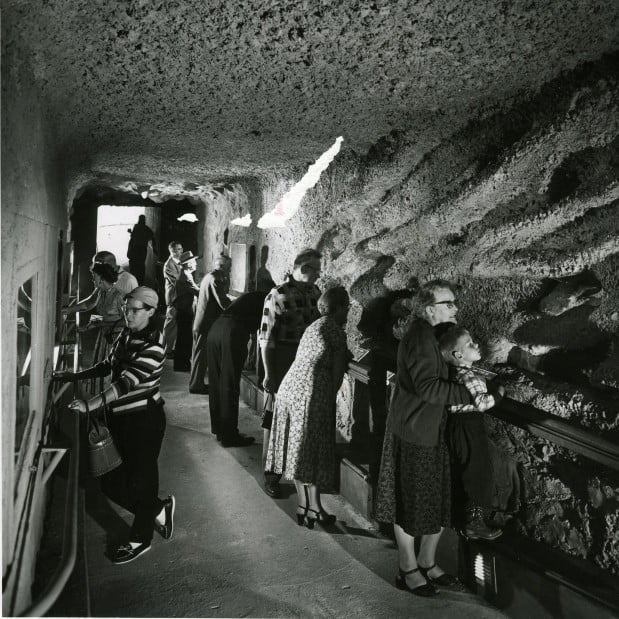
On Oct. 26, 1957, one of the more innovative exhibits opened at the five-year-old Arizona-Sonora Desert Museum. It was the animal habitat tunnel that allowed visitors to see nocturnal creatures in their underground habitats.
The tunnel was designed by William H. Carr, a founder of the museum, and financed with a grant from the Charles Lathrop Pack Forestry Foundation. The foundation's president, Arthur N. Pack, had helped Carr when he founded the museum and provided the initial funding.
The tunnel was built over an 18-month period and was 160 feet long and 14 feet below the surface of the desert. It had 22 dens housing such creatures as ring-tail cats, western diamondback rattlesnakes, desert porcupines, yellow-haired pack rats, spotted skunks, bats, prairie dogs and a kit fox. The dens were connected to a deep indoor pit where the animals could roam out of sight of spectators.
People are also reading…
On one side of the tunnel were live animal exhibits and on the other side, people could see the roots of living plants and look through a periscope showing the plant above the ground.
Less than a week after the opening, the exhibit had been visited by photographers from Life and Time magazines and NBC.
Of course, as any visitor to the museum knows, the tunnel is still there. Now the exhibit is called "Life Underground" and is dedicated to its designer and the museum founder, William H. Carr.


