

The COVID-19 pandemic has unearthed “a dark underbelly” of society, seeking to profit from vulnerable residents through frauds and scams, state officials said Tuesday.
“As much as this pandemic has brought out the best in so many of us, where we see neighbors taking care of neighbors, where we see friends checking in on others and just lending people who need a hand, it’s also brought out the worst,” said state Attorney General Gurbir S. Grewal. “We’ve seen some really unconscionable conduct in the wake of COVID-19, where unscrupulous people are trying to profit off the misery and suffering and fear of others.”
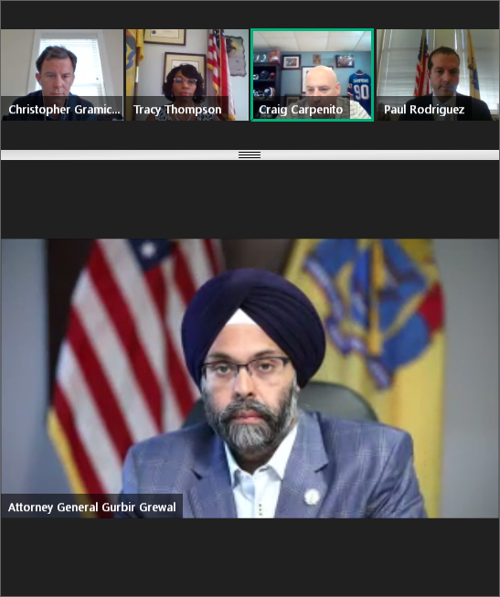
Grewal hosted a virtual town hall with other state and county officials Tuesday afternoon focused on fraud, price gouging, scams and how officials are working to educate residents and prevent them from becoming victims.
It’s the fourth in a series of virtual sessions organized under Grewal’s “21 County, 21st Century Community Policing Project,” and officials say they are a way to maintain community engagement with law enforcement, despite social distancing measures taken during the pandemic.
People are also reading…
So far, the state Division of Consumer Affairs has received 4,131 price gouging complaints and has been tipped off to 21 scams or frauds related to the new coronavirus pandemic, officials said.
“There’s a dark underbelly of our society that instead of jelling, coming together and working to help us all heal and make it through the crisis, they look inwards and they look as to how they can profit themselves and how they can take advantage of a situation,” said U.S. District Attorney Craig Carpenito. “It’s inevitable. It’s always going to be there.”
Personal protective equipment has become a commodified product, he said, and people have “inserted themselves into the supply chain” and diverted that product, marking up the prices.
Officials are also seeing instances of fraud in businesses misrepresenting products, counterfeiting name-brand items, and customers are finding that some masks don’t filter as well as they’re advertised, he said.
Monmouth County Prosecutor Christopher J. Gramiccioni said he’s seeing scammers target the elderly, who have funds saved up as a result of hard work and saving for retirement, and a general trust that comes from a different generation and limited experience with technology.
“Those three combination of things create a good opportunity for a charlatan to take advantage of people, especially during the pandemic,” Gramiccioni said, describing the grandparent scam, when a scammer calls an elderly victim pretending to be a loved one and convinces them to wire them money, as well as investment schemes, traditional email and phishing scams and health insurance scams.
The goal is to have the victim unwittingly provide personally identifiable information, such as a date of birth, credit card number or bank account numbers, Gramiccioni said.
There have also been vaccine schemes, in which people go to a tent purportedly set up by a pharmacy and residents pay in cash or give their insurance information to get a finger prick test that promises quick results, said Tracy M. Thompson, acting insurance fraud prosecutor.
It’s all fake, she said, but now those scammers have the resident’s personal information and can use it to their advantage.
Paul R. Rodríguez, acting director of the Division of Consumer Affairs, said scammers are reusing old methods “with a COVID twist.”
Instead of telling an elderly victim they’ve been arrested, scammers are now claiming they’re quarantined and need money, Rodriguez said. Or, instead of calling from the IRS about back taxes, it’s the federal government calling about a stimulus check.
Officials said they are being proactive in enforcement, including using undercover officers, informants and wire taps to “relentlessly chase this thing,” but they also said a resident’s common sense can be the best defense.
“Now is a time to ask more questions,” Carpenito said. “It’s a time to look at everything with a more suspect eye, because fear is one of the richest petri dishes for the disease of fraud, and there are folks that are very experienced in working in that pool.”


