

A gunite machine is a wondrous thing. With it, you can build bomb shelters, irrigation ditches or swimming pools.
Brack Whitaker did all three. But mainly he built pools — pools stretching from Southern Arizona to Cody, Wyo.
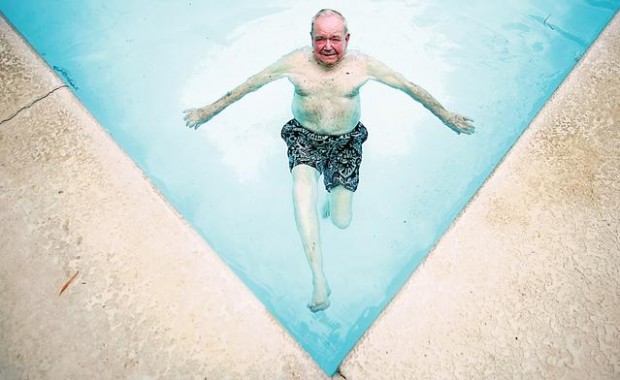
"That one was indoors," says Whitaker, 88, a pioneer in the Tucson pool-building industry.
"When I started, Austad Steel was the only one building pools in Tucson, but they mainly did steel work," he says.
Chances are, you've dipped your toes in a Whitaker pool — municipal, hotel or the backyard variety.
Nowadays, seemingly everybody and his neighbor has a backyard pool. Not so, however, when Whitaker dug his first pool in the late 1940s.
"At first our customers were all doctors and lawyers," says Whitaker, whose first office was a 12-by-24-foot edifice on East 36th Street, across from Tucson Greyhound Park.
People are also reading…
Fast-forward a couple of decades and the company had split into three different pool brands and price brackets — Whitaker, Fiesta and Biltmore — with offices in Albuquerque and Denver.
"In our best year, we built 330 to 340 pools," says Whitaker, whose work force swelled to more than 120. "Everyone wanted a pool the minute it turned 100 degrees."
He also built pools for schools everywhere from Casa Grande to Willcox. "At one time we built more Olympic-sized pools than anyone else in the country."
Born in Spokane, Wash., Whitaker grew up all over the American West. "My father drove a truck that delivered materials for highway construction. I went to eight or nine grammar schools."
By 1931, he and his parents were in Northern Arizona. "They were just paving the road to the Grand Canyon and to Williams. We lived in a tent. As the job moved down, we did, too."
After attending school everywhere from St. Johns to Nogales, he made a deal with his dad that he could choose one place in Arizona to attend high school. He chose Glendale High, graduating in 1940.
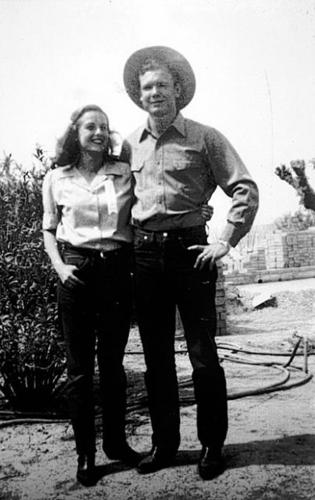
A jock, he enrolled at the University of Arizona on a track scholarship, eventually earning a degree in mechanical engineering. The "eventually" part came about when World War II plopped him into the service in '43 after his junior year.
By early 1945, he was flying bombing missions over Tokyo. Once the war ended, Whitaker left the service "in about 30 minutes" and headed to Tucson.
Here, he soon found work helping a friend who was building a house with a $2,500 loan. "We did it all — the electrical, the plumbing — and sold the house for $6,500."
Though his friend went into the banking business, the profit from that first house was enough to turn Whitaker into a builder, erecting everything from homes to apartment complexes to motels along the Benson Highway.
During this time, he also got his degree at the UA and married Jackie, his late wife. They had two children: a daughter, Dale, and a son, Brack.
While in Marana, Whitaker had noticed the irrigation ditches lined with concrete. He decided gunite would be better.
"I built a shop, I formed a ditch, and I went into the gunite business in irrigation ditches."
But the work, it turns out, was seasonal.
"I had bought this gunite machine for $10,000. I needed to put it to use the rest of the year."
Around the same time, he visited a doctor whose backyard pool pump had a problem. "I thought, 'I can do pools.' "
And so it began. Before long, he had built up a crew of 15.
"We did it all. There was no contracting out," he says, with the average pool going for anywhere from $3,500 to $5,000.
Most pools were about 15 by 30 feet, rectangular or oval, with 4 feet of surrounding deck.
"We had colored concrete. Kool Deck did not come until the mid-1950s or later." Self-cleaning was still years away.
Over the years, Whitaker took out a dozen or so patents for various pool improvements, including self-cleaning inventions. He also spent considerable time perfecting pool equipment, which he says "was always breaking down."
With digging equipment and gunite, it seemed a natural for Whitaker to get into the bomb-shelter business, which he did after 18 Titan missiles started ringing the city in the early 1960s.
"We dug the hole, placed the forms, gunited them and made a fiberglass ceiling," says Whitaker, who charged $3,500 for a shelter 7 feet in height with a circular stairway. "We probably made about 15 or 20. They were selling like hot cakes. And then the emergency was over."
Ah, well. At least everyone still wanted a pool. Even so, Whitaker sold the business in 1979 so he and Jackie could travel. But under the new owners, business went south and Whitaker wound up taking it back. "I cleaned it up and sold it again. Now it's Falcon Pools."
Now living in a modern retirement complex, he still enjoys a dip now and then. Never mind that it's not in a Whitaker pool.
DID YOU KNOW
In 1965, Whitaker Pools won a first-place award for residential pools in a national contest judged by a panel of 21, including syndicated columnist Art Buchwald.


 U of A acceptance rate rises to 90% as applications plunge


