

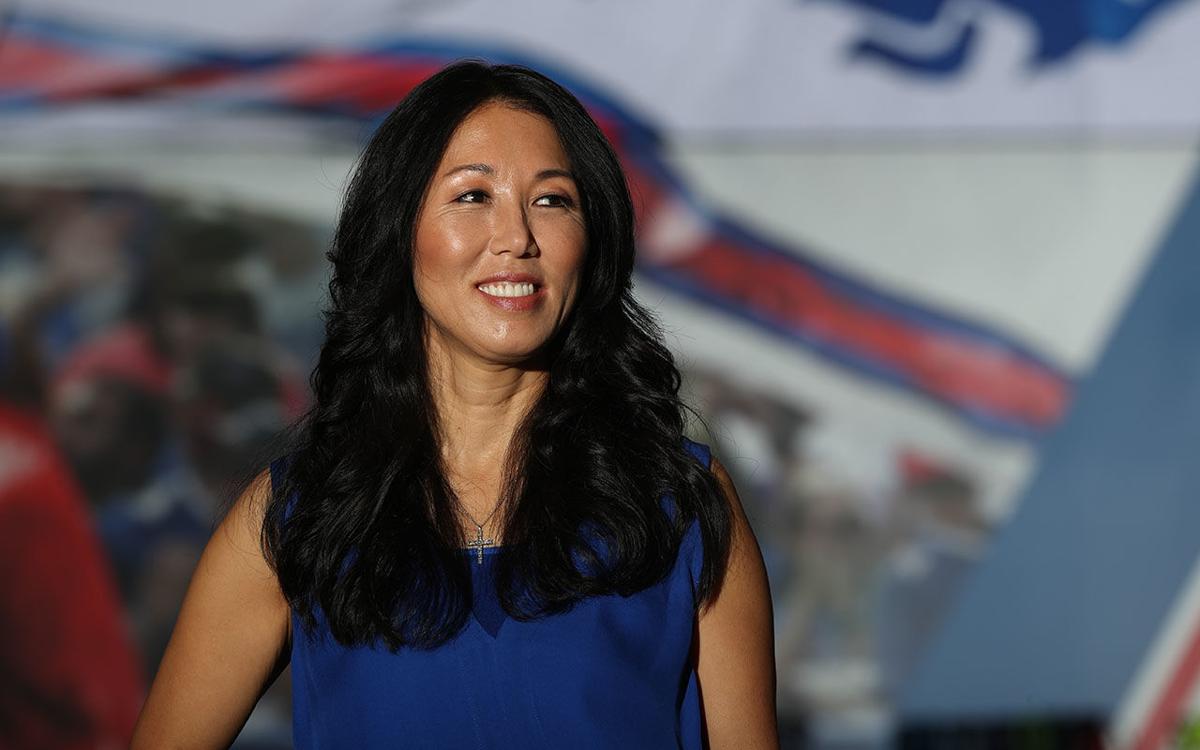
For months, the Pegula family wasn’t ready to answer the questions. They were living it, caring for their wife and mother, but not sharing it with others. Only the tightest circle of people knew the details of what happened in June, when Buffalo Bills and Sabres co-owner Kim Pegula was befallen by a medical condition that, for the public and even most people within the family’s sports organizations, was unknown.
Some of the answers came Tuesday, when Kim and Terry Pegula’s 28-year-old daughter Jessica shared publicly for the first time the details of her mother’s medical situation. In an essay published on The Players’ Tribune website, Jessie, as she is known, revealed that her mother suffered a cardiac arrest at home. Kim was saved through CPR administered by her younger daughter, Kelly, and her long recovery has been complicated by brain injury that impacts her memory and speech.
People are also reading…
“My mom is working hard in her recovery, she is improving,” Jessie wrote, “but where she ends up is still unknown.”
One point of clarity has crystallized: By lending words and context to a complex situation, and by allowing the public a view into a scenario that has – until now – been private, Jessie Pegula, already one of the world's top athletes, has emerged as her family's leading voice.
It's a role her mother long filled, and one Kim Pegula perhaps even prepared her daughter to do.
...
Terry Pegula hasn’t spoken publicly of his wife’s condition. Neither have their adult children. References to Kim would occasionally come on social media: Five months ago, for example, their youngest daughter Kelly Pegula posted an older picture of her riding a golf cart with her then-healthy mom, leaning onto Kim’s shoulder, with a caption that referenced “a rough few months” and urged her followers to “make sure you tell the people in your life you love them.”

Kim Pegula likely isn’t coming back to her role as president of the Buffalo Bills and Sabres. So how has that changed who runs the business side for the two teams owned by Terry and Kim Pegula?
Jessie, a star on the Women's Tennis Association circuit, is occasionally asked about Kim during interviews. During a lengthy lunch conversation last summer in New York, days before the U.S. Open, she spoke to The Buffalo News about Kim’s influence. Her mother taught her to “compartmentalize,” Jessie said. “She was always very: move on, work on it, and get better. I look at her health that way, and I look at my career the same way: separate. She was good at keeping things like that – at knowing emotionally where to be involved, and not letting it affect her work.”
Jessie’s ability to compartmentalize became clear as the year went on. As her mother worked to rehabilitate and the Pegula family struggled with the excruciating difficulty of the situation, Jessie had the strongest year of her professional career. She ascended to a No. 3 worldwide ranking, which also made her the top-ranked American tennis player, male or female. In November, she won her first WTA 1000 tournament in Guadalajara, Mexico. She dedicated the trophy to Kim, who, Jessie wrote, “cried during my speech and trophy ceremony.”
A higher ranking (currently she’s fourth in the world) brings more media attention, and Jessie never shied from the questions about Kim. She answered them in broad truths, tinged with hope.
At Wimbledon, three weeks after Kim became ill, Jessie told reporters, “She’s doing a lot better now.”
She didn’t get more specific, then or ever. Nobody in her family did. It wasn't time.
That changed in the last few weeks.
After watching medical professionals save Bills defensive back Damar Hamlin, who suffered a cardiac arrest on the field in early January and received life-sustaining CPR, Jessie Pegula decided she was ready, or at least close to it. In her essay, she reflected, “I texted my husband, Taylor, that the situation with my mom was weighing on me. When can we start talking about it? When can I tell her story, my story, my family’s story? Everyone just keeps asking me. I really need to get it off my chest.”
In the weeks that followed, Jessie penned that essay for The Players’ Tribute, one that would reveal what happened to Kim Pegula.
The title: “I want to talk to you about my mom.”
In her tweet sharing the story, Jessie added a message: “It felt like it was time.”
...
Jessie was on the other side of the planet when Hamlin was injured, but she said his situation was visceral. She was sitting courtside at the Austrian Open, waiting to play mixed doubles, and told one of her teammates, “I am a little freaked out right now, this is too close to home, and I feel like I am going to have a panic attack.”
Time. During a cardiac arrest, the ticking of a clock runs against the effort to restart the ticking of a stopped heart.
“The thought of what Damar and his family were about to go through hurt my heart,” Jessie wrote. “I knew how important time was. I just kept thinking time, time, time, time. I hope they got him back and quick enough.”
In her essay, Jessie detailed the specifics of what happened to Kim Pegula on her 53rd birthday: Terry Pegula woke up to Kim going into cardiac arrest. Kelly Pegula, the couple’s youngest daughter, was staying at their house that night. She had recently taken a CPR class for a potential job, prompting Kim Pegula to note in the family group text, “Nice Kells! Now if we have a heart attack you can revive us.”
However unintentional, it was a prescient statement. Kelly Pegula administered CPR to her mother, sustaining Kim’s life until the ambulance arrived.
“She absolutely saved her life,” Jessie wrote, “followed by the critical job performed by the paramedics who arrived and were able to restore a heartbeat.”

Pegula’s career to this point – even as she is finally operating near the top of her sport – has been stacked with challenges. And they are challenges that her family’s resources cannot fix.
At the hospital, doctors were able to handle the cardiac condition. “But the big question was how she would be when she woke up,” Jessie continued. “Our concern had now moved from the cardiac arrest to a brain injury. Not to mention all the other issues that come with both of those events. Breathing, swallowing, preventing infections, there are so many things that can go wrong.”
Kim Pegula was in the hospital for the next two weeks, moving out of the ICU after the first week. Her recovery today continues at home. Her recovery has been difficult, marked by “significant expressive aphasia” – speech difficulties caused by brain damage – “and significant memory issues.”
“She is improving every day,” Jessica wrote, adding, “She can read, write, and understand pretty well, but she has trouble finding the words to respond.”
Jessie acknowledges in the essay that her mom “loved to work,” but that her role as the day-to-day leader of the family’s sports teams – as the person who “lived it and loved it” – is “most likely gone. That she won’t be able to be that person anymore.”
She also shared that “my mom always wanted me to be involved, she wanted me to learn and eventually do what she was doing. She always told me to wait until after tennis was done.”
Jessie's range of thoughts included pondering whether she should reprioritize her time to focus on the family and business: “Does my dad and family need help?” she wrote. “Maybe I should just go back to school and work for the family.”
What the future holds for the Pegulas – from Kim’s health to Jessie’s professional priorities – remains to be known. But by recognizing it felt like the right time to share her mom’s story, Jessie may have been following a lesson Kim taught her from a young age: When a task clearly needs to be done, simply do it.
“She was always reiterating, 'If you want to do something, you can do it – but go and do it,' ” Jessie told The News in August. “ 'What are you waiting for?' ”


