

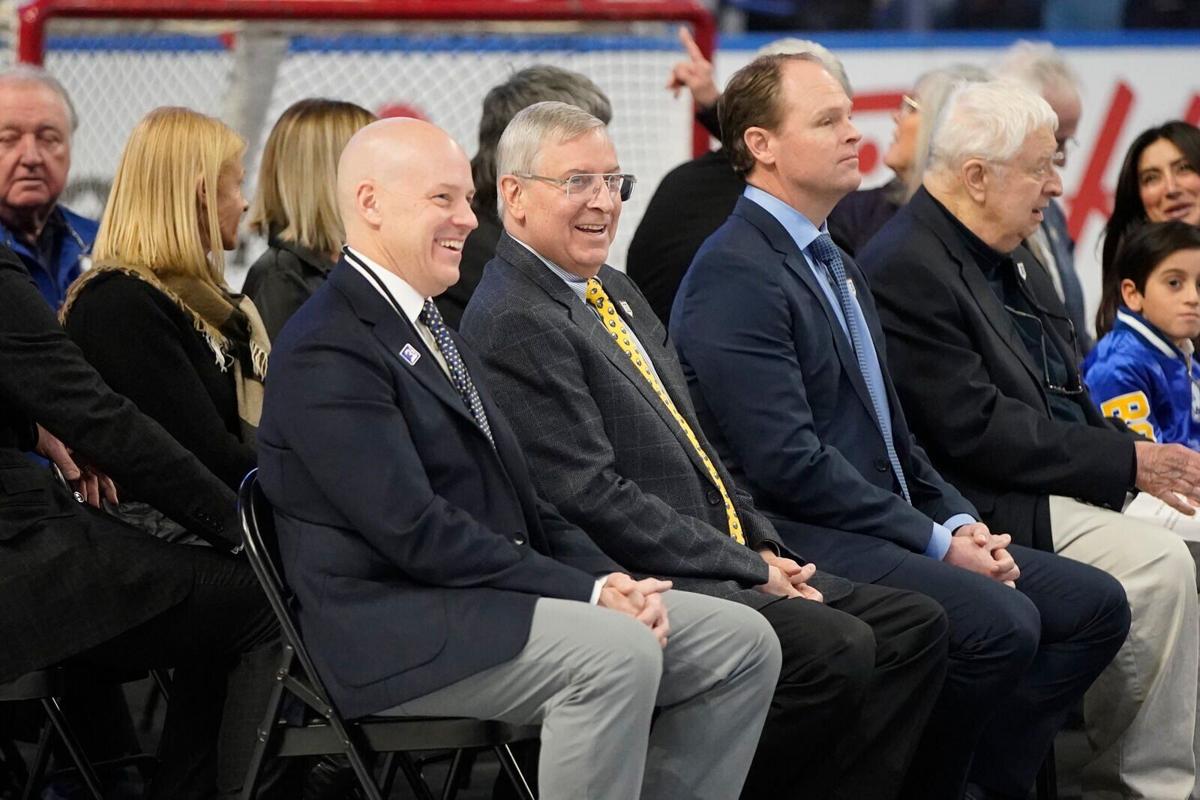
The Buffalo Sabres and Pegula Sports & Entertainment dropped a bit of a bombshell last month with the hiring of John Roth as the chief operating officer for both entities.
Roth has a business background while working at Fidelity Investments in Boston over the last 24 years and has known Sabres owner Terry Pegula through almost all of Pegula's 12 years at the helm at the club. But Roth has no prior experience working in professional sports, and has now been given the reins of the PSE offices and the business side of the Sabres.
Roth was an economics major at Colby College in Maine and has a master's of business administration from the MIT Sloan School of Management.
People are also reading…
He inherits an organization that appears to be turning a corner on the ice but still lingers near the bottom of the NHL in attendance.
In addition, the Sabres appear to be in line for a major renovation of KeyBank Center, a 27-year-old arena that has become dated in many areas compared to its counterparts. PSE as well as state and local government officials likely can move forward on that project once the final details are completed on the agreement for the Bills' new stadium in Orchard Park.
In an exclusive interview, Roth spoke to The Buffalo News before Tuesday's game against the Toronto Maple Leafs. Here are the highlights of that session, lightly edited for space and clarity.
Buffalo News: Let's start here. Not being flippant at all, but a big part of the reason for wanting to talk to you is to get a sense of who you are. You come without any background in professional sports and here you are in this position. How did this happen?
John Roth (laughing): Working at Fidelity the last 25 years was all about analyzing businesses, investing in businesses, learning businesses. That's what I do. That is my passion. That's something I've talked to Terry about for the last 10 years. That is what I'm all about. That means my lane really is the fan.
Kevyn (Adams) and Don (Granato) are doing their job on the ice with the team, and I take care of the rest and work with them. The good news is we have a really experienced, seasoned leadership team here. I'm not just coming in cold.
There's some really talented people here that have been around for a long time, that understand how this business works and want to make it better and want to continue to improve. And so that's what we're going to be focused on. And it's a little bit like what Kevyn and Don are trying to do on the ice. They have really focused on culture and culture is really important. And that flows through to this part of the business, too.
BN: What was Terry's mandate to you?
JR: From the first day Terry has wanted to win the Stanley Cup, and I can assure you that hasn't changed. I think the team is in good shape. My mandate is to do what I just outlined: Support that goal and make sure that we are prepared for success, make sure that we are doing the best job we can for the fans, given whatever constraints that we may have.
BN: As far as coming in from outside of sports, how much of a positive is that? And how much of a negative is that?
JR: I have had a long conversation with Terry about this. I think there's something to be said for a broader, different perspective. I certainly won't want to get involved with picking hockey players but as far as business, I bring a broader perspective with a combination of a seasoned leadership team that's been in the organization. And I think that is a powerful combination.
BN: This team has been in the red for quite a while. How much does that play into every decision you're going to have to make? And how much do you think just a better team and a mostly full building can turn that around?
JR: That certainly helps. There's just no question it's a big difference in terms of the economics when you start to fill the building up. We're seeing it this year. Our season ticket sales are up this year versus last year pretty significantly People are coming back. We'd like to see more during the week, but the weekends are great. You can feel it turning and I think that momentum will continue.
(Estimates are that the Sabres' season ticket numbers have gone from about 6,500 last year to more than 9,000 this season).
BN: I know your relationship with Terry goes back about a dozen years. How did it develop?
JR: I invested in his company. I got to know Terry through that. We did a couple of investments together that were both pretty successful. And he was one of these guys that right off the bat, I kind of knew he was different. Got to know him personally, got to know Kim personally over the years. And I can remember thinking to myself, "God, if I ever decide not to work at Fidelity and with the Johnson family, I'd work with the Pegulas." Over the last five or so years, we talked about different things. And this became a reality. It's just really exciting.
I got to meet Kevyn and Don, spend time with them and I believe in what they're doing. This is an exciting place to be. You can feel it. You're more of a hockey professional than I am. I'm kind of a people person, and that is a cohesive team. I can recognize that.

Kim Pegula likely isn’t coming back to her role as president of the Buffalo Bills and Sabres. So how has that changed who runs the business side for the two teams owned by Terry and Kim Pegula?
BN: How much of coming aboard now unfortunately was based on Kim's medical situation? I know you've talked for five years, but you came in now at a time when the organization needed to fill in her duties.
JR: It's kind of hard to say because we had talked about it before, and it was already in motion before that happened. It's kind of hard to connect the two.
(A Sabres spokesperson notes Roth is filling a role equivalent to the one Ron Raccuia has as executive vice president/COO of the Bills).
BN: This figures to be a tough night for the organization. Many of your season ticket holders dumped their tickets for this game and we've seen it from time to time against other teams like Montreal, Boston and Pittsburgh. Just not to the Toronto level. How do you get your fans to use their tickets more and not sell them just as an investment vehicle to recoup their money?
JR: Kevyn and Don and the team are doing a great job. And then on the business side, we've got to try to make the experience as good as we can for fans. I'm a month and a half into the job. So, one of the first priorities is to go through and think about every interaction that we have. The arena, how everything flows, food and beverage, all of those things you write about a lot that impacts the fan. I think what we want to do there is be methodical and be thoughtful about it. And it's going to take a little while, but it's something that we are very much aware of and that's my lane.
BN: How do you balance short-term projects, short-term goals with long term? The long term of this organization is clearly doing whatever needs to be done with this building in a major way.
JR: Part of the process is evaluating everything, and we're going break it into buckets, things that we need to tackle today, and then we have we got the long term. And you know, you saw what happened. Orchard Park, they figured it out. And we're gonna do the same thing here. It's early. I don't have a lot to tell you. It's also 1996 vs. 1972. (The hockey arena was built in 1996; the Bills stadium was built in 1972.)
It's not lost on anyone, and we're looking at it and actively working on it. And to your point about short term, long term, I think there's going to be short-term things that we can do soon, and there's gonna be things that are going to take a little longer. We're gonna hit some other competing venues. Do any kind of due diligence we can. I can also look at your tweets. We saw some of the scoreboard comments. Points taken.
(There are 17 NHL arenas built between 1993 and 1996 that have undergone major renovations in recent offseasons, topped by the $350 million in work done at Wells Fargo Center in Philadelphia)
BN: When you think of this place, what jumps out to you first ?
JR: The bones are good, right? The Pegulas invested a lot in the infrastructure. The ice plant, the dehumidifiers, there's a lot of capital that went in and so that's really encouraging. It'd be much worse situation, if that was a problem. It's not. The locker rooms got a big investment and those are the positives. People have pointed out negatives and I think some of them can be done sooner rather than later. And some of them we've got to figure out what the plan is.
The scoreboard is definitely on the list of things to look at. We did the ribbon boards (at the start of last season) and those have been successful. So, yeah, just give me some time. That's something that we're looking at. Some things we can hit earlier, some things will take longer.
BN: How daunting is it knowing you're going to have to keep all parties together after the work done on the football stadium?
JR: That's why we need time. But I'll say this: It's less daunting than what they did in Orchard Park.
BN: I'm assuming you're involved right away in a staff evaluation when we see an executive removed here shortly after you arrived. (Mike McFarlane, the senior vice president of finance and administration for the Sabres). Is that an ongoing process?
JR: What I can say is that leadership changes at businesses all the time. I don't have anything specific to say about the first one and I wish him really well. But it's a normal part of a business.
BN: How do you build a relationship with Kevyn since you're on different sides of the organization but will have to come together at many times?
JR: The old-fashioned way: Spending time. We're going to travel with the team a little bit and I've talked to him a couple times a week. He's a very accessible, great guy so it makes it a lot easier. And he's very communicative himself, and I find him very supportive. I couldn't ask for a better partner in this business.
BN: Anything that's out there business-wise comes under your umbrella, so do you anticipate that you will take many months to go over everything regarding this organization?
JR: That's the plan. Some things can go faster, some will take longer. It's tough to give a concrete answer.
BN: Something a lot of people want to know, and I'm certainly one of them, is the broadcast issue. The team went from no travel (from announcers Dan Dunleavy and Rob Ray) to a good amount of travel this year, but it's not the industry standard, where virtually all teams have returned their talent to the road for every game. Where do you stand on that going forward?
JR: We're looking at everything. We had some situations (during last week's game in Anaheim) that were technical issues that we fixed. Can we fix it faster? Would we want to? Yes. But our team was all over it and did a good job given the situation. But, yeah, that's something that we don't love so we're gonna look at that, too.
BN: What sports teams are you a fan of?
JR: I'm gonna get myself in trouble. I grew up in Boston. I could walk to Fenway so it was more it was Red Sox kind of growing up and Boston's a big hockey city. I didn't play hockey, but I had friends who went to Bruins games, and then you get the Patriots. That said, I'm all Buffalo now.
BN: Are there lessons you take from the Boston Garden, Fenway Park and Gillette Stadium?
JR: I lived through the old Garden going to the Fleet Center (now TD Garden). This building reminds me of the Fleet Center. It's very similar, but they've done a good job of keeping it current enough. There are lessons to be learned from all of our competitors in terms of game presentation and arenas and infrastructure and how the fans experience it all. That's gonna be a big focus for the near term.
We have a good team in the front office. We want to get the culture right. And I think everybody wants to see this team be successful and everybody wants to win the Stanley Cup. We're all pulling on the same oar and that is very, very encouraging.


