

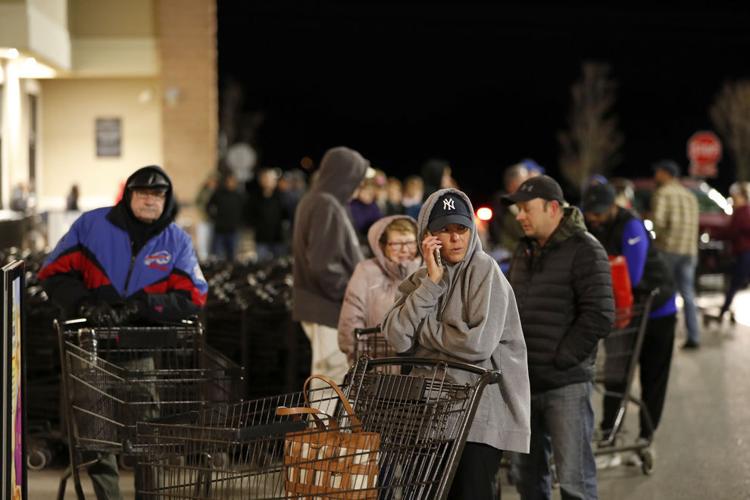
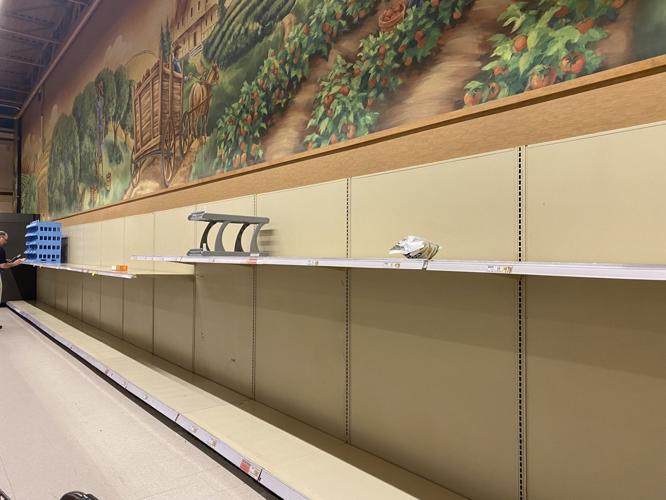
I went to Wegmans at 5:47 a.m. Saturday.
Oh. My. God.
I wrote those words on the morning of March 14, 2020, never thinking the experiences that shaped them would still hold true some 20 months later. Nor did I suspect my admittedly dramatic “Oh. My. God.” reaction would endure.
But it has.
Even today, when the phrase “getting back to normal” would require time travel – because the abnormalities of pandemic life are enduring, too – I still manage to leave grocery stores, or hear others talk about them, with a forehead-smacking reaction. My inner dialogue goes something like this:
People are also reading…
Hey, that guy just got mad at a 15-year-old checkout worker for asking him to wear a mask.
Really?
That woman just grabbed a package straight out of the hands of a store employee who was stocking shelves.
Say what?
That person asking for help just leaned close into the face of a worker, pulled down her mask, and spoke loud in her face?
For real?
Yes, for real, these things happen, and they aren't the only form of craziness inside grocery stores. Products run out quickly. (Try to buy a rotisserie chicken lately?) Hours are shorter. Walking by people can involve an awkward toe-tapping dance of trying not to get too close, while trying not to appear too rude.
Except none of this is likely news to you, because grocery shopping is one of the most commonly held experiences in our society. In some form or another, most of us do it, and so you’ve probably participated in it. In this Pandemic Lessons, we dig into the changing experience of buying our food.
Let’s start with the craziness inside stores. What’s going on?
You won’t find people carting towering stacks of toilet paper, which I wrote about in that March 2020 story.
But try going to a grocery store and finding everything you want.
You likely won’t, and that's because of global supply chain issues and worker shortages, plus the occasional run of panic buying that date to the beginning of the pandemic. The dynamic has created some scenes that, if you looked at it from the outside and had no idea that a virus was behind it all, would seem almost comical: toilet paper when there was no suggestion that it would run out. Or today, people loading up on Gatorade, lest it not be available next week, and thus causing a temporary sports drink shortage within a store.
Or the aforementioned rotisserie chickens, which are a popular item in Wegmans’ prepared food sections. The supply-and-demand-driven scarcity on those means you will sometimes see people gathered in a semicircle, waiting for them to come out of the oven, into a package and placed into the customers’ hands.
How have supply chain issues affected shoppers?
We’ve all had to learn to be a little more flexible.
The high demand for goods, coupled with worker shortages on farms and factories, and in shipping companies, docks and warehouses, creates snags at every point in the supply chain. Bob Rich III, president of ROAR Logistics, estimates “there’s a shortage of probably 300,000 truck drivers out there.”
Rich, whose company is a third-party logistics provider that helps find modes of transportation to ship goods, pointed out in an interview with The News that this means “you're paying more to these drivers, as well as you're paying more to get your freight moved to the consumer, which ultimately means at the bottom of that funnel, the consumer is going to pay higher prices. They're going to see shortages, because at every step in the supply chain, you just don't have enough horses to pull the wagon right now.”
Spokespeople for both Tops Friendly Markets and Wegmans told us that their respective companies have made changes to their supply chain practices, which essentially means expanding whom they work with to buy and receive goods to keep their shelves stocked. “Our biggest takeaway from this pandemic has been the importance of remaining agile,” said Michele Mehaffy, Buffalo consumer affairs manager for Wegmans Food Markets.
We have all had to learn to be flexible in what we buy to keep our cupboards stocked. “Shoppers have learned to flex as well and learned to buy off brand in order to get the items they were looking for,” said Kathy Sautter, spokesperson for Tops.
A spokesperson for Takeoff, a company that works with grocers across the country to fulfill online orders, said inflation “has hit particularly hard in the grocery industry, in particular meat prices.” The company’s East Coast fulfillment centers saw an 11% drop in the number of meat units sold between April and November of 2021. “Customers could be buying more bulk packages to save,” a Takeoff public relations representative noted, “or simply buying less meat.”
Tell that to the people waiting in line for chicken.
Speaking of those lines – how safe are grocery stores nowadays?
They’re good.
“Our grocery stores are relatively safe,” said Dr. Thomas Russo, chief of infectious disease at the University at Buffalo’s Jacobs School of Medicine and Biomedical Sciences. But how safe, he added, is dependent on three variables:
• How rapidly Covid-19 is spreading in the area. In Western New York and across the state, numbers from the Omicron surge are high, but trending downward. “Thank God, we’ve turned the corner a little bit,” Russo said. “But we still have a ton of community disease right now.”
• Your own immunity level to Covid-19. That comes from a combination of vaccination and boosters, and previous infection. If you’ve had none of those, you’re more susceptible. If you were infected or vaccinated several months or more than a year ago and haven’t gotten a booster, you’re likely more vulnerable too, especially to the Omicron variant, than someone with a more recent infection, a booster shot or both, which Russo calls “the top of the immunological mountain.”
• The environment inside the grocery store. High ceilings, wide aisles, good ventilation and workers wearing masks are all good signs. But customers are more difficult to control. Despite masking mandates, it's common to see customers without masks walking around grocery stores. For practical purposes, if they aren't infected, that won’t matter.
But you don’t know who is infected, and who isn’t.
If you’re a customer, it is still fairly simple to keep yourself safe. Maintain a distance, avoid crowded aisles and opt for respirator masks like KN-94s and N-95s. You can also opt for contactless checkout through apps, or curbside pickup or home delivery.
Grocery workers are actually the people who are most vulnerable to someone who is maskless or poorly masked and infected. The supermarkets have worked to protect employees – hence the shields you encounter at checkout – but unlike shoppers, they still have to deal face to face with customers. That complicates two infection factors: time and exposure. If a customer pulls down a mask to lean in close and talk to a worker? They’re potentially exposed.
Over the course of an hourslong shift, short exposures can accumulate to infection. “A very high exposure load could overwhelm whatever level of immunity you might have,” Russo said.
Can’t grocery stores force customers to wear masks?
Theoretically, sure. Practically? That’s kind of like trying to remove every fan at a Bills game who is shouting drunken obscenities. You can try to do it, but the scene has already been caused, and it might just get worse. Plus, a small number of people have a medical reason to go unmasked. A considerably larger group refuse to do it because they don’t like the rule. It can be difficult to tell the difference.
We asked both Tops and Wegmans whether employees are empowered and expected to enforce public masking mandates. In email responses, both emphasized the importance of safety for everyone within the store; neither indicated that employees are expected to remove noncompliant customers.
“We ask associates to approach customers who do not have on a mask and remind them of the mask mandate, offer the customer a copy of the mandate, and offer them a disposable mask,” said Sautter, of Tops. “We also have signage in our stores reminding shoppers of the policy.”
Wegmans, similarly, has signage and free masks for customers. “We are focused on complying with these mandates, while keeping the health and safety of our employees and customers a top priority,” Mehaffy said. “In today’s world, asking our people to approach an unmasked person could be unsafe for them, and we’re not going to put them in that position.”


