

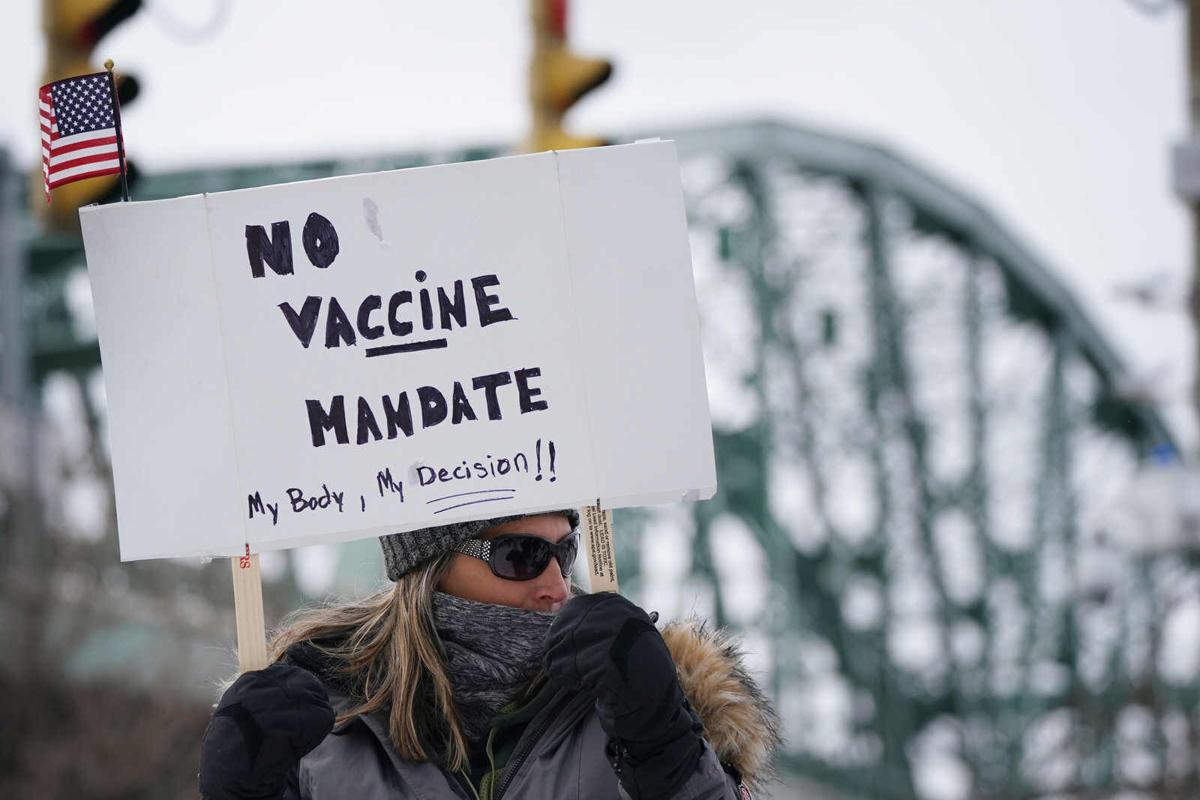
Two years into a battle that has seemed much longer, the pandemic is finally stalling. Or slowing. Or maybe – if fate and viral spread allow – ending.
At a minimum, we have a breather; we can even choose to drop our masks. At best, the pandemic is melting into an endemic, and we can push forward with our lives.
But there’s at least one type of viral spread that will be harder to stop, even when Covid-19 does settle into seasonal respiratory virus status. That elusive foe is misinformation, and it’s likely to stick. We explore why in this week’s Pandemic Lessons:
Clearly, misinformation and conspiracy theories have been an issue during the pandemic. How big a problem have those been?
Lethal, and it partially explains both the ongoing impact of the pandemic and why we may not yet be done with it.
People are also reading…
Hospitals abound with stories of unvaccinated patients who had significant comorbidities, believed Covid-19 to be nothing worse than a bad cold or mild flu, and died.
It’s notable, too, that variants like Omicron emerge when a virus spreads easily and continually replicates, mutating into a more dangerous version of itself. The higher an immunity level in a population, the less a virus has that chance to spread and mutate. The Omicron surge, combined with vaccinations and other previous infections, has left much of the United States with a high enough community immunity level to drive infection numbers down.
That is not true globally, however, because vaccination levels vary vastly by country and continent. North America has a relatively high vaccination rate: Mexico is 62% fully vaccinated; the United States, 65%; and Canada, 82%. But much of Africa, by contrast, is in the single digits or teens.
Access to vaccinations is one reason for that. But dangerous fiction masquerading as facts is another.
Dr. Riyaz Hassanali, a cosmetic surgeon in Williamsville, has left his business for months at a time over the last year to set up and run a large-scale vaccination program in his native country of Tanzania. Even when Hassanali and his team in Tanzania, which has a vaccination rate of about 4%, have had shots available, misinformation has been a challenge.
During an interview in his office, Hassanali pointed to an iPhone.
“This is a wonderful tool, but also a very dangerous tool,” he said. “Every person in Tanzania – most people, including the guy who sells fruits at the street stands – has a smartphone. It’s ubiquitous. So whatever information I have access to myself, they have access to. That’s great, wonderful, bridging the gap. But in this instance, it’s being misused in that people are falling prey to the conspiracy theorists.”
Hassanali heard concerns about the vaccines containing materials that can be used to track people, which is untrue, and about the shots causing miscarriages or sterility, both of which are also false and have been repeatedly debunked by doctors and scientists. To that point, the brain’s ability to communicate with the reproductive system “in men and women would be far more disrupted by getting Covid,” said Dr. Sarah Berga, chair of the Department of Obstetrics and Gynecology at the University at Buffalo.
But still, Hassanali received texts from people in Tanzania – people he considers intelligent, and some of whom are his family. “(They say), ‘You're pushing this vaccine on us. But have you thought about these problems that are associated with vaccines?’ ” Hassanali recalled. “And I say to them, ‘But how do you explain all the deaths that are going on? How do you explain the high rate of complication that we're seeing?’ ”
Conspiracy theories may continue to haunt us. Why?
Conspiracy theories tend to be simple, intriguing, and if you’re skeptical, oddly reassuring. They take minimal effort to understand, and if you relieve yourself from the exertion of critical thinking, they can be easy to accept.
“What makes conspiracy theories so attractive is it provides the immediate answer to what you’re worried about, meaning, ‘How does this all work? How did the virus start? What’s behind the vaccines?’ ” said Dr. Paul Offit, director of the Vaccine Education Center at Children’s Hospital of Philadelphia. “It provides a narrative. It’s a false narrative, but it provides an immediate narrative, to provide order out of chaos.”
Offit, a leading voice for decades against conspiracy-fueled misinformation, continued, “Science will also provide a narrative. Science will also offer order out of chaos. But it takes a while.” Offit was referring to the process scientists follow of reviewing multiple studies on a singular issue, collecting data and findings over time to build a consensus.
“A long while, in this case,” he said.
How much do people actually believe in conspiracy theories?
A pair of University at Buffalo researchers are conducting an ongoing study that helps us understand the wide spectrum of choices and reactions to pandemic fears, vaccination and misinformation.
Janet Yang, a communications professor who specializes in risk perception, and her doctoral student Jody Wong are researching misinformation and risk perception as part of a National Science Foundation grant. In their initial May 2021 survey, they found vaccinated people viewed the pandemic as a higher dread risk, while the unvaccinated participants viewed the vaccine as a higher unknown risk. Essentially, vaccinated people tended to think the pandemic was scary, and they wanted to do something about it — which was getting their shots. Unvaccinated people, meanwhile, often viewed the shots as uncomfortably new, and because of that, hesitated to get them.
“While vaccinated people view the vaccines as a solution to a problem,” Wong told The Buffalo News last summer, “the unvaccinated tend to view them as a significant unknown risk, and they are uncomfortable with that.”
Last August, Yang and Wong conducted a second survey of U.S. adults in which they studied people’s views on conspiracy theories, asking how strongly they agreed or disagreed with mistruths about the pandemic broadly (“Covid-19 is less dangerous than the seasonal flu”) and vaccines specifically (“The Covid-19 vaccines include a tracking device”).
The sample size of 1,025 was 56% female and 44% male; the average age was 45 and 62% of the respondents were white. Half were vaccinated, and about four of 10 had some higher education. (The other approximately 60% had an associate's degree or below.) The median household income was $50,000 to $59,999. Participants were asked to share their political identification: approximately 38% were independent, 29% were Republican, and 33% were Democrat.
They asked the participants, “Thinking about the Covid-19 pandemic and the Covid-19 vaccines, which do you think poses a greater risk to you?”
Two-thirds cited the pandemic as a greater risk, and did so in an overall emotional tone that the researchers gauged as negative. “Surprisingly,” Wong wrote in an email, “very few pertained to misinformation about the pandemic.”
The remaining third of the respondents pointed to the vaccines as a more formidable risk than the pandemic itself. ‘The overall emotional tone was much more negative,” Wong said, noting that 54% of the comments “contained misinformation.”
One out of every five of those statements had misinformation about the pandemic. For example: “I am young and healthy. Covid-19 is not a risk to me.” (Young people have died from the virus, and are susceptible to long Covid.)
But nearly all of those responses (93%) had misinformation about the vaccines, and about 13% cited both the shots and the pandemic. For example: “Because Covid-19 is a hoax and the vaccine potentially changes your DNA/RNA.” (Six million people worldwide have died from Covid-19, the U.S. death count is north of 950,000, and the vaccinations do not impact the genetic information in your cells.)
Yang and Wong found that unvaccinated people believe in misinformation more than vaccinated individuals, and Republicans “were more likely to believe in misinformation the most” compared to independents and Democrats.
OK, let’s ask again: Why? Why does misinformation stick with so many?
Yang, who last year was promoted by UB to full professor status and was honored by the Society of Risk Analysis for her work, has a take slightly different than Offit.
“From the early discovery of the coronavirus to vaccine development, science has also provided a narrative, but this narrative is rejected by those who’d rather believe in conspiracy theory,” she said.
Yang points to confirmation bias as the “fundamental reason.”
A person who thinks the vaccine is unsafe, or fears the government will mandate it, is “much more likely to believe in conspiracy theories because they confirm their existing beliefs,” Yang said. “Similarly, those who believe the pandemic is a hoax all along are much more likely to use conspiracy theories to justify their beliefs.”
To her, conspiracy theories aren’t an answer. They are a justification. “They help to justify the skepticism or objection people have all along about science and others who do not share their political beliefs,” Yang said, “even before the pandemic started.”
And even as it – hopefully – ends. With any luck, Covid-19 is fading. But viral misinformation is a spread that may be even harder to stop.


