

Welcome to another year in which confusion is our most predictable reality.
Life with Covid-19 has made it difficult to count on anything. Like last week, when the Centers for Disease Control and Prevention released new guidance recommending what people should do if they are exposed to the virus or get infected. As we emerge from the holiday season and head back to school, sports, dance and theater classes, tucked away in the guidance was a set of details that seemed potentially difficult for a group of young people in a different way: kids ages 12-15 who are six months beyond their original vaccination.
In this Pandemic Lessons, we dig into what it’ll take to keep those adolescents attending school and activities. By extension, we also examine what public-health guidance looks like in practice.
What’s going on in the CDC guidance for young adolescents who are fully vaccinated?
People are also reading…
This is a classic example of how broad public health rules can sometimes miss a specific group.
Kids ages 12-15 were approved for Pfizer shots last May, which means the first of them to receive the two-shot regimen passed their six-month window in December. But as of the end of 2021, the Food and Drug Administration and CDC had approved booster shots only for those 16 and older.
That changed Monday, as the FDA approved Pfizer boosters for 12- to 15-year-olds. According to the Washington Post, the CDC and its panel of outside vaccine advisers is expected to review the FDA decisions this week. Assuming the Advisory Committee on Immunization Practices, which is scheduled to meet Wednesday, signs off on the additional shots, CDC director Rochelle Walensky is expected to officially recommend them later that day.
Until that happens, the CDC guidance on quarantining after exposure puts those younger teens – and anyone else who is six months outside their Pfizer or Moderna vaccination, or two months beyond their single Johnson & Johnson dose – in the same category as people who were never vaccinated at all. For anyone who is exposed to Covid-19 but isn’t recently vaccinated or boosted, the guidance reads, in part: “CDC now recommends quarantine for five days followed by strict mask use for an additional five days.”
Theoretically, those guidelines could mean missed school, sports or activities for a teen who’s been around someone with Covid – even if that teen is showing no symptoms, and was fully vaccinated last spring.
“The new guidance is problematic for them,” acknowledged Dr. Thomas Russo, chief of infectious diseases at the University at Buffalo.
But Russo and other experts and public officials we interviewed for this story also acknowledged that masking, common sense and a pending change in booster qualifications for teens may make life easier for adolescents than what the guidance may indicate.
“CDC’s fallback has always been, ‘This is JUST guidance – it’s still up to individuals, and institutions to do what they feel is best,’ ” said Dr. Jerome Adams, the United States surgeon general during the Trump administration.
How, then, are these guidelines applied – and what is “best” practice?
That varies by locale, which is the reason why schools in New York have Covid protocols that are different from institutions in other parts of the country.
For the broad view, we turned to Adams, who traveled the United States as surgeon general and now serves as the executive director of health equity initiatives at Purdue University. Answering questions in a series of text exchanges, he said, “If everyone is masked, it’s not likely to qualify as a high-risk exposure.”
Adams foresees this playing out “literally school by school” across the country.
“So the question becomes whether the schools that aren’t having students mask currently are going to be pushed/persuaded to either a) mask or b) quarantine more kids after an exposure,” Adams said. “My honest guess is if they were doing it before, they will continue to do it now, and if they weren’t doing it before, they’re not going to do it now.”
How does that translate in New York?
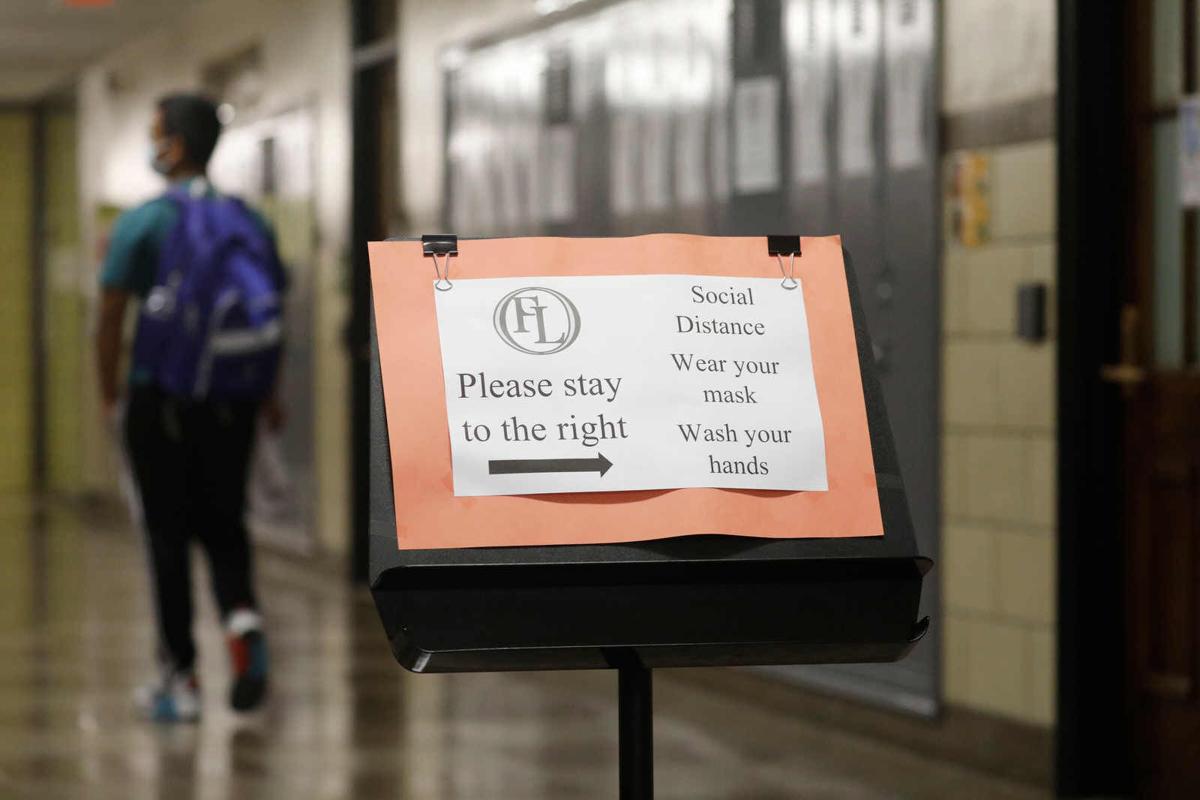
Gov. Kathy Hochul mandated masking in schools on her first day in office in August. That rule, coupled with New York’s definition of a “close contact,” makes it possible for most children to stay in school.
A close contact is someone who has been exposed to a person who is confirmed or suspected to have Covid. According to the state, that can include living in the same household, having direct physical contact, or exposure to the infected person’s “infectious secretions” – a euphemism for having the infected person cough, sneeze or spit on you. Another form of close contact is being within 6 feet of an infected person for a total of 15 minutes or more within a day’s time.
The state also recognizes two pathways to immunity within its close-contact definition: One is full vaccination, and the other is post-Covid immunity from a recent infection. If you’re two weeks beyond a single Johnson & Johnson dose or a two-shot Pfizer or Moderna series, you won’t be considered a close contact. The same is true if you’ve recovered from Covid in the last three months.
With waning immunity from vaccination and a large number of breakthrough cases with the Omicron variant, the new CDC guidance suggests that only people with booster shots can sidestep pre-emptive quarantining after exposure, unless they are within their two- or six-month window.
That would, in theory, impact the 12- to 15-year-olds who were vaccinated last spring but are now unboosted: Imagine an eighth-grade math class that includes three students who test positive. Would quarantining apply to every person whose seat is located within a 6-foot radius of each of those individuals? And to every student seated within 6 feet of classmates who test positive in the days afterward?
With a quick-moving virus like Omicron, it’s easy to see how that could quickly shut down classes over the next month. But it’s not that simple.
Kara Kane, spokesperson for the Erie County Department of Health and Michael Cornell, the superintendent of the Hamburg Central School District and president of the Buffalo Niagara Superintendents Association, separately pointed to New York State Department of Health rules that narrow the definition of “close contact” to students sitting less than 3 feet away. The state regulations note that this exception applies “if both the infected student and the exposed student(s) correctly and consistently wore well-fitting masks the entire time.” It includes students only, not teachers or other adults.
Meanwhile, New York’s “Test-to-Stay” program, which allows less-than-fully vaccinated students who are deemed close contacts to keep attending school so long as they are asymptomatic and test negative, will also be enacted in counties across the state beginning this month.
What can you do to keep kids in school – and to keep all of us clear of Covid issues?
The basics still apply: Wear masks, get vaccinated and sign up for a booster shot.
As complex and unclear as Covid life can be, that is one set of principles that hasn’t changed. What has changed, said UB’s Russo, is the virus itself and our willingness to take precautions. While Omicron is less severe for most, its contagiousness is producing record-high infections, which could still result in the infection of susceptible people and overload hospitals.
“The virus has evolved to become increasingly adept to infect and evade immunity from vaccines and prior infection, and we seem to be increasingly more complacent in letting our guard down and enabling ourselves to be infected,” Russo said. “That’s a bad combination, and that combination is going to cost us.”


