

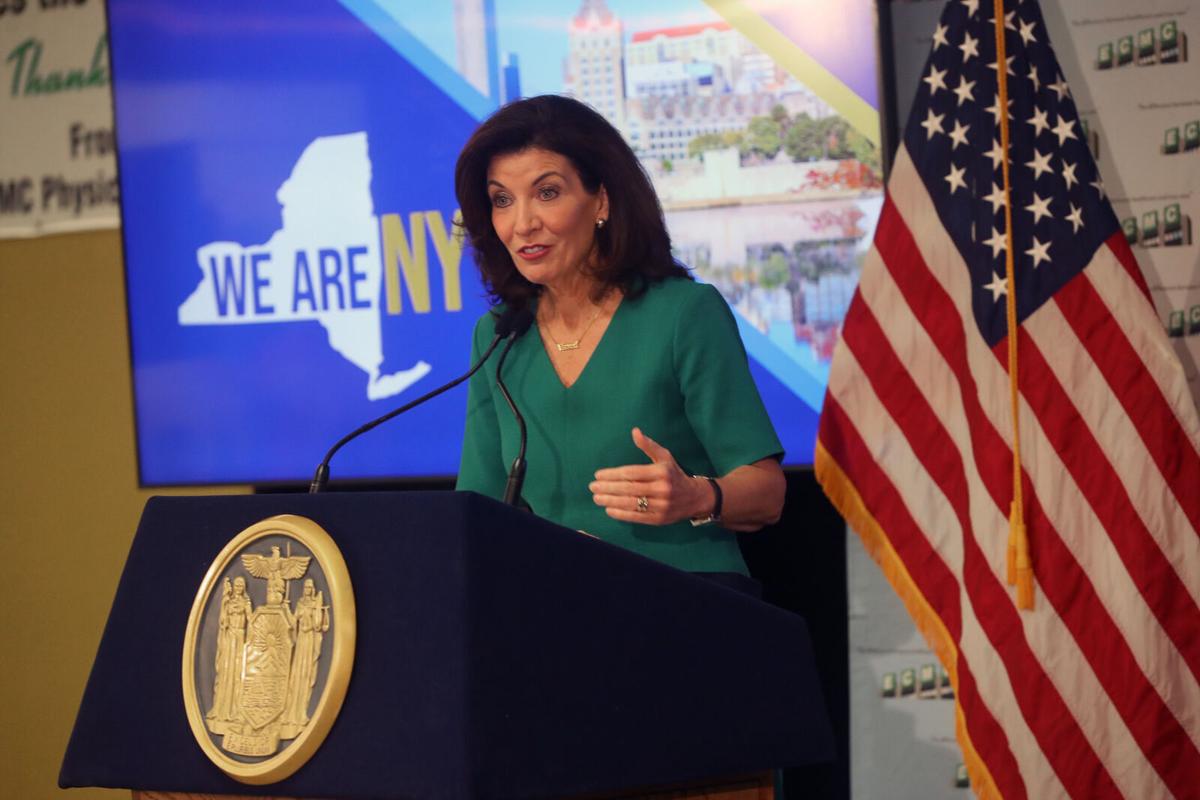
Soon after Bruce Blakeman was sworn in as Nassau’s county executive earlier this month, he signed a trio of orders delivering a message to Gov. Kathy Hochul: We’re not listening to your masking mandates.
For the most part, those executive orders will likely have more bite on paper than in reality, since state regulations supersede local edicts. But they do capture the counterargument to Hochul's Covid-19 approach. The governor's broad indoor masking policy, which applies to nearly everyone regardless of vaccination status, reflects a group-strength approach to managing the virus. “We can all do this, New Yorkers," Hochul said last month. "It is not that hard to do."
But Blakeman, like many of his fellow Republicans, is pushing individual decision-making. He believes Covid-19 protocols such as masking should be decided by school districts, families and individuals. “I think it's all about choice,” Blakeman told The Buffalo News in an interview last week.
People are also reading…
This installment of Pandemic Lessons dives into Hochul's approach to leading New York through life with Covid-19 since she took over as governor for Andrew Cuomo in August, and explores how some of her earliest political work, back to her days as a Town of Hamburg councilmember in the 1990s, shapes her thinking today.
How big a deal is Blakeman's dissension?
It's a loud challenge to Hochul's authority, and could conceivably result in more Nassau County businesses ignoring masking rules, but it's not a hard threat. The checks and balances system empowers courts and the Legislature to expand, reinforce or curtail a governor's power. Individual local politicians can't do as much. But they can get attention, especially in a place like Nassau County, which has 1.4 million residents on the western end of Long Island and abuts New York City. That gives Blakeman enough of a bully pulpit to get wide attention for his views. For example, a New York Post article about his “school masking fight with Gov. Hochul” included a link to Blakeman’s Fox News interview with Laura Ingraham.
But this isn’t a clash between equals. Hochul, the Buffalo Democrat who represents nearly 19.5 million people as governor, has a bigger pulpit and greater executive authority.
“I have the law of the State of New York behind me, and I will exercise my authority and obligation to protect the health of the people of this state,” said Hochul, whose other mandates include booster shots for health care workers and public college students returning to campuses. She added that municipalities “have to follow state law” and that schools are regulated by the state Education Department, which Hochul called “an additional point of leverage in that they fund all the school districts.”
It was essentially a gubernatorial version of a parental admonishment: You live in our house. We pay your bills. We're doing what's best for you, even if you don't like it. You follow our rules.
“Those who underestimate me do so at their own peril, including the county executive of Nassau County,” Hochul said.
Columbia University epidemiologist Stephen S. Morse told The News that Omicron "seems like a step on the road to SARS-CoV-2 becoming another endemic coronavirus.” That means living with Covid-19 like we live with influenza, making it Hochul's job to lead New York into that phase, especially if she wins a four-year term in November. First, though, Omicron needs to recede. How are our numbers?
Still hot, with signs of cooling.
As of Jan. 14, the state’s seven-day average for positive test results was 17.59%. That's down from the 20s several days earlier, but markedly higher than the 4.83% we saw just one month ago.
Hospitalization numbers are also high. Though many people fight off Omicron in a few days with minimal or no symptoms, not everyone fares that well. Western New York hospitals, for example, had a collective average of 582 Covid-19 patients daily as of Jan. 11. Nearly one of every seven patients was in intensive care. That’s slightly worse than the hospitalization numbers Western New York saw 12 months earlier, amid what at the time was among the toughest waves seen during the pandemic.
“Now that Omicron is widespread, even vaccinated and boosted individuals can become infected, albeit at a much lower rate than the unvaccinated,” said Dr. Nancy Nielsen, a senior associate dean at the University at Buffalo and former president of the American Medical Association. “That adds even further to the need for universal masking indoors in public until the pandemic subsides.”
Here's an optimistic post-script: The number of new cases has been dropping. If that continues, then hospitalizations – which lag behind cases – should follow.
What type of complex situations will Hochul need to navigate as we move toward the endemic phase?
Broadly, she'll have to set policies that keep businesses and schools open – which she has cited as a priority – while dealing with ever-more-divisive politics. For example, New York is one of nine states that requires indoor masking in public, regardless of vaccination status. All nine are led by Democrats.
Hochul will have to provide clarity when rules and bureaucracy are confusing or contradicting. The situation in schools offers a panoramic window into the complexities of navigating – and sometimes regulating – pandemic life. Here’s one example: In the wake of the enormous numbers of positive cases that Omicron has created, the practice of contact tracing – finding and informing people who have been exposed – has largely become unworkable. The Erie County Department of Health, for example, recently acknowledged it can’t keep up with contact tracing.
In educational settings, that shifted responsibility solely to schools, which also struggle to keep up. Michael Cornell, the superintendent of the Hamburg Central School District and leader of the Erie-Niagara School Superintendents Association, surveyed his colleagues in December and found that area districts are spending 70-80 hours weekly, and in some cases 100-plus hours per week, on contact tracing. That’s the equivalent of two to three full-time workers, and it comes as schools are grappling with the implementation of test-to-stay programs that allow unvaccinated children to remain in school if they are exposed to Covid-19, but test negative.
Test-to-stay requires contact tracing, and Cornell acknowledged that even as they implement the programs, school officials are looking at what’s next. If public health agencies are dropping contact tracing because “the general sense is that the juice isn’t worth the squeeze,” he said, “we wonder about the efficacy of even chasing down close contacts in the school setting…
“That’s an interesting inflection point we find ourselves in right now.”
Ultimately, Hochul's administrative team is responsible for providing clarity to schools on issues like contact tracing, quarantining and the definition of fully vaccinated, among many issues. As case numbers fluctuate, federal guidance changes and scientific knowledge builds, that's an ongoing process.
How does Hochul think about daunting decisions?
The best insight into this question comes from the governor herself. During a one-on-one interview with The News in the fall, Hochul spoke about viewing every leadership challenge holistically. “You have to look at the situation with a very strong sense of purpose,” she said. “What is my role in this situation? In this environment?”
She pointed to her experience at every level of government: Hochul was a Hamburg Town Board member in the 1990s, and then became Erie County clerk in 2007, a member of Congress in 2011 and lieutenant governor in 2015. “I know all the resources and all the levers to be able to pull at every level of government,” said Hochul, a lawyer who worked early in her career for former Rep. John LaFalce and the late U.S. Sen. Daniel Patrick Moynihan, and later had a brief stint as a government relations official for M&T Bank. “That gives me a clarity of purpose, which I believe is what is necessary to be able to process data from many diverse sources, and to be analytical myself, then to make quick decisions.”
Hochul’s friend Tom Quatroche, who served with her on the Hamburg Town Board and is now president and CEO of Erie County Medical Center, points to their local government experience as a training ground for the inevitable, intense and often unpredictable criticism she faces as governor.
“She knows how to handle it,” Quatroche said. “Town government is one of the last forms of government – other than maybe school boards – where people can stand up at a meeting and you have no idea what question they’re going to ask you. You’re doing it on the record, in a public forum with the press there, every Monday night.”
When someone – say Blakeman, the Nassau county executive – adopts an adversarial stance, “They’re taking it because of the position that Kathy is in,” Quatroche said. “It’s not necessarily directed at Kathy Hochul. It’s directed at ‘Governor Hochul.’ She understands that comes with the territory.”
How deep are the divisions?
Maybe, maybe, not as deep as you think.
Blakeman, for example, is pro-vaccine, acknowledges the effectiveness of masks like N94s and N95s or the equivalent, and supportive of testing. The best available science says that those tools help, and Blakeman does, too. He’s set up vaccination sites, distributed tests and wants government to hand out free or low-cost respirator-style masks to people who need and want them.
“I think government has an important role in protecting our vulnerable citizens, especially our children,” he said.
But he wants people to opt in – or out. “It should be based on choice,” he said. “It should be an option.”
Choice is the point of sharp divergence, and it’s one that Hochul will likely have to navigate with her detractors for as long as she is governor. Her version of choice on Covid-protocols is much more specific: She has given businesses the option of requiring vaccines for entry, or requiring masks. “It’s a different approach,” Hochul said at a recent news conference. “It works. We’re standing behind it.”
For Hochul and those who share her thinking, personal choice isn't the bottom line. She extends it a step further, to the implications of those choices. “If people had gotten vaccinated when we asked them to, and got the booster shots,” Hochul said in a mid-December news conference, “I wouldn’t have had to put in place a mask mandate.”


