

As the old cliché goes, the road to hell is paved with good intentions.
But in the square-mile city of South Tucson, that road also appears to come with stop signs at each intersection.
The city recently ordered new street signs to the tune of about $18,000, but there was a big problem — literally.
City officials mistakenly ordered jumbo-size signs meant for the highway and not smaller ones suited for residential streets.
Despite their extra size, many of the street signs were usable. But that wasn't the case for 66 stop signs, which not only were too big but also didn't come with the proper amount of reflective coating.
"It was an honest mistake," said Angel Lopez, South Tucson's Department of Public Works director. "Arizona calls for three different (sign) regulations, and we just picked the wrong one."
People are also reading…
Like so much in life, the sign saga started with the best of intentions.
Hoping to save the cash-strapped city some bucks, Lopez put the sign order out to bid, and the lowest bidder came in from Mississippi.
Red Bud Supply Inc. of Belmont, Miss., made an offer that was several thousand dollars less than other bids, and so Lopez placed the order.
In filling out the order, Lopez said, he used the same code he's used in the past when he's ordered signs locally. But that code is actually for larger highway signs, not smaller residential ones.
Local venders must have known what Lopez really wanted, because, as Lopez said, "I order signs all the time, and when I do them here locally they give them to me exactly what I want."
But not this time.
When the stop signs arrived at 42 inches, and not the expected 30 inches, Lopez said he didn't know what to do with them. They were too large for South Tucson's small residential streets, but because they were the right size for the state's Department of Transportation, he contacted the state to see if it was interested in them.
The state mandates the larger signs because the high speeds on interstates highways require greater visibility, ADOT spokeswoman Linda Ritter said.
Perhaps the state might have been interested, but talks never got that far. As it turns out, the signs didn't have enough reflective coating to meet federal regulations or Arizona standards, which are far more stringent.
"We follow the federal government standards, but we tend to exceed the standards because of our environment," Ritter said.
The management for Red Bud would not comment about the problems.
So what's a public-works director to do with 66 stop signs he can't use?
Fortunately for Lopez — and for the South Tucson budget — the stop-sign saga is coming to a halt.
Lopez found a sign maker in the Phoenix area who was able to trim the signs to 30 inches while also adding the required reflective coating — all for the cost of about $1,100.
"This guy is like the Superman of signs," Lopez said of Zumar Industries, which did the job.
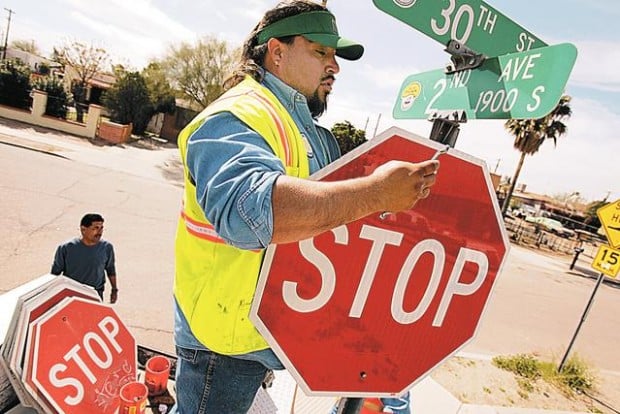
Indeed, the stop signs look fine, and workers have been installing them over the past few days.
Meanwhile, reaction of South Tucson officials was mixed.
Mayor Jennifer Eckstrom said she hadn't been aware of the issues, but she was glad the signs were fixed at a reasonable cost.
Finance Director Ruben Villa said he had asked Lopez for a report about why the signs were ordered incorrectly, and that the city may pursue some type of reimbursement from Red Bud.
And Councilman Ildefonso Green, who often votes in the minority, said he planned to raise the matter at the next City Council meeting.
While he's glad the issue has been resolved, he said he didn't understand why the signs were ordered incorrectly in the first place, and he would like to put a stop to such mistakes in the future.


