

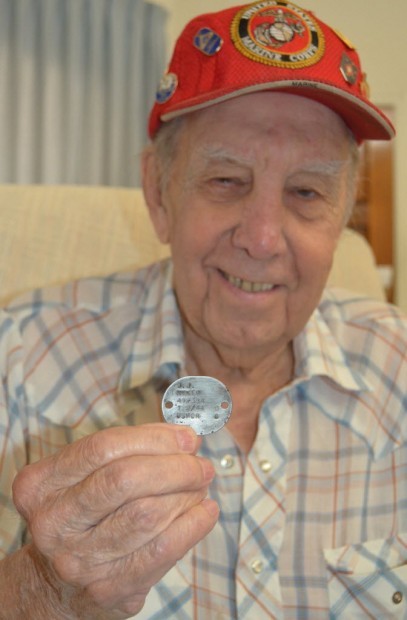
Green Valley Marine Corps veteran John Joseph Keker got an unexpected surprise in the mail recently when his military dog tag was returned to him more than 67 years after he lost it in World War II.
Accompanying Keker's dog tag was a letter from Shane Fender, a reservist with the Australian army, who stumbled upon a box of dog tags while deployed in the Solomon Islands last year.
Keker, originally from Chicago, enlisted in the Marines at 17 and served from 1942 to 1945. He lost his dog tags when he was stationed at Guadalcanal in the Solomon Islands northeast of Australia as the Allied forces battled the Japanese.
Keker, 88, a retired cement mason who moved to Green Valley in 1987, was a soldier in Carlson's Raiders of 2nd Marine Raider Battalion serving under Lt. Col. Evans F. Carlson. He doesn't recall the exact time or place he lost his tags, but he knows it was in Guadalcanal "maybe a year or so" into his duty.
People are also reading…
"We wore two of them around our necks, one hanging high and the other low, so they wouldn't hit each other and make noise," Keker recalled. "They were always getting caught on things. I was a kid and didn't think about it much. We all lost our tags."
Keker said he received a phone call a couple of months ago from a man who claimed he had found his dog tag and wanted to return it "to its rightful owner."
"I didn't know what to think at first," Keker said. "He had an accent and I was a bit confused at first and I thought he was a wisecrack. But the more I listened to him, the more I realized he was serious about finding my dog tag and wanting me to get it back."
Keker said Fender found him when he searched the Marine Raiders on the Internet. "He looked under Raider battalions, so he was one smart guy."
In a letter that arrived shortly after that phone call, Fender explained to Keker that he's a reservist in the Australian army where he works as a forward observer/bombardier in the artillery. He was sent to the Solomon Islands in 2011 for a peacekeeping deployment and to restore security.
"It was during this deployment that I happened to be in a local's house when I noticed a whole bunch of dog tags in a box," Fender wrote in his letter.
Fender, 40, went on to write that while on army assignment earlier in 2011 in France, he visited the grave of his great-uncle in Belgium, who had fought in World War I.
"It dawned on me that those tags needed to get home rather than rust away in a box," Fender wrote. "If someone had sent me a personal item from my relatives from either World War I or World War II, I could not explain what it would mean to me or how special it would be."
Fender, who lives in a Sydney suburb, told the Green Valley News that when he returned from the Solomon Islands he started combing the Internet using the men's names and military details. That eventually put him in touch with the Marine Raider Association, which did some research and found Keker's address and telephone number.
In addition to Keker, Fender found the relative of another Marine who died in Guam during the war; he sent that dog tag off to Illinois last week.
"I still have another 10 or so to go," Fender said. "My goal is to get them all home where they belong."
In his letter to Keker, Fender said it was a privilege to be able to return the dog tag.
"While my uncle and his mates were fighting and dying up in New Guinea, you and your mates were doing the same all over the Pacific (the world in fact)," he wrote. "What you men of our countries did is not forgotten and never will be. So, please accept this gesture of mine as a humble thank you from me for what you did."
Keker's last duty station was in Okinawa, where a Marine buddy died in his arms.
"I'm sorry to say, but at times it was brutal," Keker said. "It's not always easy to talk about or to remember."


 Nancy Guthrie's Tucson neighbors: Life with streamers 'unbearable'


