Judson Baker was a man of steel.
Born in Bisbee in 1941, Baker began having epileptic grand mal seizures and developed familial essential tremor, an uncontrollable shaking of the hands and forearms, when he was a child.
As an adult, Baker developed spinal stenosis, a narrowing of the spine; congestive heart failure that necessitated a pacemaker; and chronic obstructive pulmonary disease — COPD — a combination of chronic bronchitis and emphysema. In the late 1980s, he was injured in a Los Angeles building collapse during an earthquake, and in his last 10 years, Baker developed Parkinson's disease.
"He'd nearly died and had last rites so many times that we assumed he was Superman," said Baker's ex-wife, Linda Hoffman Baker.
Given her former husband's ability to rally after each health crisis, it was unexpected when Baker, a Tucson musician and songwriter, died at his home Nov. 6. He was 66.
People are also reading…
Constant pain from his spinal condition kept Baker in seclusion for many of the last 15 years, but he still ventured out to play an occasional live gig or go into the recording studio with friends.
"He was giving lessons until the day he died," said Hoffman Baker, who had been her ex-husband's caregiver since their divorce in the 1990s.
Despite his tremors and other ailments, Baker was a gifted musician, a trait he earned from his grandmother, Juanita Daniel, a Yaqui Indian.
"She was his inspiration for life. They loved each other dearly," said Hoffman Baker, who also is a musician.
"She played the piano and the guitar and Judson played just about everything he picked up. He was one of the most naturally gifted musicians I ever met," Hoffman Baker said.
As a boy, Baker took a few violin lessons from an elderly Bisbee music teacher for 25 cents per class, said Ray Armstrong, a friend of Baker's, but the teacher died. Much of the rest of Baker's musical training was informal.
"His grandmother was an old Yaqui Indian lady, and she taught him a bunch of traditional Mexican songs," Armstrong said. "He told me he used to shine shoes in Brewery Gulch in Bisbee as a boy. He loved music and his first guitar was a stick with a shoebox and a couple pieces of copper wire. Shining shoes, he earned enough to buy his first guitar."
Baker was 9 when he bought his first real guitar. Over the next 57 years, Armstrong said, Baker composed more than 2,000 songs. Some were recorded by other bands and some Baker made under his own labels, Fuego Music Productions and Disco Rebelde.
Hoffman Baker met her future husband in 1973, when the musician was still healthy enough to travel the country playing gigs.
"He was the nicest man I've ever met and one of the best-looking and, of course, one of the most talented. He sounded to me a lot like John Lennon, only better. He had a very good voice," she said. "And he'd give anybody the shirt off his back, and frequently did, actually."
It was his unselfish nature that prompted Baker and his mother, Margarita "Ma" Baker, into action in the late 1960s as part of the movement to build a community health center to provide affordable medical care in their predominantly Hispanic neighborhood, Hoffman Baker said. He even made a record to sell as a fundraiser for the center, now known as El Rio Community Health Center.
Baker traveled frequently to the country's hot music centers, where he was semi-successful in selling his songs and was invited to sit in on recording sessions with some of the big Spanish-language singers of the time.
"He had a lot of friends in Hollywood, Nashville and San Antonio," Hoffman Baker said. "Basically Jud knew everybody who was anybody in this area of music.
"He went first to California in his teens to live and try to perform. He knew Ritchie Valens and his producer, Bob Keene, at Del-Fi records. As a teenager, Jud had wanted to do "La Bamba" bilingually. He went to Bob and somehow Ritchie ended up doing it in Spanish, but he (Jud) still thought it should have been done bilingually," she said.
But songwriting never quite paid the bills, she said.
After he was injured in the L.A. quake, Baker returned to Tucson for good. He gave music lessons, advised other musicians and kept writing songs.
Maria Renteria-Villa and her ex-husband, Tucson vocalist Joe Mera, met Baker in 1990. Her ex-husband is anguished at the loss of the longtime friend, she said.
"Joe almost didn't want to sing anything that wasn't written by Jud," she said. "The lyrics were everything from the heart and we could relate to it — specifically places and people we know in Tucson and Arizona. The music centered around that. It was stuff that was so easy to relate to."
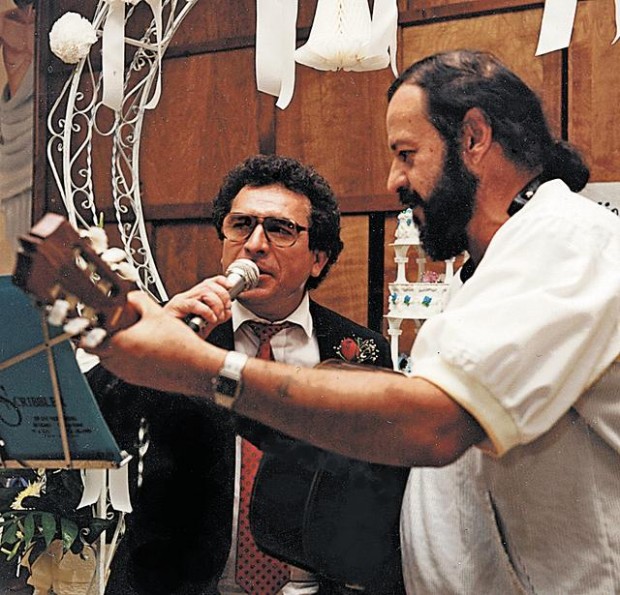
Mera serenaded his bride at their 1990 wedding, with the help of their buddy, Baker.
"To this date, it was such a performance that people for years after talked about it," Renteria-Villa said. "They just outdid themselves that day."
In the last several years, Baker co-wrote a dozen or so songs with Armstrong, who has a recording studio in his home. The men recorded one of Armstrong's compositions shortly before Baker's death.
"I'd go to his house, pick him up and he'd be in really bad shape. He'd be hurting and he'd have cold sweats and he'd take extra pain medication and I'd take him to the house," Armstrong said. "It would take me an hour to get him to the house just for 20 minutes to record. He did it with love. He told me, 'I haven't got too much time. You're going to have to get all you can out of me.'
"Put a guitar in his hand and he was a young man again, without a tremor, no stammering or stuttering or anything."
Life Stories
This feature chronicles the lives of recently deceased Tucsonans. Some were well-known across the community. Others had an impact on a smaller sphere of friends, family and acquaintances. Many of these people led interesting — and sometimes extraordinary — lives with little or no fanfare. Now you'll hear their stories. Past "Life Stories" are online at go.azstarnet.com/lifestories.

 Tucson's newest Shake Shack gets neighbors