
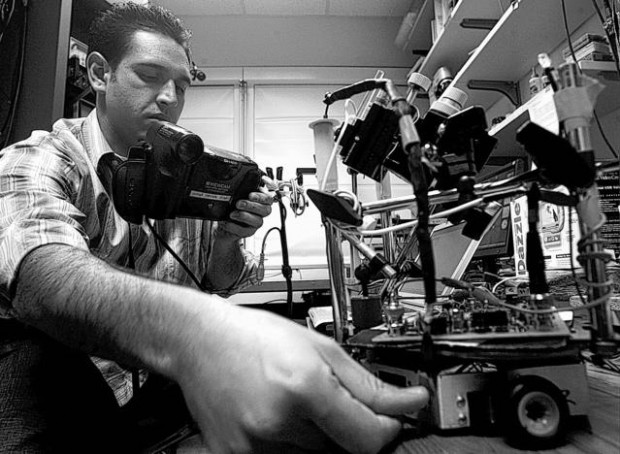
Imagine: a big moth, tiny wires protruding from its brain, strapped to the top of a crawling robot that it's commanding to find a bomb — or to deliver one.
We may not have to imagine for long.
Mothbot: coming soon from a laboratory near you.
Many animals have senses of smell, sight or hearing many times more sensitive than humans do, said Charles Higgins Jr., a University of Arizona researcher.
Current technology can't even come close to making an artificial equivalent of the human nose, said Higgins, an associate professor of neurobiology, and electrical and computer engineering.
And he said humans can't smell a lick compared with dogs or hawk moths.
Even the pale artificial imitations are fantastically expensive, he said.
People are also reading…
But it occurred to him that if he could wire up a robot to a super-sensing animal's brain, he could have the best of both: an nearly indestructible machine with a cheap, disposable sensor.
You could get the equivalent of something with thousands of times the sensitivity of a state-of-the-art artificial sensor for about $4 — the cost of obtaining a hawk moth.
"There are no ethical considerations," Higgins said about tossing a used-up moth in the trash and "installing" a new one. "This stuff can be done with rats, cats and monkeys," he said. "But I have some ethical concerns with them, especially monkeys. But throw away a moth — who cares?"
The hawk moth, the adult version of the horned tobacco caterpillar, is rugged — with a wingspan of about 3 1/2 inches — lives several weeks, and has a stunning ability to detect certain odors with its long, coiled proboscis.
Besides detecting bombs, Higgins said, the brain-machine interface has the potential for military missions, land-mine sniffing and stealthy approach with low detectability.
After all, if wheels were so great for getting around, Higgins said, insects would have evolved wheels by now instead of legs. And, he said, insects' ability to crawl over obstacles far outstrips anything a robot can do on wheels or trying to mimic animal leg motion.
So an insect properly wired could become the robot, or at least direct the mechanical robot's legs.
The brain-wired insect, mounted atop a robot, "would think" it was doing the walking, seeing that it was moving where its brain was directing it.
"In disaster scenarios," Higgins said, "you don't want to send humans in, but an insect can cover rugged terrain" that a robot can't.
There are other obstacles to overcome, he said. Making the electrical connections is tough. And since the brain signals are so faint, circuitry must be highly sensitive while rejecting outside "noise" signals.
Timothy Melano, Higgins' collaborator on the research, was scheduled to present some of their findings at the Society for Neuroscience's annual convention in San Diego on Sunday.

 Former Sam Levitz building sells for $8.6 million