

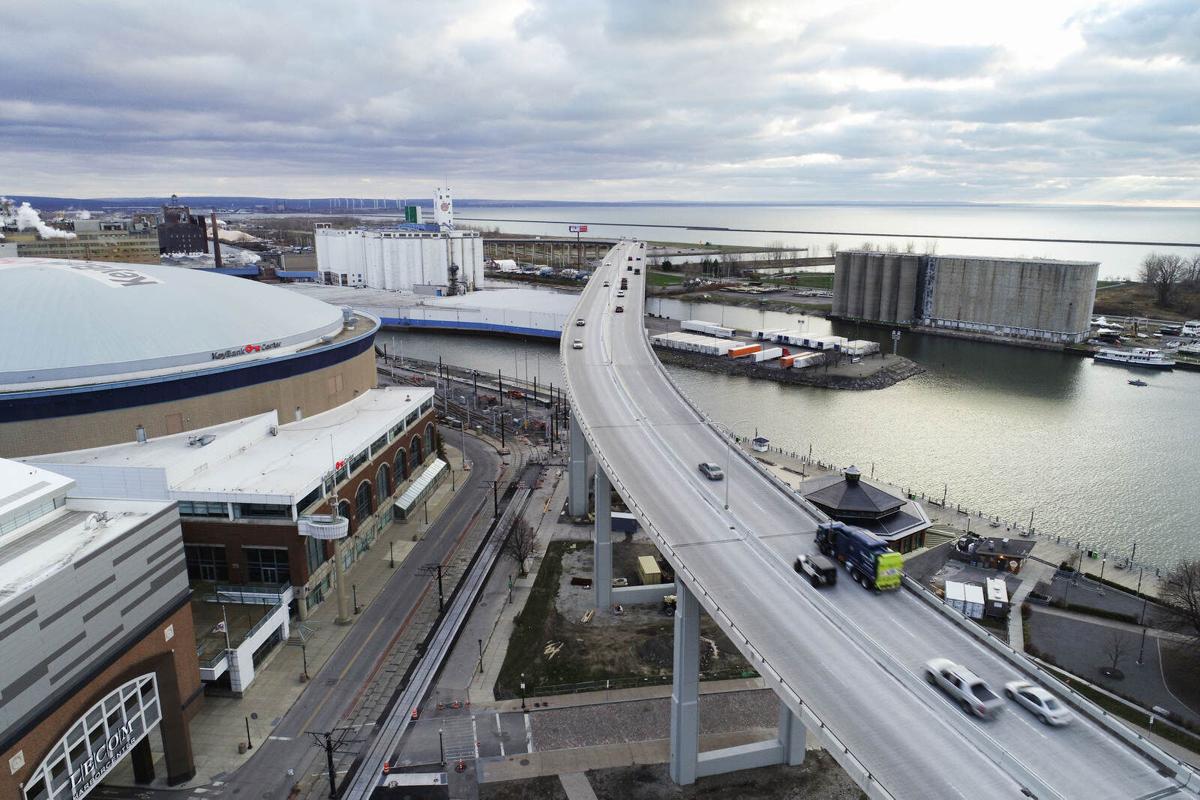
WASHINGTON – Buffalo's highway relics – including the Skyway, the Scajaquada and the Kensington – could finally be fixed.
The lead water pipes that serve thousands of city homes could be replaced with something safer.
Derelict housing could be retrofitted for modern times.
And every corner of Western New York, from city neighborhoods to the rural hinterlands, could finally get high-speed internet.
Such are the local ramifications of President Joe Biden's $2.25 trillion infrastructure plan, which he unveiled Wednesday in Pittsburgh.
It's the sort of bricks-and-mortar reinvestment program that Rep. Brian Higgins, a Buffalo Democrat, has been proposing for a decade.
"You know, in the aggregate, we're going to reinvent the American economy," Higgins said. "This is a seminal moment. This is epic."
People are also reading…
Then again, $2.2 trillion is a lot of money, and Biden plans to collect it through a lot of taxes – which is one reason why passing his "American Jobs Plan" is likely to be a tough job in and of itself. Nearly all congressional Republicans are likely to oppose it.
"The president’s blueprint is a multi-trillion-dollar partisan shopping list of progressive priorities, all broadly categorized as ‘infrastructure’ and paid for with massive, job-killing tax increases," lamented Rep. Sam Graves of Missouri, the top Republican on the House Transportation and Infrastructure Committee.
Whether you see Biden's effort as epic or partisan, one thing is for certain. If passed, it would remake communities nationwide.
Here's a closer look at the proposal's likely local impacts:
A highway reinvention
Higgins wants the Skyway to no longer serve as a concrete conduit to the Southtowns, and he envisions the Scajaquada and the Kensington as urban parkways, not highways.
And Biden's proposal, while not calling for any such specific projects, presents Buffalo with what Higgins called "a-once-in-a-lifetime opportunity to address all three."
That is because there is so much money in the bill for transportation improvements: $621 billion in total, including $20 billion to specifically fix past highway mistakes.
Also, $17 billion would be targeted to land border crossings, and Higgins foresees some of that money possibly improving the Peace Bridge.
The largest chunk of the transportation money – $115 billion – would be targeted to the roads and bridges in most need of repair. Gary Hill, president of Union Concrete and Construction of West Seneca, said he thinks some of that money could be directed to modernizing state roads such as Route 62 and the parts of Niagara Street that have not recently been redone. More than 40 local bridges need work and could get the federal money, too.
"When you rebuild these roads in these neighborhoods, it's just makes such a difference," said Hill, a longtime member of the local Fair Apportionment of Infrastructure Revenue Committee.
The Biden plan also calls for multi-billion-dollar investments in airports, railways and mass transit.
Cleaner water
One of Buffalo's most daunting infrastructure challenges lays hidden beneath its streets: 100 miles of lead pipes that provide water to an estimated 41,000 residential buildings – 60% of the city's total.
Lead pipes can lead to lead in the drinking water, a health risk that Biden wants to eliminate. His plan would spend $45 billion to replace every lead water pipe in the country.
"This would really be a historic accomplishment," said Rob Hayes, director of clean water for Environmental Advocates in Albany. "Lead pipes have contaminated drinking water in this country for over 100 years, and now we're on the cusp of eliminating them."
Under Biden's plan, $56 billion would go to improving water processing plants, as well as sewage and storm water drainage systems.
“The Biden administration’s plan will help millions of people in the Great Lakes region and across the country who are struggling to pay for higher and higher water bills and whose health is jeopardized by serious threats such as toxic lead contamination and sewage pollution,” said Laura Rubin, director of the Healing Our Waters-Great Lakes Coalition.
Reinventing neighborhoods
The Biden plan also includes numerous elements aimed at expanding housing and repairing neighborhoods.
In total, the proposal would set aside $213 billion to renovate or build 2 million units of affordable housing. One key element of that is a proposal that Higgins introduced and Biden included in his plan: the Neighborhood Housing Investment Act, which would create a tax credit for the renovation of housing in distressed neighborhoods.
"This is hugely important," said Julie Barrett O'Neill, executive director of Local Initiatives Support Corp. WNY, a nonprofit that aims to boost city neighborhoods. "We have neighborhoods that we know have a lot of potential but they are not (revitalized) yet largely because of historic racism and disinvestment. It's a very important piece of legislation and could be very helpful in our particular market."
Biden also suggests spending $100 billion to rebuild schools, $25 billion for childcare facilities and $18 billion to modernize veterans hospitals and clinics.
Universal broadband
Swaths of Buffalo, as well as rural Western New York, have next to no access to high-speed broadband internet service. But all that would change under the Biden plan, which would set aside $100 billion for an effort to bring fast online service to every American.
That effort comes as great news to Fillmore Council Member Mitch Nowakowski, who's been working to bolster the internet offerings in his district.
"In today's world, access to broadband is not a luxury utility, but a necessity needed to live," Nowakowski said.
He said the pandemic proved that students need high-speed internet access to thrive in school. What's more, Nowakowski added, such service is necessary for any neighborhood that's looking to attract business development.
Biden, meanwhile, noted that 35% of rural America lacks broadband access, and he said that would change under his plan.
In addition, "we're going to drive down the price for families who have service now and make it easier for families who don't have affordable service to be able to get it," Biden added.
A political fight
Biden's plan not only promises a lot of change; it also promises a big political fight.
Echoing the Republican party line, Rep. Chris Jacobs of Orchard Park said: “This infrastructure package is shaping up to be yet another expensive, partisan package. There are pressing infrastructure needs that Congress must address in a bipartisan fashion, like bolstering rural broadband development, rebuilding roads and bridges and upgrading our power grid. However, this package is overbroad and includes major tax hikes while we are still trying to recover from the pandemic."
To pay for the plan, Biden proposes hiking the corporate tax rate from 21% to 28% while ending other business tax breaks and increasing taxes on the wealthiest Americans.
While that guarantees Republican opposition, some Democrats aren't thrilled with the plan, either. Most notably, several downstate and New Jersey Democrats said they would not back the plan unless it restored the full deduction for state and local taxes, which Republicans trimmed in 2017.
Given that Senate Majority Leader Charles E. Schumer, a New York Democrat, also wants to restore the "SALT" deduction, Biden's plan could be amended to do just that.
“It’s something that I think is very important and I’m going to fight hard to see that it get done," Schumer said in Buffalo Wednesday.
For his part, Biden sounded willing to accept changes to his plan as long as its key elements remain.
"We'll have a good-faith negotiation with any Republican who wants to help get this done. But we have to get it done," Biden said.


