

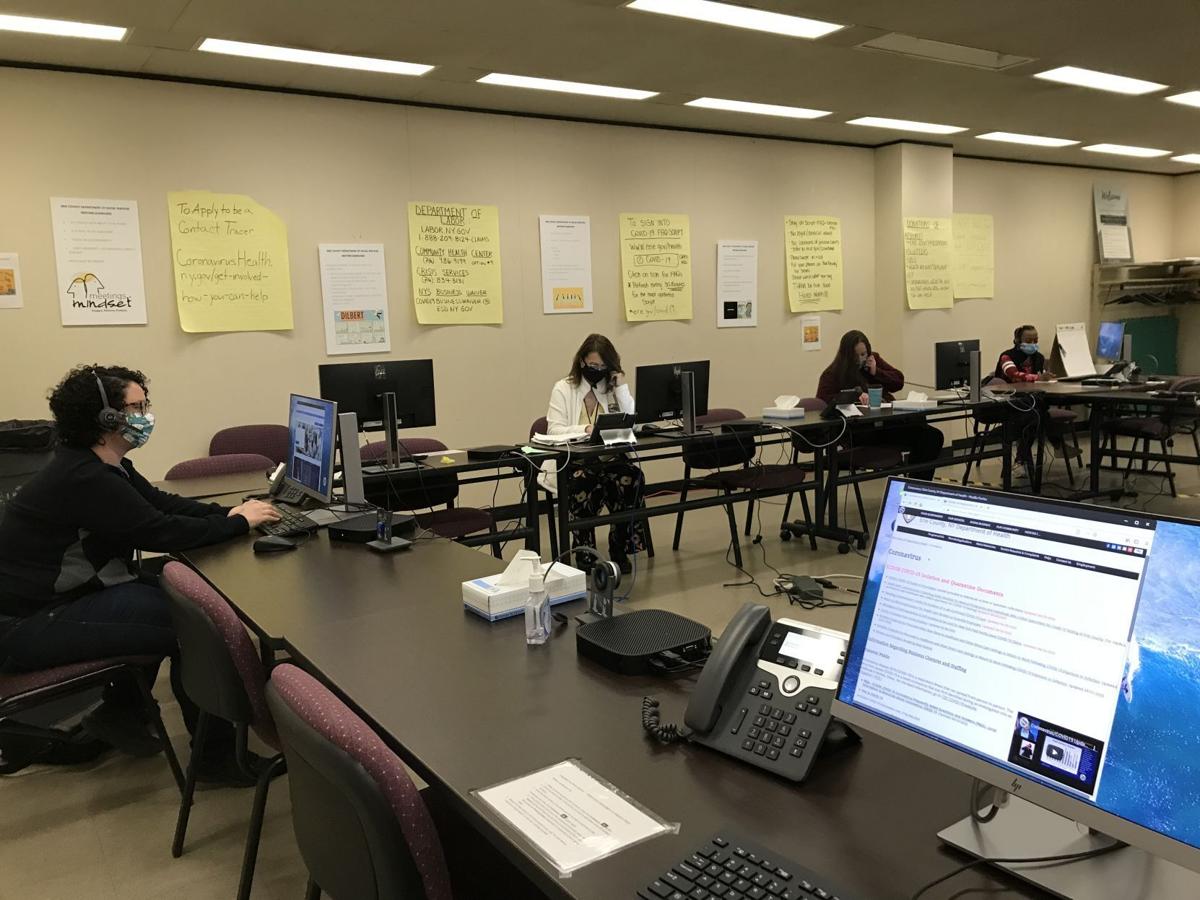
If you or someone you know tests positive for Covid-19, chances are a contact tracer from Erie County will not be calling you to follow up.
That's a major change from earlier in the pandemic and is largely driven by the surge in the number of cases being driven by the Omicron variant. But it's a change that one expert said makes plenty of sense.
"I’m in the camp where I’m mostly OK with this," said Dr. Thomas Russo, an infectious disease specialist with the University at Buffalo Jacobs School of Medicine and Biomedical Sciences.
As record numbers of new cases flood the county Health Department, county case investigators are refocusing their attention on containing major outbreaks and high-risk populations, not on alerting small groups who may have gathered for a house party.
To be clear, the county is not halting all contact tracing. Case investigators are still following up with people who test positive at Erie County sites, mailing letters to others who test positive, and fielding calls from individuals, schools and employers, said Health Department spokeswoman Kara Kane in an email. But the county's case investigators are focusing on children and people in larger group living situations, she said.
People are also reading…
Health Commissioner Dr. Gale Burstein did not return requests to comment from The Buffalo News on Monday. At a recent news conference, she said the Health Department's case investigators contacted individuals who tested positive within 24 hours.
"Usually, it's much shorter than that," she said.
The county issued a different message late Sunday afternoon, citing limited resources during a Covid case surge. Burstein had also previously indicated that the county had to shift its focus to concentrate on high-risk groups, such as children who attend school or day cares.
"We've really had to prioritize our strategy in terms of case investigation and contact tracing," she said.
She also said the county's refocused strategy has state support.
The county had previously ramped up the number of contact tracers reaching out to county residents during the first year of the pandemic as the county attempted to contain the spread of the virus. As it has become clear that Covid-19 is all but impossible to contain, the county now has between 20 to 25 case investigators reaching out to the public. Double that number are trained and available to assist, along with state contact tracers, Kane said.
At its peak last year, the county had about 100 contact tracers working to identify close contacts and clear out a backlog of cases.
The reason behind contact tracing is to minimize harm by quickly identifying and isolating the virus so that it infects fewer people. But people are most infectious when they first contract the virus and within the first few days of symptoms. By the time they get tested, receive the results back and speak with a county investigator, who may then reach out to others, infected people's most contagious days may be behind them.
"Most of the time, the damage had been done," Russo said, adding, "Even if we had a zillion, endless-to-infinity contact tracers, the impact is still sort of fractional."
In addition, individuals may not be honest with contact tracers about reckless behavior, or they may want to feel the need to shield friends, family or local businesses by not reporting them to the county.
That might be OK if the infected individual is educated enough and responsible enough to isolate, contact their health care provider, warn close contacts about the need to monitor for symptoms, get tested, quarantine and wear a high-quality mask in public if they must leave home.
"Again, it’s up to people doing the right thing," Russo said. "But if people are knowledgeable about doing the right thing and actually do it, it could be a plus."
With rapid testing more widely available, and greater general education about what to do if test results are positive, people who are infectious are more capable of getting their results back quickly, isolating and personally reaching out to close contacts to halt the spread of the virus, Russo said. The only problem is that many people are still unsure of what steps to take.
Russo knows that firsthand because he still hears from them.
The Health Department urges anyone who has been exposed to someone who has tested positive to self-quarantine, especially if not fully vaccinated, monitor for symptoms and seek a Covid-19 test five to seven days after exposure, or sooner if symptoms develop. Erie County residents are also asked to self-report positive Covid-19 at-home test results at erie.gov/hometestreport.


